previous
  • Plants that Spark!
    Plants that Spark!
  • Mulch for a Healthy Garden
    Mulch for a Healthy Garden
  • Lawn Alternatives
    Lawn Alternatives
  • Fast-Growing Trees for Impatient Gardeners
    Fast-Growing Trees for Impatient Gardeners
  • Thoughts From a Foreign Field
    Thoughts From a Foreign Field
  • Dwarf Citrus Trees
    Dwarf Citrus Trees
  • Make a Succulent Topiary
    Make a Succulent Topiary
  • Indeterminate or Determinate Tomatoes?
    Indeterminate or Determinate Tomatoes?
  • Save Money by Growing Your Own
    Save Money by Growing Your Own
  • Garden Confidential: A Plant Walks into a Bar
    Garden Confidential: A Plant Walks into a Bar
  • Colorful Selections for Shade
    Colorful Selections for Shade
  • Designing with Curved Terraces
    Designing with Curved Terraces
  • NEW Video Series: There's a Better Way
    NEW Video Series: There's a Better Way
  • 6 Tips for Weed Control
    6 Tips for Weed Control
  • Comfortable Alfresco Dining
    Comfortable Alfresco Dining
  • Slideshow: Beautiful Clematis
    Slideshow: Beautiful Clematis
  • Building a Compost Bin
    Building a Compost Bin
  • Stylish Shady Containers
    Stylish Shady Containers
  • Elephant's Ears
    Elephant's Ears
  • Containers as Focal Points
    Containers as Focal Points
  • Plant an Easy-to-Water Strawberry Jar
    Plant an Easy-to-Water Strawberry Jar
  • Fragrant Plants for Pathways
    Fragrant Plants for Pathways
  • Pretty in Pink
    Pretty in Pink
  • Homegrown / Homemade
    Homegrown / Homemade
  • In Pursuit of the Perfect Potting Shed
    In Pursuit of the Perfect Potting Shed
next

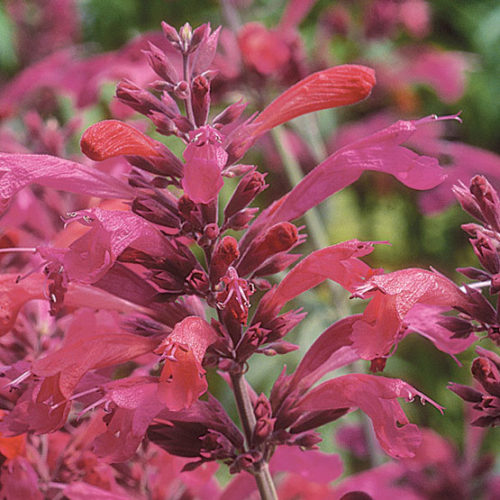
Agastache 'Desert Sunrise' (Hummingbird mint)

Agastache 'Desert Sunrise' Photo/Illustration: David Salman/High Country Gardens

(Based on 2 user reviews)

Rate this plant

Plant Showcase - from our advertisers


Hardiness Zones: 1 2 3 4 5 6 7 8 9 10 11
Botanical Name: Agastache 'Desert Sunrise' ag-ah-STAK-ee Common Name: Hummingbird mint Genus: Agastache
This hummingbird mint boasts large spikes of reddish-pink tubular flowers with an orange tint over a long season in summer and early fall. The whole plant is aromatic. Grow in a bed, border, rock garden, or xeric garden.
Noteworthy characteristics: Hybrid of A. rupestris and A. cana. Large plant with spikes of pink-red-orange flowers that hummingbirds love.
Care: Grow in full sun and well-drained, fertile soil. Tolerates dry, xeric sites but also grows well in regular garden conditions.
Propagation: Start seeds indoors in early spring at 55° to 64°F; divide in spring; take cuttings in late summer.
Problems: Usually easy to grow, but mildew and rust can be problems during a dry summer. Downy mildew and other fungal diseases occasionally occur.
Height 3 ft. to 6 ft.
Spread 1 ft. to 3 ft.
Growth Pace Moderate Grower
Light Full Sun Only
Moisture Dry to Medium
Maintenance Low
Tolerance Deer Tolerant;Drought Tolerant
Characteristics Attracts Butterflies; Attracts Hummingbirds; Fragrant Flowers; Fragrant Foliage; Showy Flowers
Bloom Time Early Fall; Fall; Late Summer; Summer
Flower Color Pink Flower
Uses Beds and Borders
Style Rock Garden
Seasonal Interest Summer Interest, Fall Interest
Type Perennials

Plants you might also like

Agastache foeniculum Agastache foeniculum
(Anise hyssop)
(2 user reviews)
Hardiness Zones: 1 2 3 4 5 6 7 8 9 10 11

A classic plant for both herb gardens and borders, anise hyssop is composed of erect branches of mint-and-licorice-scented, medium green leaves ending in fuzzy spikes of small lavender flowers. The plant grows to 3 to 5 feet tall and 1 foot wide and reseeds freely. The flowers are edible and are charming crumbled into salads. The flowers are highly attractive to bees, butterflies, and hummingbirds.

Nepeta × faassenii 'Walker's Low' Nepeta × faassenii 'Walker's Low'
(Catmint)
(11 user reviews)
Hardiness Zones: 1 2 3 4 5 6 7 8 9 10 11

This mound of lavender-blue flowers and aromatic, grayish green leaves up to 2 feet tall and 3 feet wide is great as edging or in a border, herb, or rock garden. It is an easy to grow, prolific bloomer that seems to be deer resistant. It blooms the whole summer and tolerates some shade. It also looks great with roses or on walls.

Agastache rupestris Agastache rupestris
(Sunset hyssop)
(1 user review)
Hardiness Zones: 1 2 3 4 5 6 7 8 9 10 11

True to its name, sunset hyssop encapsulates a Western sunset in its flowers: bronze with hints of orange and yellow, and streaks of magenta and pink along the margins. More and more flowers emerge as summer progresses. The plant blooms heavily in August, and continues into autumn.

Sedum ‘Autumn Joy’ Sedum ‘Autumn Joy’
(Stonecrop)
(13 user reviews)
Hardiness Zones: 1 2 3 4 5 6 7 8 9 10 11

This plant is as dependable and adaptable as they come. Its flowers bloom from August into November; they open pink and mature to a copper befitting of autumn. It is 2 feet tall and wide, with succulent stems and leaves. 'Autumn Joy' looks great with ornamental grasses.  

Salvia reptans Salvia reptans
(West Texas cobalt sage)
Be the first to rate this plant
Hardiness Zones: 1 2 3 4 5 6 7 8 9 10 11

West Texas cobalt sage is a marvelously distinct species that can be enjoyed by gardeners farther north, as long as they purchase the west Texas form, which is quite cold-hardy. This salvia has rigid stems with narrow, pungent leaves and resembles a bright green, upright grass for much of the growing season. In early fall, cobalt blue flowers burst open almost overnight and are a big draw for hummingbirds. Thanks to its deep roots, this wildflower is extremely xeric. West Texas cobalt sage grows to 4 feet tall.