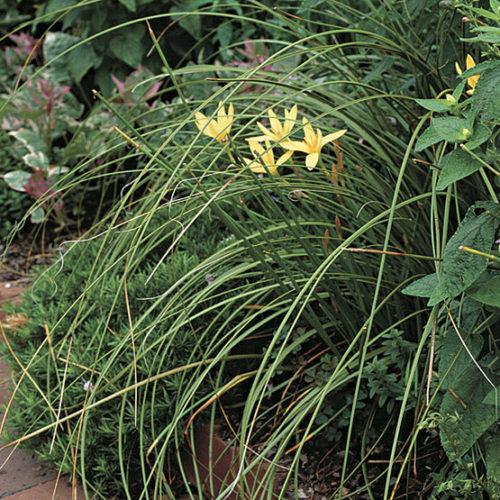
Zephyranthes reginae (Rain lily, Rainflower, Valles yellow rain lily, Zephyr lily)

Zephyranthes reginae Photo/Illustration: Jenks Farmer


Be the first to rate this plant

Hardiness Zones: 1 2 3 4 5 6 7 8 9 10 11
Botanical Name: Zephyranthes reginae zef-er-AN-theez REE-jin-ay Common Name: Rain lily, Rainflower, Valles yellow rain lily, Zephyr lily Synonyms: Cooperia reginae Genus: Zephyranthes
These Mexican native bulbs actually offer demanding gardeners flowers on demand. They produce strappy foliage to 12 inches tall and clusters of buttery-yellow, starry, crocus-like blossoms two to three days after every rain in summer and early autumn. Or, if it doesn't rain, simply water and fertilize three days prior to your intended display, and the moisture will prompt the flowers to appear, hence the common name, rainflower. These bulbs are widely adaptable to diverse soil conditions, and may be grown in full sun to partial shade, but they prefer some shade.
Noteworthy characteristics: They are perfect for rock gardens, border edges, or for naturalizing. Where not hardy, they can be grown indoors in a cool greenhouse, or placed outside in containers for summer display.
Care: Provide moist, well drained soil in full sun or partial shade. Avoid excess winter moisture. Adaptable to a wide range of soils.
Propagation: Sow seed when fresh; separate bulbs in spring.
Problems: Infrequent.
Height Less than 6 in.
Spread Less than 6 in.
Growth Habit Clumps
Growth Pace Moderate Grower
Light Full Sun to Part Shade
Moisture Dry to Medium
Maintenance Low
Tolerance Deer Tolerant;Drought Tolerant
Characteristics Native; Self Seeds; Showy Flowers
Bloom Time Fall; Late Summer; Summer
Flower Color Yellow Flower
Uses Beds and Borders, Container, Ground Covers, Cut Flower, Indoor Plant, Naturalizing, Suitable as Annual, Cottage Garden
Style Desert Garden, Meadow Garden, Formal Garden, Rock Garden
Seasonal Interest Summer Interest, Fall Interest
Type Bulbs

Plants you might also like

Camassia leichtlinii ssp. suksdorfii 'Blue Danube' Camassia leichtlinii ssp. suksdorfii 'Blue Danube'
Be the first to rate this plant
Hardiness Zones: 1 2 3 4 5 6 7 8 9 10 11

Spikes of violet, star-shaped flowers top stems reaching from 2 to 4 feet in late spring. The species is native to western Oregon. 'Blue Danube' would be beautiful in a border, meadow, or containers. Camassia make good cut flowers.

Allium caeruleum Allium caeruleum
(Blue globe onion)
Be the first to rate this plant
Hardiness Zones: 1 2 3 4 5 6 7 8 9 10 11

This plant produces dense clusters of bright blue flowerheads up to 1 inch wide. Its leaves clasp its stem and die back before flowering.

Allium schoenoprasum Allium schoenoprasum
(Chives)
Be the first to rate this plant
Hardiness Zones: 1 2 3 4 5 6 7 8 9 10 11

The purple or white pom-pom flowers of chives top aromatic stems in summer. The leaves are edible and have a mild onion flavor; the flowers can be used as garnishes. Plants grow in dense clumps to 2 feet high. Use chives in a cottage, herb, or vegetable garden, or in containers.

Allium senescens var. glaucum Allium senescens var. glaucum
(Circle onion)
Be the first to rate this plant
Hardiness Zones: 1 2 3 4 5 6 7 8 9 10 11

This plant's silver-blue leaves swirl like a cowlick. It produces flowers that are lollipop-shaped, pink with bright yellow accents and about 16 inches tall.

Allium giganteum Allium giganteum
(Ornamental onion)
Be the first to rate this plant
Hardiness Zones: 1 2 3 4 5 6 7 8 9 10 11

In summer, this plant bears large rounded flower heads up to 4 inches across with a multitude of star-shaped lilac-pink flowers.