previous
  • Design an Engaging Entryway
    Design an Engaging Entryway
  • The Only Shrubs You Need to Grow
    The Only Shrubs You Need to Grow
  • Soil Testing is Worth the Effort
    Soil Testing is Worth the Effort
  • Perfect Edges for Your Beds and Borders
    Perfect Edges for Your Beds and Borders
  • 10 Perennials Easily Grown from Seed
    10 Perennials Easily Grown from Seed
  • Variegated Plants Create Drama
    Variegated Plants Create Drama
  • Cool-Season Annuals
    Cool-Season Annuals
  • 15 Deer-Resistant Plants
    15 Deer-Resistant Plants
  • All About Starting Seeds
    All About Starting Seeds
  • Spectacular Spring Bloomers
    Spectacular Spring Bloomers
  • Celebrate Spring with Cool-Season Containers
    Celebrate Spring with Cool-Season Containers
  • Backyard Makeover Game
    Backyard Makeover Game
  • How to Start a Vegetable Garden
    How to Start a Vegetable Garden
  • How to Grow Raspberries
    How to Grow Raspberries
  • Garden Catalog Collector
    Garden Catalog Collector
  • Make Your Own Hypertufa Container
    Make Your Own Hypertufa Container
  • Building a Compost Bin
    Building a Compost Bin
  • Find the Perfect Tomato
    Find the Perfect Tomato
  • Sweetly Scented Tulips
    Sweetly Scented Tulips
  • Lilacs: Time for a Fresh Look
    Lilacs: Time for a Fresh Look
  • A Gardener's Checklist for Early Spring
    A Gardener's Checklist for Early Spring
  • Enchanting Japanese Maples
    Enchanting Japanese Maples
  • Video: Make a Straw-Bale Garden
    Video: Make a Straw-Bale Garden
  • Friendly Ways to Battle Garden Pests
    Friendly Ways to Battle Garden Pests
  • Viburnums are Versatile Shrubs
    Viburnums are Versatile Shrubs
next

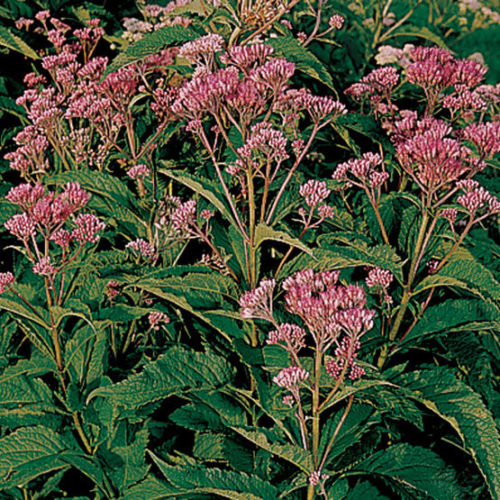
Eupatorium purpureum (Joe Pye weed)

Eupatorium purpureum Photo/Illustration: Courtesy of Park Seed


Be the first to rate this plant

Plant Showcase - from our advertisers


Hardiness Zones: 1 2 3 4 5 6 7 8 9 10 11
Botanical Name: Eupatorium purpureum yew-pah-TOR-ee-um per-per-EE-um Common Name: Joe Pye weed Genus: Eupatorium
Large, domed flowerheads of pink, light purple, or off-white add soft color and texture to the summer and fall garden. The leaves are purple-tinged on thick stems suffused with maroon. This eastern U.S. native attracts butterflies from mid-summer to early fall.
Noteworthy characteristics: Grow this plant where its stature can be appreciated, in a mixed border or in wild or other naturalized areas. 
Care: It prefers moist, alkaline soil in full sun or partial shade.
Propagation: Sow seed in a cold frame in spring; divide in spring.
Problems: Rust, powdery mildew, white smut, Cercospora and Septoria leaf spot, Southern blight, snail, slugs.
Height 6 ft. to 10 ft.
Spread 3 ft. to 6 ft.
Growth Habit Clumps
Growth Pace Fast Grower
Light Full Sun to Part Shade
Moisture Medium Moisture
Maintenance Low
Characteristics Attracts Butterflies; Native; Showy Flowers
Bloom Time Early Fall; Fall; Late Summer; Summer
Flower Color Pink Flower; Purple/ Lavender Flower; White Flower
Uses Beds and Borders, Naturalizing
Style Cottage Garden, Meadow Garden
Seasonal Interest Summer Interest
Type Perennials

Plants you might also like

Echinacea purpurea Echinacea purpurea
(Purple coneflower)
(2 user reviews)
Hardiness Zones: 1 2 3 4 5 6 7 8 9 10 11

Because of its carefree performance, this native meadow perennial with daisy-like flowers appropriately inhabits the gardens of many. It blooms from midsummer into early autumn, with prominent, copper-orange central cones surrounded by rose-purple, ray petals (to 5 inches across).

Echinacea purpurea 'Kim's Knee High' Echinacea purpurea 'Kim's Knee High'
(Purple coneflower)
(3 user reviews)
Hardiness Zones: 1 2 3 4 5 6 7 8 9 10 11

This native meadow derivative is a compact version of the species. It blooms from midsummer into early autumn, with prominent, copper-orange central cones surrounded by drooping, rose- or purple-pink ray petals. It will reach 24 inches if not cut back.

Echinacea purpurea 'Magnus' Echinacea purpurea 'Magnus'
(Purple coneflower)
(12 user reviews)
Hardiness Zones: 1 2 3 4 5 6 7 8 9 10 11

This native meadow derivative has vibrant, daisy-like flowers that bloom from midsummer into early autumn. Its prominent, dark orange central cones are surrounded by larger (to 7 inches across) and more horizontal, reddish-pink, ray petals than the species.

Echinacea purpurea ‘Bright Star’ Echinacea purpurea ‘Bright Star’
(Purple coneflower)
Be the first to rate this plant
Hardiness Zones: 1 2 3 4 5 6 7 8 9 10 11

This native meadow derivative with daisy-like flowers blooms from early summer into early autumn. 'Bright Star' has prominent, copper-orange central cones surrounded by red-purple ray petals (to 5 inches across), and grows to less than 3 feet tall.

Salvia pratensis Salvia pratensis
(Meadow clary)
Be the first to rate this plant
Hardiness Zones: 1 2 3 4 5 6 7 8 9 10 11

This woody-stemmed perennial produces sticky spikes of deep violet or, rarely, white to pink flowers. It blooms from early summer to autumn; reblooming is most reliable if spent flowers are deadheaded promptly. It has wrinkled leaves and forms an upright clump 3 feet tall by 1 foot wide. This salvia is most noted for its many hybirds with S. nemerosa.