
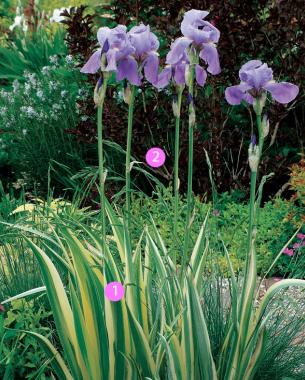
I will admit to being a sucker for just about any variegated plant, regardless of its garden worthiness, and I’ve gone to great lengths to track down oddities like variegated-leaf tomatoes, barley, and sunflowers. Stripes, spots, splashes, or dots—no matter in what form the variegation appears, I like them all. While the obscure variegated plants may interest only obsessed collectors like me, there are plenty of mainstream variegates that make striking additions to beds, borders, and containers. The best ones look great for most or all of the growing season, adding a splash of color where you don’t want or need flowers. Variegated leaves are more than simply practical and dependable; they’re invaluable for adding a touch of drama, a bit of quirkiness, or just plain “wow” to combinations that may be a little ho-hum. The key is knowing how to use them artfully and judiciously.
Use variegates singly or in small groups
Photo/Illustration: Todd Meier
Photo/Illustration: Nancy J. Ondra
Photo/Illustration: Janet M. Jemmott
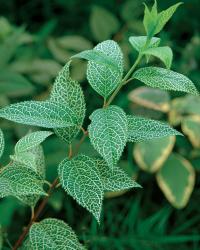
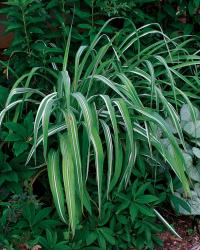
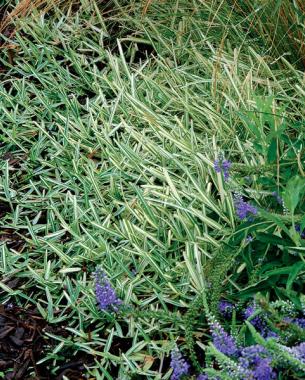
Variegated plants, especially those with dramatic markings, are ideal as focal points in borders and landscapes. In shady sites, variegated creeping sedge (Carex siderosticha ‘Variegata’, USDA Hardiness Zones 6–9), variegated creeping Jacob’s ladder (Polemonium reptans ‘Stairway to Heaven’, Zones 3–7), and other shade-tolerant multicolors are great for brightening things up. Wherever you find expanses of solid-green foliage in your garden—in a border or in a patch of ground covers—an easy way to add more visual interest is to replace some of those plain-green plants with groupings of variegated perennials or individual variegated shrubs.
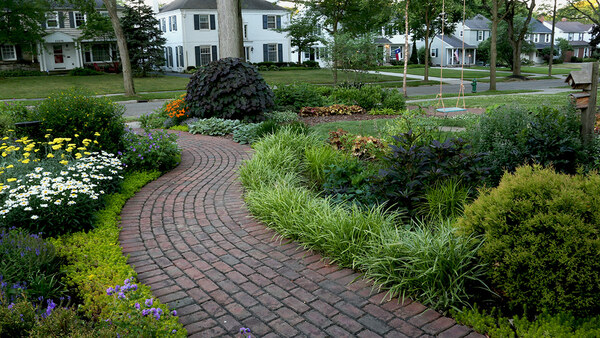
Most variegates work best where you see them up close: along a path, in a foundation planting, or near the front of a bed or border. They’re excellent in pots and planters, too, because you can admire delicate pinstriping or tiny speckles without having to stoop over. Strongly variegated plants can show off well at the back of a large border, but at a greater distance—roughly 15 feet or more—even distinctly marked white-variegated plants tend to have a hazy, grayish appearance, while those with gold markings have an overall yellow-green look.
In any site, single specimens or small groupings are usually most satisfying. Mass plantings of a particular variegate or a mélange of many different variegated plants in one area may thrill foliage fanatics, but to most gardeners, the effect appears overwhelmingly chaotic.
Let color control the combination
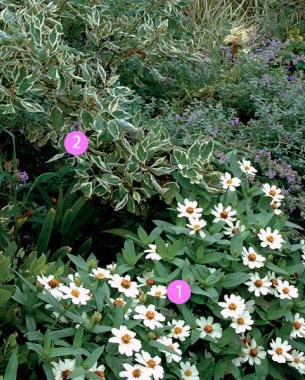
Photo/Illustration: Todd Meier
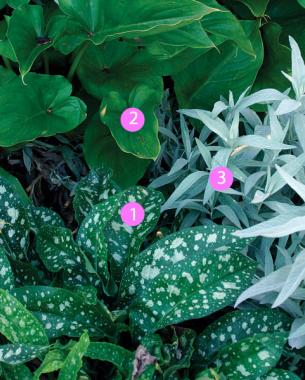
Too many variegated plants may indeed be too much of a good thing. One way to help variegated leaves pop is to site them against contrasting elements. These can include a dark background, such as a fence, wall, or hedge. It can also include plant partners that have deep green, purple, or near-black foliage, providing a dramatic contrast to white or yellow leaf markings.
If you prefer harmonious combinations, choose companions with flowers and foliage in a similar color range as the markings. Few pairings are as pleasing as, for instance, white-and-green leaves with white flowers, which look cool and elegant in shady sites and bold and dramatic in the sun. While harmony works well, as in pure white variegation with crisp white flowers and bright silver leaves, contrasting, rich blue blooms can be stunning. Cream-colored markings pair perfectly with creamy yellow, peach, and pink blooms or blue flowers and foliage. Yellow-marked leaves look wonderful with yellow, blue, purple, or orange flowers and with all-yellow foliage, too.
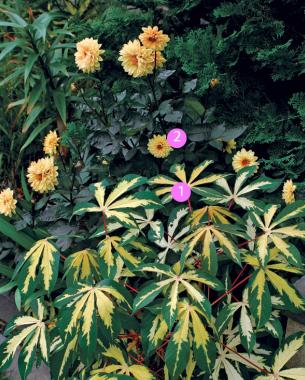
Photo/Illustration: Jennifer Benner
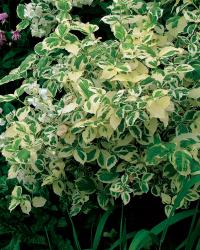
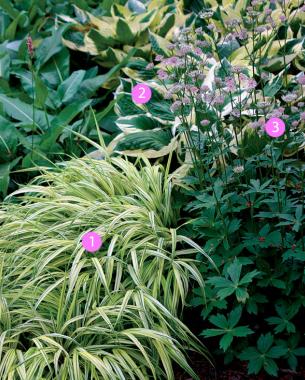
You’ll often hear that you shouldn’t put two or more variegated plants next to each other. Like all other design rules, this one is made to be broken. Try pairing plants that are variegated with different amounts of the same two colors—for example, one that’s mostly green with a little yellow combined with one that’s mostly yellow with a little green. Variegated partners with distinctly different forms or textures can work well together, too. In a shady corner, you might combine a spiky, low-growing, narrow-leaved sedge with a large hosta that has broad leaves. The variegation provides some unity, while the different leaf shapes and sizes add a welcome contrast. If you’d like to use several different variegates in one border or container, include plenty of solid-green companions to provide enough uniformity to offset the dramatic patterns.
Terrific Tenders
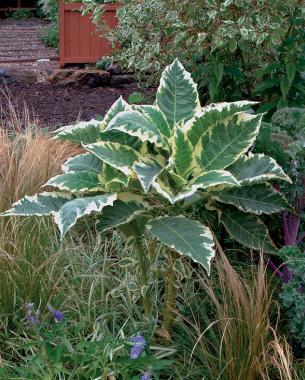
Photo/Illustration: Todd Meier
Variegated angels’ trumpets
Brugmansia ‘Snowbank’
Zone 11
‘Snowbank’ is big and bold, with fragrant flowers that are nearly a foot long and velvety leaves that draw the eye. The foliage sports a wide, irregular, creamy white edge around a gray-green to deep green center. In Zones 9 and higher, grow brugmansias as shrubs.
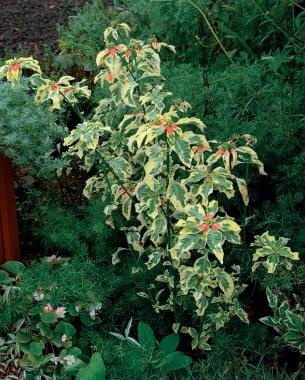
Photo/Illustration: Todd Meier
‘Yokoi’s White’ euphorbia
Euphorbia cyathophora ‘Yokoi’s White’, syn. E. heterophylla ‘Yokoi’s White’
Annual
Sometimes referred to as summer poinsettia, this multicolor euphorbia grabs attention. The 1- to 3-foot-tall plant produces green leaves broadly edged with creamy white to light yellow, and tiny flowers with an orange-red center splash.
Photo/Illustration: Todd Meier
Variegated St. Augustine grass
Stenotaphrum secundatum ‘Variegatum’
Zones 9–11
Variegated St. Augustine grass is low and spreading, with light green blades boldly striped with creamy white, on horizontal stems that take root as they spread. This beauty grows just 6 to 8 inches tall and, by summer’s end, will easily fill a space several feet square. Its trailing stems also look terrific cascading out of a planter, window box, or hanging basket.
Pick plants that keep their stripes
Photo/Illustration: Jennifer Benner
Some variegated plants are so striking in sales displays or catalog photos that they’re practically irresistible. While it’s true that impulse buys can turn out to be real gems, a little investigating before you buy can help you avoid disappointment later. Over the years, though, I’ve noticed several traits that make the difference between must-have variegates and those I’m not sorry to part with after a year or two.
First, look for plants with season-long color. It’s not unusual for some white-, cream-, or yellow-marked leaves to turn mostly solid green by early to midsummer. ‘Sunningdale Variegated’ masterwort (Astrantia major ‘Sunningdale Variegated’, Zones 4–8) is one of these; some hostas (Hosta spp. and cvs., Zones 3–9) and Japanese maples (Acer palmatum cvs., Zones 5–8) do this, too. If the plants actively produce highly variegated new leaves through the summer, they can still offer some interest; otherwise, their color contribution is limited to just part of the growing season. Plenty of variegates, however, hold their bright markings from spring to fall, so choose those to get the maximum impact.
Photo/Illustration: Jennifer Benner
Some variegated plants don’t lose their markings for just part of the growing season—they lose them permanently. These unstable variegates require attention because the all-green parts are usually more vigorous and can crowd out slower-growing variegated sections. If the reverted, solid-green growth shows up along a stem, cutting back below that point removes the reversion and encourages new, variegated growth. But if the reverted section grows directly from the base of the plant (as in a hosta), dig up the clump and divide out the reverted part.
Almost any variegated plant can occasionally produce an all-green shoot, and removing the random reversion is no big deal. Those that revert frequently can be a bother, so avoid them if you tend to ignore your plants for periods of time. Some variegates that routinely produce plain-green shoots in my garden include ‘Geisha’ gooseneck loosestrife (Lysimachia clethroides ‘Geisha’, Zones 4–9), ‘Striped Phantom’ lambs’ ears (Stachys byzantina ‘Striped Phantom’, Zones 4–8), and variegated meadowsweet (Filipendula ulmaria ‘Variegata’, Zones 5–9).
Photo/Illustration: Nancy J. Ondra
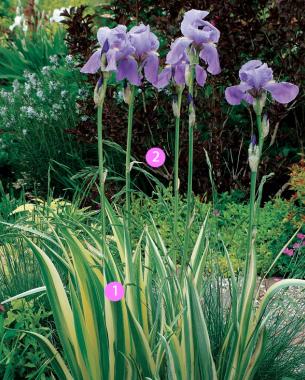
Finding the perfect site for a variegated plant is a matter of finding the perfect level of light for its needs. Generally, the more white or yellow a leaf has, the more sun it needs to produce the same amount of food as an all-green leaf but the more susceptible it is to damage by intense sunlight. The challenge is to provide enough light for the plant to thrive but not so much that the leaves get scorched. If you give it a too-shady spot, the plant will be weak and spindly and it will lose some or all of its variegation. Giving the plant more sun usually brings back the bright leaf markings. Fortunately, many variegated plants adapt to a range of light and moisture conditions and still keep their showy markings. These stalwart selections are the stars of border and container combinations, mingling well with a variety of companions without any fuss. Regardless of your taste or your site requirements, I’m certain one of these plants will add pizzazz to your borders.







Comments
Log in or create an account to post a comment.
Sign up Log in