

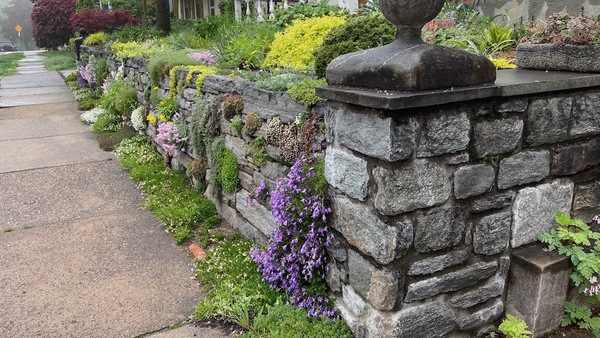
Rock gardens come in many forms. Depending on the sun exposure, slope, soil conditions, and plants, they can mimic the open tundra of the American West, the steep cliffs of the Rocky Mountains, the granite outcrops of a woodland forest in the Northeast or Upper Midwest, or the rocky coast of the Pacific Northwest.

When my husband, Bill, and I moved from New York City to a house in the Colorado plains, at the base of the Rocky Mountains, I quickly decided to fill the landscape around our new home with some of the beautiful flowers I’d seen in the surrounding countryside. The only problem was that I had no idea how to grow these rock-garden plants. So I built my own slope and experimented with gravelly soil mixes various types of rocks, and tiny plants with big flowers like those I’d seen in the wild. Today, I have a series of rock gardens around my house, and they have given me so many hours of delight that rarely do I even consider other types of gardening.
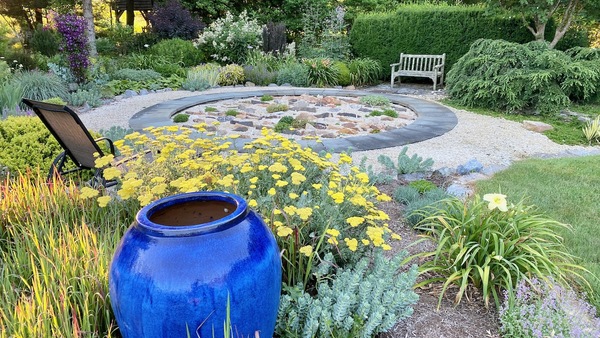
Rocky outcrops, no matter where they are located, often appear the same. The plants that have adapted to these sparse conditions are, most often, genetically small. There are dwarf trees, shrubs, perennials, succulents, and bulbs ideally suited to rocky outcrops and gravelly soil. Because of the plants’ small size, it doesn’t make sense to place a rock garden on the back forty. The tiny plants simply won’t show up from a distance, and you’ll forget to go look at them. Instead, site your rock garden close to the house, facing a door, deck, or window, so you can view it often and from close range.
Choose from a multitude of plants
Many rock garden plants are slow to establish, but there are also many quick-growing plants that can fill the garden in its early years, then be cut back or moved to another location as the garden matures. Rock soapwort (Saponaria ocymoides) spreads easily in a low mat, as does creeping phlox (Phlox stolonifera).One of the charms of rock gardening is that while the plants are generally small, they often have large flowers. The pasque flower (Pulsatilla vulgaris), with its showy, early blooms, is a perfect example. Others, such as campion (Silene schafta) and maiden pink (Dianthus deltoides), cover themselves in flowers.

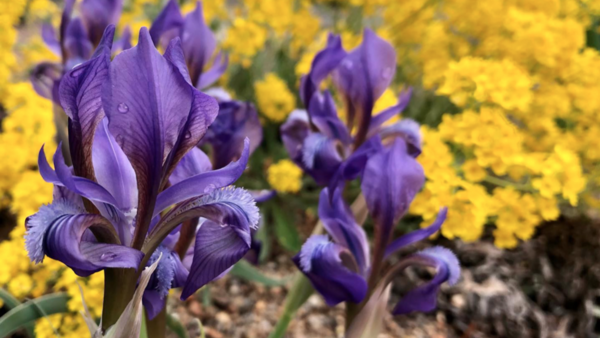
In a new rock garden, it’s nice to include some plants that will flower in their first year. Two of my favorites are basket of gold (Aurinia saxatilis) and aubretia (Aubrieta x cultorum), which bloom simultaneously in early spring.
Spring and early summer are often the highlight of the rock-gardening year, as many plants are at their peak, but you can enjoy the other seasons as well. Snowdrops (Galanthus spp.), the petite Crocus chrysanthus, and the tiny hoop-petticoat daffodils (Narcissus bulbocodium) are among the first to announce the arrival of spring. Penstemon and Sedum species, evening primroses (Oenothera spp.), prostrate speedwell (Veronica prostrata), and small daylilies (Hemerocallis spp.) provide color throughout summer, while Aster species and cultivars and California fuchsias (Zauschneria spp.) bloom in the fall.
For year-round interest, I like hens and chicks (Sempervivum spp.). They are evergreen, often with colored foliage, and can be squeezed into cracks and crevices or used to fill holes in rocks.
Place rocks intentionally
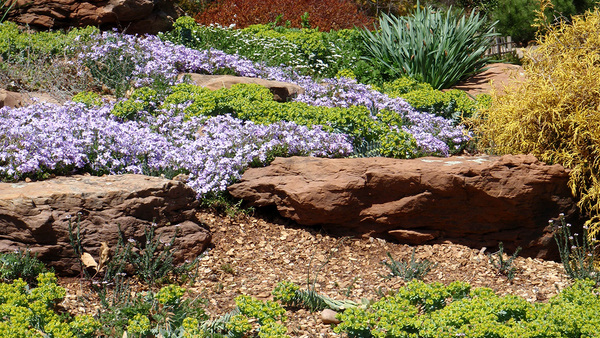
Rock placement is an important design issue if you’re building a rock garden from scratch. While you can certainly pick up ideas by observing natural sites, I find it’s easier to learn from other rock gardens where the scale is more similar to that in my own garden. Three tips when working with rocks: First, start with the big rocks and finish with the small rocks. Second, always bury large rocks by at least a third if you want them to look natural. And third, use just one kind of rock per garden.
Make the most of the rocks when you plant, allowing creeping plants to fill the cracks and drape over their edges without covering them completely. I especially like to group rock garden plants to emphasize their contrasting growth habits, such as mat-forming alpine pinks (Dianthus alpinus), clumping bloody cranesbill (Geranium sanguineum), and an upright pencil point juniper (Juniperus communis ‘Pencil Point’).
Since rock garden plants require good drainage, the author made her own slope
|
|
|


Sandy’s soil recipes
Not every site has a rocky outcrop, but you can create your own rock garden from scratch, either by adding rocks and improving the soil on a hillside or by building a mound on flat ground.
When I’m creating a rock garden from the ground up, I have a landscape supply company mix soil to my specifications and deliver it to my site, though you could mix your own materials if your rock garden is small.
Sometimes I’ll create a single rock garden that has both of these environments, and I’ve found that it’s not necessary to place a barrier between the mixes. Keep in mind that freshly mixed soil has a lot of air in it, so build your mound about a third higher than you want it to be and give it a few months to settle. The settling process doesn’t seem to affect rock placement, as everything settles together. I like to build a garden in fall, and plant it the following spring.
For sunny, south-facing sites:
I use this soil mixture for most of my rock gardens.
1 part topsoil
1 part peat moss
1 part stone mixture (1/3 crushed river rock, 1/3 pea gravel, and 1/3 squeegee, a grade between sand and pea gravel)
For north-facing sites:
This soil is finer grained and is appropriate for a woodland rock garden.
1 part sharp sand
1 part top soil
1 part rotted sawdust
Sometimes I’ll create a single rock garden that has both of these environments, and I’ve found that it’s not necessary to place a barrier between the mixes. Keep in mind that freshly mixed soil has a lot of air in it, so build your mound about a third higher than you want it to be and give it a few months to settle. The settling process doesn’t seem to affect rock placement, as everything settles together. I like to build a garden in fall, and plant it the following spring.
Upkeep is relatively easy
|
|
|


I can spend hours puttering around the garden rearranging plants and potting up seedlings, but when I am busy with other parts of my life, the rock garden will just hang in there. A good mulch of pea gravel or crushed stone helps prevent plants from rotting, keeps the soil from drying out so quickly, and keeps weeds under control.
How much water your plants need will vary depending on your climate, soil, sun exposure, and plant choices. Many rock garden plants have long taproots that reach more than twice the length of the plant to search for water. Though few are truly xeric, most don’t like having wet feet.
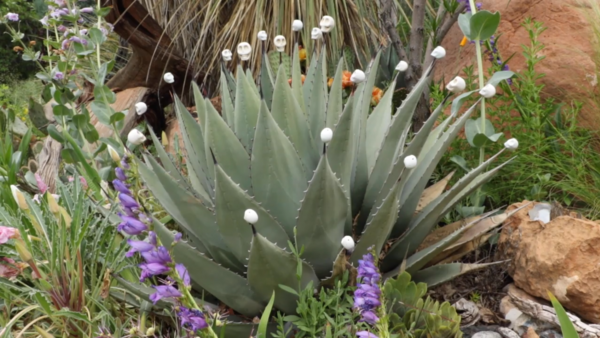
Since I live in a hot, dry climate, water is important, so I’ve rigged a simple irrigation system for my beds. For instance, even though my southfacing garden gets hotter and drains faster, I water it less often than I do the north-facing garden, which mimics more of a woodland environment. And my cactus garden receives even less water.
Rarely do you rip out a whole rock garden to revitalize it. As it grows and matures, you may choose to rework a section or two, but as long as you’re happy with the rock placement, your garden will just get more interesting as it continues to grow.




Comments
I wonder if chunks of broken up concrete (urbanite) would work for creating a rock garden? I have a sloping yard but living in Florida have no native rock available. I guess I'm afraid the concrete chunks would not be aesthetically pleasing, despite flowers and plants.
Bob -- absolutely go with urbanite if available. Two fabulous examples are Plant Delights Nursery in Raleigh with a very fancy urbanite garden and Smith-Gilbert Gardens with a recent, more natural looking urbanite installation. I highly recommend you -- and any other gardeners interested in rock gardens -- check out the NARGS.org website and consider joining this great, fun rock gardening organization. It isn't all about alpines, as this ATL gal will tell you! Their great Rock Garden Quarterly has had several articles about urbanite over the last few years.
Log in or create an account to post a comment.
Sign up Log in