
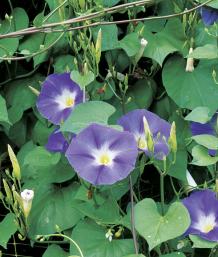
Every spring, without fail, I press fat ‘Heavenly Blue’ morning glory (Ipomoea tricolor ‘Heavenly Blue’) seeds into peat pots and anticipate the wall of China blue that I’ll relish come high summer. In the past few years I have also grown ‘Pearly Gates’, ‘Scarlet O’Hara’, ‘Scarlet Star’, ‘Scarlet Climber’, and the related species moonflower (Ipomoea alba). I’m charmed by the color of the trumpeting flowers, by the heart-shaped leaves, and by the way the plants ascend whatever meager structure they can wrap their tendrils around. ‘Heavenly Blue’ opens with the sunrise and greets me on my way to work every summer morning. It’s a quick glimpse indeed, as each flower unfurls only once, then closes and dies, quickly replaced by another blue charmer.
When I return in the evening, I’m welcomed home by the ethereal scent and sight of the moonflowers. The 6-inch blooms of this white-flowered sweetie unfold mid- to late-afternoon, standing in for the ipomoeas that flowered and then closed earlier in the day. I plant I. tricolor and I. alba together in a prominent spot, near a kitchen window, where the perfume of the moonflower wafts inside during the evening.
The Ipomoea genus is a large one, with over 500 species, the familiar sweet potato (I. batatas) being one of the notable, though less showy, members. Morning glories originated in the warmth of the tropics, where they grow rangy and scrappy enough to be considered pests. In most zones in this country, they can be grown only as annuals.
Besides being both food crop and garden ornament, some notorious Ipomoea species have been used for their hallucinogenic properties. The Aztecs ingested the seeds of I. tricolor—which contain a lysergic acid alkaloid—during rituals to commune with their gods. It was risky business, as who knew whether the gods wanted to communicate or not, and it’s certain the seeds are toxic and potentially lethal.
Growing ipomoeas
Gardeners looking for a vigorous climber to cover a wall or trellis in only one season will be delighted with ipomoeas. If you have cool springs, sow seeds indoors. Morning glories don’t like their roots disturbed, but in cooler climates you’ll need a jump on the season or you won’t get flowers until late summer.
Start seeds three to four weeks before the last expected frost date. Soak the seeds in warm water for 24 hours before planting, or carefully file or chip their hard overcoats to encourage germination, then soak them. Put them in peat pots so the transition into the garden won’t disturb their roots as much. Seeds will germinate in about a week. If you start them too soon, some of the quick-growing varieties will seek a support to climb on, or start twining around each other. If your seedlings get to this point, insert twigs in their pots (carefully, so as not to damage the roots), and transplant as soon as the weather warms up.
In zones with longer growing seasons and milder temperatures, sow seeds outdoors where they are to flower, after the last frost date. Plant morning glories in average, well-drained soil but make sure they get a full blast of sun (especially I. alba). I have grown the tricolor morning glories in partial sun on a western wall. They took longer to flower, but once they did, it was in profusion.
I. alba likes rich soil, but most of the I. tricolor cultivars prefer soil that is not too rich, otherwise you’ll get an abundance of foliage and few flowers. Morning glories aren’t water lovers, either, and will do well with average precipitation.
Morning glories are twiners: they reach out, pirouetting in their predetermined, typically clockwise direction, seeking something to grab hold of. (The plants are genetically programmed to grow and unfurl in one direction only—watch your plants, you’ll see.) The tendrils are far stronger than they appear. Give them a trellis, a string, a lamp post—anything that will allow them to grow upward. And grow they will, until a frost stops them dead in their tendriling tracks.
Varieties galore
Most of the popular cultivars now on the market have descended from I. tricolor. If you prefer purples or reds, an Ipomoea cultivar for you might be ‘Scarlet O’Hara’, ‘Scarlet Star’, ‘Morning Star’, ‘Crimson Rambler’, or ‘Mt. Fuji’ or ‘Grandpa Ott’. ‘Flying Saucers’ is a stunning mutation of ‘Pearly Gates’, which was a pure white mutation of ‘Heavenly Blue’. Regardless of what cultivar you choose, you won’t be disappointed in this irrepressible climber that well deserves its name, morning glory.













Comments
Enjoy 9 windows and would love to see vines growing down for the look of Italy......the ledges are too short....any ideas?
I was given a cutting and told that it was a "standing morning glory" but I can't find anything about that...does it have another name?
Can morning glories be wintered inside or do they have to be planted each spring?
They often self seed and come back up. However, I always just harvest my own crop of seeds and replant every spring.
I want to grow them up a trellis by the pool which is open on both sides. (the trellis is about 12 feet tall mounted against the pool fence) My question is will morning glories flower towards the sun like Sunflowers do or in both directions? (towards and away from the sun.) I like the neighbors but I want to plant them so we can see them too!
It would REALLY be helpful if, when you are asked about how to 'grow' something, you'd say how deep to plant, how to space, etc. ............
Morning Glories do great in South Florida. They thrive in both full sun and partial shade. They do not have any problems with insect pests. By Gregg L. Friedman MD
Log in or create an account to post a comment.
Sign up Log in