previous
  • Comfortable Alfresco Dining
    Comfortable Alfresco Dining
  • Fast-Growing Trees for Impatient Gardeners
    Fast-Growing Trees for Impatient Gardeners
  • Building a Compost Bin
    Building a Compost Bin
  • Save Money by Growing Your Own
    Save Money by Growing Your Own
  • Colorful Selections for Shade
    Colorful Selections for Shade
  • In Pursuit of the Perfect Potting Shed
    In Pursuit of the Perfect Potting Shed
  • Mulch for a Healthy Garden
    Mulch for a Healthy Garden
  • Pretty in Pink
    Pretty in Pink
  • 6 Tips for Weed Control
    6 Tips for Weed Control
  • Fragrant Plants for Pathways
    Fragrant Plants for Pathways
  • Indeterminate or Determinate Tomatoes?
    Indeterminate or Determinate Tomatoes?
  • Stylish Shady Containers
    Stylish Shady Containers
  • Designing with Curved Terraces
    Designing with Curved Terraces
  • Elephant's Ears
    Elephant's Ears
  • Slideshow: Beautiful Clematis
    Slideshow: Beautiful Clematis
  • Plant an Easy-to-Water Strawberry Jar
    Plant an Easy-to-Water Strawberry Jar
  • Make a Succulent Topiary
    Make a Succulent Topiary
  • Dwarf Citrus Trees
    Dwarf Citrus Trees
  • Garden Confidential: A Plant Walks into a Bar
    Garden Confidential: A Plant Walks into a Bar
  • Containers as Focal Points
    Containers as Focal Points
  • NEW Video Series: There's a Better Way
    NEW Video Series: There's a Better Way
  • Thoughts From a Foreign Field
    Thoughts From a Foreign Field
  • Fine Gardening's Tip Off!
    Fine Gardening's Tip Off!
  • Homegrown / Homemade
    Homegrown / Homemade
  • Meet Our Mini-Magazines
    Meet Our Mini-Magazines
next

Genus Tetrapanax (Rice-paper plant)

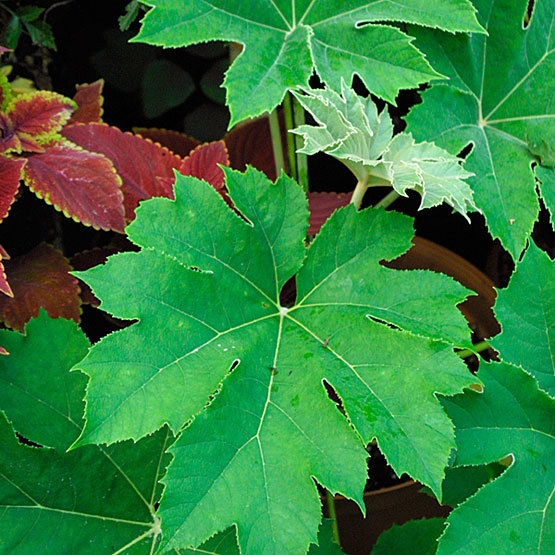
Tetrapanax Tetrapanax papyrifera Photo/Illustration: Jennifer Benner
tet-trah-PAN-aks Common Name: Rice-paper plant Synonyms: Aralia, Fatsia,
The genus Tetrapanax has just one species (T. papyrifer), a suckering, evergreen shrub that can be grown as a small tree. It is native to woodland in southern China and Taiwan and produces large, lobed leaves and umbels of white flowers in panicle-like inflorescences that attract bees. Flowers are followed by clusters of black fruit. Grow in a sheltered border where hardy, or against a warm wall, in a container, or in a cool greenhouse where not hardy.  
Noteworthy characteristics: Large leaves; wooly flowers; black fruit. The flowers attract bees. May be invasive in some areas. Suckers can come up as far as 20 feet away from the parent plant.
Care: Tolerates any well-drained soil in full sun. Provide shelter from wind. Remove suckers at the extremities to control spread.
Propagation: Sow seed in a cold frame in the fall, or remove suckers in spring or summer.
Problems: Infrequent.

Species, varieties and cultivars for genus Tetrapanax

Tetrapanax papyrifer Tetrapanax papyrifer
(Rice-paper plant)
(1 user review)
Hardiness Zones: 1 2 3 4 5 6 7 8 9 10 11

Large—to 20 inches across—almost rounded, lobed leaves colored a downy gray-tinged green contrast beautifully with almost any companion plant. This thicket-forming, sparsely branched, evergreen shrub, which behaves like an herbaceous perennial in Zones 6 and 7, produces thick, leafy shoots topped by white flowers borne on branching stems to 20 inches long in fall.