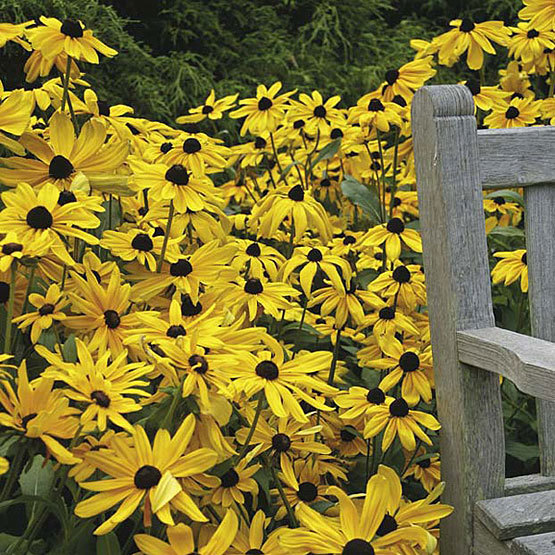
Genus Rudbeckia (Coneflower)

Rudbeckia Rudbeckia hirta 'Indian Summer' Photo/Illustration: Courtesy of Bluestone Perennials
rud-BEK-ee-ah Common Name: Coneflower
The genus Rudbeckia is comprised of 20 or so species of annuals, biennials, and perennials from the meadows and woodlands of North America. They are grown for their often numerous, daisy-shaped, mostly yellow flowers with central cones that can be black, brown, or green. The flowers often attract butterflies, and the seedheads attract birds. Use in a border, woodland, or natural area.
Noteworthy characteristics: Daisy-like flowers with central cones. Long blooming. Good cut flowers.
Care: Coneflowers prefer heavy soil that is well-drained but does not dry out, in full sun or partial shade.
Propagation: Perennials may be grown from seed started in a cold frame in early spring, or by division in spring or fall. Annuals and biennials should be started from seed in spring at 61° to 64°F.
Problems: Aphids, powdery mildew, rust, smut, and leaf spots can occur, while slugs and snails can eat young plants.

Species, varieties and cultivars for genus Rudbeckia

Rudbeckia fulgida var. sullivantii 'Goldsturm' Rudbeckia fulgida var. sullivantii 'Goldsturm'
(Orange Coneflower, Black-eyed Susan)
(12 user reviews)
Hardiness Zones: 1 2 3 4 5 6 7 8 9 10 11

Large flowers consisting of brassy orange-yellow rays surrounding brown cones are what make this plant so popular. It blooms for 7 or 8 weeks beginning in midsummer. The flowers top 18- to 30-inch-tall plants that will readily self sow in cultivated soils. 

Rudbeckia hirta Rudbeckia hirta
(Black-eyed Susan, Gloriosa daisy, Coneflower)
Be the first to rate this plant
Hardiness Zones: 1 2 3 4 5 6 7 8 9 10 11

This biennial or short-lived perennial has given rise to numerous cultivars which are often grown as annuals. From summer into early autumn, it bears daisy-like blossoms (to 3 inches across) with light or deep yellow rays and brownish-purple centers. The flowers are a staple in late summer bouquets.

Rudbeckia hirta ‘Indian Summer’ Rudbeckia hirta ‘Indian Summer’
(Black-eyed Susan, Gloriosa daisy)
(2 user reviews)
Hardiness Zones: 1 2 3 4 5 6 7 8 9 10 11

'Indian Summer' is a standout among a sea of Black-eyed Susans because of its extra-large, golden yellow flowerheads. It will bloom from early summer until first frost. Use it in borders, cottage gardens, meadows, or for naturalizing. Butterflies are drawn to it. The species is native to the central U.S.

Rudbeckia maxima Rudbeckia maxima
(Giant coneflower, Black-eyed Susan)
Be the first to rate this plant
Hardiness Zones: 1 2 3 4 5 6 7 8 9 10 11

This choice species makes a strong vertical statement with its large, smooth, sea-green leaves and towering stems to 6 feet tall. It bears short, yellow ray florets with giant, upright cones at the center. It prefers average soil with good drainage, and is excellent in native or wild plantings.

Rudbeckia subtomentosa Rudbeckia subtomentosa
(Sweet coneflower)
(1 user review)
Hardiness Zones: 1 2 3 4 5 6 7 8 9 10 11

This dignified U.S. native species has downy leaves and bears clusters of luminous clear-yellow flowers with reddish-brown center cones. It blooms for over a month starting in mid- to late-summer.

Rudbeckia subtomentosa 'Henry Eilers' Rudbeckia subtomentosa 'Henry Eilers'
('Henry Eilers' sweet coneflower)
Be the first to rate this plant
Hardiness Zones: 1 2 3 4 5 6 7 8 9 10 11

The unique, finely quilled, 2-inch-wide flowers are what make 'Henry Eilers' stand out from the rest of the coneflowers. The petals sit separate from one another, forming a brilliant, golden yellow starburst around a dark brownish purple cone. The blooms grow on strong, upright, 4- to 5-foot-tall stems in late summer, and are produced in such abundance that you can cut some for bouquets and you'll never even notice they are missing from the garden. The stems are covered with a soft, hairy down, while the leaves have a pleasing vanilla-and-anise scent.

no image available Rudbeckia triloba
(Brown-eyed Susan, Coneflower)
Be the first to rate this plant
Hardiness Zones: 1 2 3 4 5 6 7 8 9 10 11

This biennial makes a superb, self-sown companion in a mixed border or wild garden. It reaches up to 5 feet tall and exhibits a long-lasting, airy spray of small, daisy-like blossoms in yellow with purple-black centers. The flowers are beautiful in late summer bouquets.