previous
  • Indeterminate or Determinate Tomatoes?
    Indeterminate or Determinate Tomatoes?
  • Pretty in Pink
    Pretty in Pink
  • Plants that Spark!
    Plants that Spark!
  • Plant an Easy-to-Water Strawberry Jar
    Plant an Easy-to-Water Strawberry Jar
  • Containers as Focal Points
    Containers as Focal Points
  • Fast-Growing Trees for Impatient Gardeners
    Fast-Growing Trees for Impatient Gardeners
  • Fragrant Plants for Pathways
    Fragrant Plants for Pathways
  • Colorful Selections for Shade
    Colorful Selections for Shade
  • Dwarf Citrus Trees
    Dwarf Citrus Trees
  • Save Money by Growing Your Own
    Save Money by Growing Your Own
  • Elephant's Ears
    Elephant's Ears
  • Lawn Alternatives
    Lawn Alternatives
  • Make a Succulent Topiary
    Make a Succulent Topiary
  • Comfortable Alfresco Dining
    Comfortable Alfresco Dining
  • 6 Tips for Weed Control
    6 Tips for Weed Control
  • Mulch for a Healthy Garden
    Mulch for a Healthy Garden
  • Homegrown / Homemade
    Homegrown / Homemade
  • Garden Confidential: A Plant Walks into a Bar
    Garden Confidential: A Plant Walks into a Bar
  • Stylish Shady Containers
    Stylish Shady Containers
  • Thoughts From a Foreign Field
    Thoughts From a Foreign Field
  • Designing with Curved Terraces
    Designing with Curved Terraces
  • In Pursuit of the Perfect Potting Shed
    In Pursuit of the Perfect Potting Shed
  • NEW Video Series: There's a Better Way
    NEW Video Series: There's a Better Way
  • Building a Compost Bin
    Building a Compost Bin
  • Slideshow: Beautiful Clematis
    Slideshow: Beautiful Clematis
next

Genus Paeonia (Peony)

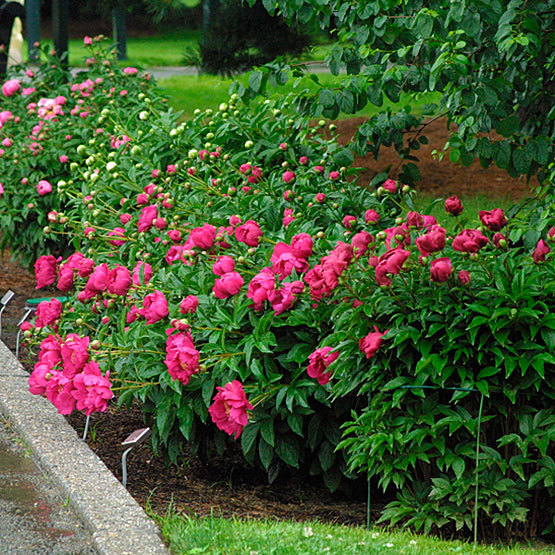
Paeonia Paeonia lactiflora 'Kansas' Photo/Illustration: Steve Aitken
pay-OH-nee-ah Common Name: Peony
Plants in the genus Paeonia are clump-forming perennials and deciduous shrubs or subshrubs grown for their large, colorful, and sometimes fragrant flowers. Blooms are usually upright and solitary, sometimes several to a stem. Use in mixed, herbaceous, or shrub borders. Herbaceous cultivars bloom in late spring and early summer. Tree peonies bloom in mid-spring and late spring.
Noteworthy characteristics: Peonies have a wide distribution in meadows, scrub, and rocky places of East Asia to Europe, and in western North America. They sometimes have showy, red- or black-seeded pod-like fruits. Flowers are saucer-, cup-, or bowl-shaped, varying widely in color and size (from 2 and up to 12 inches across), and can be single, semi-double, double, and Japanese. All parts are toxic.
Care: Deep, fertile, humus-rich, moist but well-drained soil. Full sun or part shade. Large cultivars may need support.
Propagation: Divide herbaceous cultivars in early autumn and replant, placing the new growths 2 inches below the surface; take root cuttings in winter. Take semi-ripe cuttings of tree peonies in summer or graft in winter.
Problems: Prone to ringspot virus, Verticillium wilt, Botrytis blight, tip blight, leaf blotch, stem rot, Japanese beetles, and nematodes.

Species, varieties and cultivars for genus Paeonia

Paeonia lactiflora Paeonia lactiflora
(Common garden peony)
Be the first to rate this plant
Hardiness Zones: 1 2 3 4 5 6 7 8 9 10 11

This stunning herbaceous woodland peony has upright red-mottled stems and dark green leaves that are elliptic or lance-shaped with rough margins. It bears usually solitary, single creamy white to pale pink blossoms that are cup-shaped and elegant. The blooms measure 3 to 4 inches across and have pale yellow stamens. Like all peonies, the flowers are with us for too short a time. They are followed by beautiful seedpods.

no image available Paeonia obovata var. alba
(Japanese forest peony)
Be the first to rate this plant
Hardiness Zones: 1 2 3 4 5 6 7 8 9 10 11

This plant is a beautiful addition to the garden from early spring until autumn. Red shoots with a crystalline dusting emerge in early April, followed by 5-inch-long, egg-shaped leaves that mature to a dark, reddish green. Each 18-inch stem bears a 2-inch-wide, chalice-like, single pure-white flower with yellow anthers and purple filaments. Mature seedpods open to reveal metallic-blue pea-sized fertile seeds and holly-berry red unfertilized seeds.

Paeonia suffruticosa Paeonia suffruticosa
(Tree peony)
Be the first to rate this plant
Hardiness Zones: 1 2 3 4 5 6 7 8 9 10 11

This upright, sparsely branched, woody shrub reaches 4 to 10 feet tall. It's easy to grow but slow-growing. It displays dark green leaves that are blue-green beneath, and large, silken blossoms 6 to 12 inches across in late spring and early summer. The plants maintain a graceful branching structure throughout the winter.