
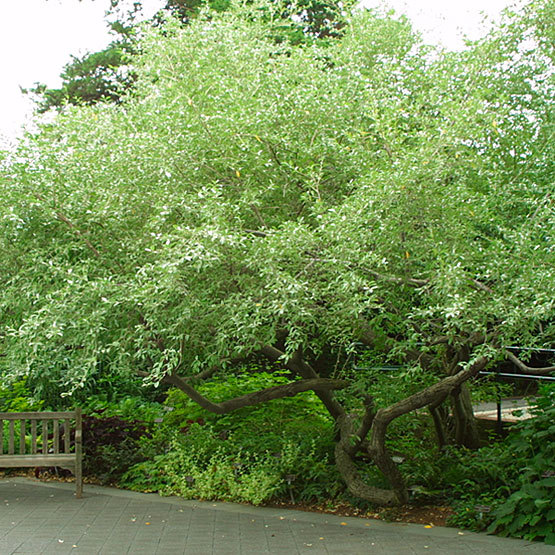
Genus Elaeagnus

Elaeagnus Elaeagnus umbellata Photo/Illustration: Michelle Gervais
el-ee-AG-nus
In the genus Eleagnus are several dozen species of shrubs and trees from thickets and dry places, mainly in Asia. They provide silvery or frosted leaves, fragrant flowers, and edible (sometimes colorful) fruit to the garden. Use as specimens, in a border, or as hedging.
Noteworthy characteristics: Silvery leaves; fragrant flowers; edible berries. Elaeagnus umbellata (autumn olive) is invasive in the northeastern, southeastern, and midwestern U.S.  
Care: Tolerant of most soil, including dry, as long as it is fertile and well-drained. Elaeagnus prefer full sun, but evergreens grow well in partial shade as well.
Propagation: Start from seed in autumn using a cold frame, or take greenwood cuttings in late spring or early summer. Deciduous species can be propagated from semi-ripe cuttings in mid-summer. Evergreens may be grafted in late winter or started from semi-ripe cuttings in summer. Remove suckers from deciduous plants in fall.
Problems: Cankers, dagger nematode, dieback, rust, fungal leaf spots, and root rot are all common troubles.

Species, varieties and cultivars for genus Elaeagnus

Elaeagnus pungens Elaeagnus pungens
(Thorny elaeagnus)
(1 user review)
Hardiness Zones: 1 2 3 4 5 6 7 8 9 10 11

This is a tough evergreen shrub with pendent flowers that provide a delightful gardenia-like perfume during October and November. Brown fruit ripens to red in autumn. Handsome foliage is a lustrous green above, dull and silvery dotted with brown below.

Elaeagnus pungens 'Maculata'

Elaeagnus pungens 'Maculata'


(Variegated silverberry)
Be the first to rate this plant
Hardiness Zones: 1 2 3 4 5 6 7 8 9 10 11

This evergreen shrub can light up the dark corners of a garden. It grows quickly, and its branches are arched and somewhat spiny. Bright yellow,  3- to 4-inch-long leaves splashed are outlined in green. The twigs are a metallic copper color, and the undersides of the leaves are specled with a copper color, too. Tiny white flowers appear under the leaves in fall. They are hard to see, but very fragrant. Small orange fruit appear in spring.

Elaeagnus umbellata Elaeagnus umbellata
(Autumn olive)
Be the first to rate this plant
Hardiness Zones: 1 2 3 4 5 6 7 8 9 10 11

Autumn olive is a vigorous, deciduous shrub with pale yellow-white bell-shaped flowers to a half-inch long borne in late spring and early summer. Its silvery fruit turns red in fall and attracts birds. Wavy-margined leaves are silvery when they emerge and mature to bright green above.


