
previous
  • Comfortable Alfresco Dining
    Comfortable Alfresco Dining
  • Dwarf Citrus Trees
    Dwarf Citrus Trees
  • Fragrant Plants for Pathways
    Fragrant Plants for Pathways
  • Designing with Curved Terraces
    Designing with Curved Terraces
  • Thoughts From a Foreign Field
    Thoughts From a Foreign Field
  • In Pursuit of the Perfect Potting Shed
    In Pursuit of the Perfect Potting Shed
  • Fast-Growing Trees for Impatient Gardeners
    Fast-Growing Trees for Impatient Gardeners
  • Indeterminate or Determinate Tomatoes?
    Indeterminate or Determinate Tomatoes?
  • Colorful Selections for Shade
    Colorful Selections for Shade
  • Save Money by Growing Your Own
    Save Money by Growing Your Own
  • Garden Confidential: A Plant Walks into a Bar
    Garden Confidential: A Plant Walks into a Bar
  • Slideshow: Beautiful Clematis
    Slideshow: Beautiful Clematis
  • Pretty in Pink
    Pretty in Pink
  • Homegrown / Homemade
    Homegrown / Homemade
  • Plants that Spark!
    Plants that Spark!
  • Elephant's Ears
    Elephant's Ears
  • Stylish Shady Containers
    Stylish Shady Containers
  • Plant an Easy-to-Water Strawberry Jar
    Plant an Easy-to-Water Strawberry Jar
  • Containers as Focal Points
    Containers as Focal Points
  • 6 Tips for Weed Control
    6 Tips for Weed Control
  • Lawn Alternatives
    Lawn Alternatives
  • Mulch for a Healthy Garden
    Mulch for a Healthy Garden
  • Building a Compost Bin
    Building a Compost Bin
  • Make a Succulent Topiary
    Make a Succulent Topiary
  • NEW Video Series: There's a Better Way
    NEW Video Series: There's a Better Way
next

Genus Coreopsis (Tickseed)

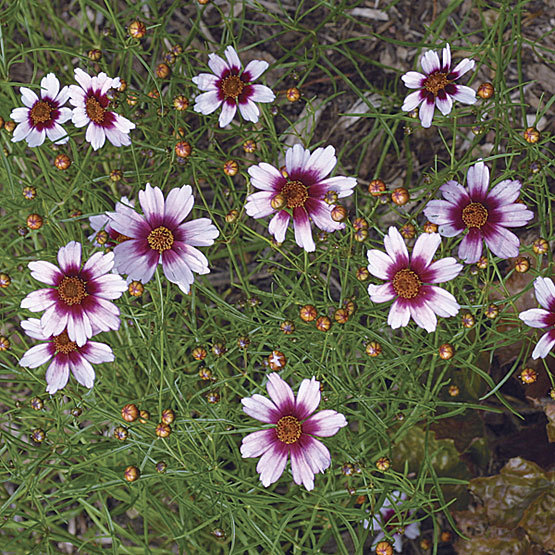
Coreopsis Coreopsis rosea 'Sweet Dreams' Photo/Illustration: Virginia Small
kor-ee-OP-sis Common Name: Tickseed
Coreopsis is a genus of  low-maintenance perennials from prairies and woodlands of North America and Central Asia. Daisy-like blooms in yellow, orange, or pink are long lasting and occur on carefree plants. Some species have fine, ornamental foliage.
Noteworthy characteristics: Most species flower in their first year from seed. The long lasting flowers may be prolonged by deadheading, and they are great for cutting. They are also attractive to bees.
Care: Grow in fertile, well-drained soil in full sun or partial shade. Stake the taller species as needed.
Propagation: Sow seed of annuals in situ, perennials in mid-late winter; divide in early spring.
Problems: Slugs, snails, bacterial spot, rust, Botrytis flower blight, aster yellows, powdery mildew, downy mildew, and fungal spots.


Species, varieties and cultivars for genus Coreopsis

Coreopsis hybrid 'Route 66' Coreopsis hybrid 'Route 66'
(Threadleaf coreopsis)
Be the first to rate this plant
Hardiness Zones: 1 2 3 4 5 6 7 8 9 10 11

'Route 66' features big, bold, bicolor blooms. A rich ring of burgundy surrounding the flower center bleeds out to the very tips of the yellow petals. Narrow, deep-green foliage forms vigorous, uniform clumps.

Coreopsis auriculata Coreopsis auriculata
(Eared coreopsis)
(1 user review)
Hardiness Zones: 1 2 3 4 5 6 7 8 9 10 11

Large golden-yellow blossoms are borne in late spring and midsummer on top of stems reaching almost 3 feet high. Native to the southeastern U.S.

Coreopsis ‘Novcorcar’ Coreopsis ‘Novcorcar’
(Creme Caramel™ Coreopsis)
Be the first to rate this plant
Hardiness Zones: 1 2 3 4 5 6 7 8 9 10 11

Developed as a sport of the popular Coreopsis 'Créme Brulee,' Créme Caramel™ displays a show of bronzy/orange blooms from mid-June to August. -Star Roses

no image available Coreopsis grandiflora
(Large-flowered tickseed)
Be the first to rate this plant
Hardiness Zones: 1 2 3 4 5 6 7 8 9 10 11

As the name implies, this species bears large, daisy-like blossoms (2.5 inches across) of golden yellow rays and darker yellow centers. It blooms from late spring to late summer and is native to the central and southeastern U.S.

Coreopsis grandiflora 'Baby Sun' Coreopsis grandiflora 'Baby Sun'
(Tickseed)
Be the first to rate this plant
Hardiness Zones: 1 2 3 4 5 6 7 8 9 10 11

A multitude of 2-inch, golden-yellow daisy flowers sits atop thready foliage from late spring to late summer if deadheaded promptly. This clump-forming perennial is native to the central and southeastern U.S. It is sometimes grown as an annual. It makes a beautiful cut flower, and its casual habit makes it valuable in cottage gardens, borders, containers, and meadows.

Coreopsis grandiflora 'Sunray' Coreopsis grandiflora 'Sunray'
(coreopsis, 'Sunray' tickseed)
(5 user reviews)
Hardiness Zones: 1 2 3 4 5 6 7 8 9 10 11

'Sunray' coreopsis has double to semi-double yellow flowers that begin blooming in late spring and continue throughout the summer. The species is native to the central and southeastern U.S. Flowers are good for cutting. Use in beds and borders or in containers.

Coreopsis lanceolata Coreopsis lanceolata
(Lance-leaved coreopsis)
(1 user review)
Hardiness Zones: 1 2 3 4 5 6 7 8 9 10 11

Solitary yellow petals with toothed edges and flat, yellow centers open from early to late summer. Native to the central and southern U.S.

Coreopsis rosea Coreopsis rosea
(Tickseed)
Be the first to rate this plant
Hardiness Zones: 1 2 3 4 5 6 7 8 9 10 11

This plant bears a profusion of lavender-pink flowers with yellow centers from mid-summer to early autumn. This perennial has finely textured leaves that give it an airy appearance.

Coreopsis rosea 'Mercury Rising' Coreopsis rosea 'Mercury Rising'
('Mercury Rising' coreopsis)
Be the first to rate this plant
Hardiness Zones: 1 2 3 4 5 6 7 8 9 10 11

Large, velvety-red blooms bring long-lasting, dramatic color to the garden from early summer into fall. This easy-to-grow beauty is deer resistant and perfect cut for summer bouquets! -American Meadows

Coreopsis rosea 'Sweet Dreams' Coreopsis rosea 'Sweet Dreams'
(Tickseed)
(1 user review)
Hardiness Zones: 1 2 3 4 5 6 7 8 9 10 11

The bicolored, white-tipped and raspberry-centered blooms are large (1 to 1.5 inches across) and long lasting. Flowers cover the mound of grassy foliage for weeks in summer and early fall. This hybrid does not produce seed.

Coreopsis verticillata ‘Moonbeam’ Coreopsis verticillata ‘Moonbeam’
(Thread-leaved tickseed)
(1 user review)
Hardiness Zones: 1 2 3 4 5 6 7 8 9 10 11

'Moonbeam' produces star-like blossoms of pale yellow from late spring into autumn. This cultivar is widely used because the refreshing tint of yellow compliments so many colors. The finely textured foliage adds interest all season long.

Corepsis verticillata ‘Zagreb' Corepsis verticillata ‘Zagreb'
(Thread-leaved tickseed)
(2 user reviews)
Hardiness Zones: 1 2 3 4 5 6 7 8 9 10 11

'Zagreb' produces star-like blossoms in egg-yolk yellow in early summer on plants 12 inches tall and wide. The sturdy, upright stems and finely textured foliage add delicate texture to the garden.


