
previous
  • In Pursuit of the Perfect Potting Shed
    In Pursuit of the Perfect Potting Shed
  • Plant an Easy-to-Water Strawberry Jar
    Plant an Easy-to-Water Strawberry Jar
  • 6 Tips for Weed Control
    6 Tips for Weed Control
  • Lawn Alternatives
    Lawn Alternatives
  • Pretty in Pink
    Pretty in Pink
  • Building a Compost Bin
    Building a Compost Bin
  • Comfortable Alfresco Dining
    Comfortable Alfresco Dining
  • Thoughts From a Foreign Field
    Thoughts From a Foreign Field
  • Containers as Focal Points
    Containers as Focal Points
  • Plants that Spark!
    Plants that Spark!
  • Indeterminate or Determinate Tomatoes?
    Indeterminate or Determinate Tomatoes?
  • Dwarf Citrus Trees
    Dwarf Citrus Trees
  • Slideshow: Beautiful Clematis
    Slideshow: Beautiful Clematis
  • Elephant's Ears
    Elephant's Ears
  • Designing with Curved Terraces
    Designing with Curved Terraces
  • Colorful Selections for Shade
    Colorful Selections for Shade
  • Homegrown / Homemade
    Homegrown / Homemade
  • Garden Confidential: A Plant Walks into a Bar
    Garden Confidential: A Plant Walks into a Bar
  • Fast-Growing Trees for Impatient Gardeners
    Fast-Growing Trees for Impatient Gardeners
  • Mulch for a Healthy Garden
    Mulch for a Healthy Garden
  • Save Money by Growing Your Own
    Save Money by Growing Your Own
  • Fragrant Plants for Pathways
    Fragrant Plants for Pathways
  • NEW Video Series: There's a Better Way
    NEW Video Series: There's a Better Way
  • Make a Succulent Topiary
    Make a Succulent Topiary
  • Stylish Shady Containers
    Stylish Shady Containers
next

Genus Arisaema

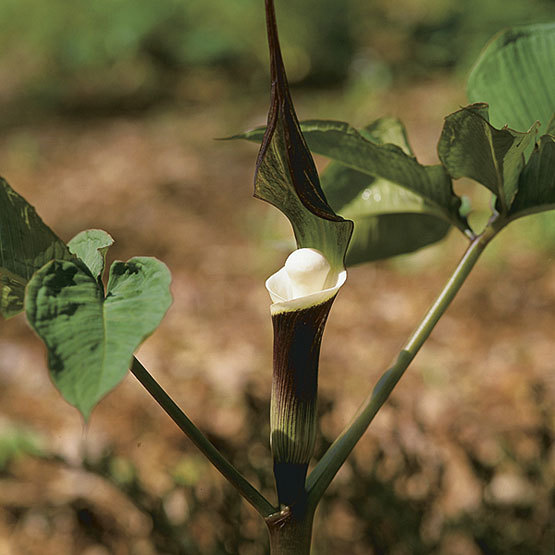
Arisaema Arisaema sikokianum Photo/Illustration: Steve Silk
air-iss-EE-mah
Plants in this genus are spring- or summer-flowering tuberous or rhizomatous perennials of moist woodlands. They are most notable for their showy and unusual hooded, funnel-shaped, fleshy spikes enclosing the insignificant flowers, often followed by colorful red to orange berries
Noteworthy characteristics: Grown for the attractive, unusual, and distinctive hooded flowers.
Care: Plant tubers or rhizomes 2-10 inches deep in autumn. Grow in moist well-drained soil, neutral to acidic, in part shade.
Propagation: Most species produce offsets which can be removed in autumn.
Problems: Slugs and vine weevils. Rust, anthracnose, leaf blight, and mosaic.

Species, varieties and cultivars for genus Arisaema

Arisaema sikokianum Arisaema sikokianum
(Japanese cobra lily)
(1 user review)
Hardiness Zones: 1 2 3 4 5 6 7 8 9 10 11

The outside of the spathe is the color of dark chocolate, and the inside, milk white and as smooth as marble. Its hood sweeps up to an arrogant point, exposing its sumptuous white lining and the thick blunt spadix, which is also milk white. This plant produces two leaves per tuber, one leaf with three lobes and one with five. Sometimes they are mottled with silver, which makes them very handsome, at least until the plant goes dormant in summer.

Arisaema triphyllum Arisaema triphyllum
(Jack-in-the-pulpit)
Be the first to rate this plant
Hardiness Zones: 1 2 3 4 5 6 7 8 9 10 11

A favorite of children, Jack-in-the-pulpit is a tuberous perennial producing one or two leaves, each divided into three narrow leaflets. But it's best known for its spring to early summer display of hooded, green spathes—Jack's pulpit—which are often striped with purple. Autumn brings clusters of densely packed, showy red berries.


