Coreopsis rosea (Tickseed)

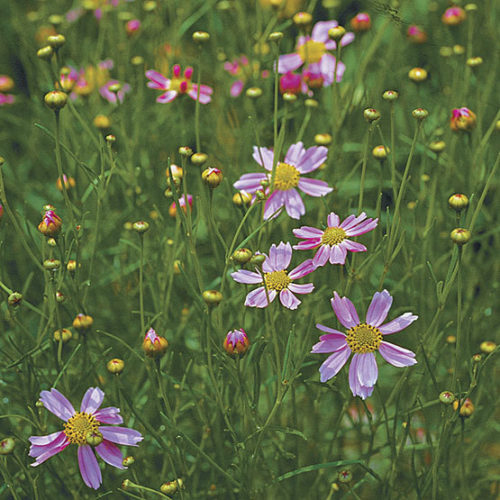
Coreopsis rosea Photo/Illustration: Chris Curless


Be the first to rate this plant

Plant Showcase - from our advertisers


Hardiness Zones: 1 2 3 4 5 6 7 8 9 10 11
Botanical Name: Coreopsis rosea kor-ee-OP-sis ROSE-ee-ah Common Name: Tickseed Genus: Coreopsis
This plant bears a profusion of lavender-pink flowers with yellow centers from mid-summer to early autumn. This perennial has finely textured leaves that give it an airy appearance.
Noteworthy characteristics: The species is good for naturalizing. It can spread rapidly by rhizomes and seed. The blooms make good cut flowers, and are attractive to bees and butterflies.
Care: Grow in fertile, well-drained soil in full sun or partial shade. Requires steady moisture.
Propagation: Sow seeds at 55° to 61°F  in mid- or late winter, or divide plants in early spring. Basal cuttings can be rooted in spring.
Problems: Slugs, snails, bacterial spot, rust, Botrytis flower blight, aster yellows, powdery mildew, downy mildew, and fungal spots.
Height 1 ft. to 3 ft.
Spread 1 ft. to 3 ft.
Growth Habit Spreads
Growth Pace Fast Grower;Invasive/Aggressive Grower
Light Full Sun Only
Moisture Medium to Wet
Maintenance Moderate
Characteristics Attracts Butterflies; Native; Self Seeds; Showy Flowers
Bloom Time Early Fall; Early Summer; Fall; Late Summer; Summer
Flower Color Pink Flower
Uses , Beds and Borders, Ground Covers, Cut Flower, Naturalizing, Waterside
Style , Cottage Garden
Seasonal Interest , Summer Interest, Fall Interest
Type ,Perennials

Plants you might also like

Salvia pratensis Salvia pratensis
(Meadow clary)
Be the first to rate this plant
Hardiness Zones: 1 2 3 4 5 6 7 8 9 10 11

This woody-stemmed perennial produces sticky spikes of deep violet or, rarely, white to pink flowers. It blooms from early summer to autumn; reblooming is most reliable if spent flowers are deadheaded promptly. It has wrinkled leaves and forms an upright clump 3 feet tall by 1 foot wide. This salvia is most noted for its many hybirds with S. nemerosa.  

Coreopsis auriculata Coreopsis auriculata
(Eared coreopsis)
(1 user review)
Hardiness Zones: 1 2 3 4 5 6 7 8 9 10 11

Large golden-yellow blossoms are borne in late spring and midsummer on top of stems reaching almost 3 feet high. Native to the southeastern U.S.

Coreopsis verticillata ‘Moonbeam’ Coreopsis verticillata ‘Moonbeam’
(Thread-leaved tickseed)
(1 user review)
Hardiness Zones: 1 2 3 4 5 6 7 8 9 10 11

'Moonbeam' produces star-like blossoms of pale yellow from late spring into autumn. This cultivar is widely used because the refreshing tint of yellow compliments so many colors. The finely textured foliage adds interest all season long.

Aster macrophyllus Aster macrophyllus
(Bigleaf aster)
Be the first to rate this plant
Hardiness Zones: 1 2 3 4 5 6 7 8 9 10 11

This striking, richly-textured, deciduous ground cover has heart-shaped leaves that turn mauve in autumn. Purple, blue, or white flowers appear in late summer to early fall.

Echinacea purpurea ‘Bright Star’ Echinacea purpurea ‘Bright Star’
(Purple coneflower)
Be the first to rate this plant
Hardiness Zones: 1 2 3 4 5 6 7 8 9 10 11

This native meadow derivative with daisy-like flowers blooms from early summer into early autumn. 'Bright Star' has prominent, copper-orange central cones surrounded by red-purple ray petals (to 5 inches across), and grows to less than 3 feet tall.