previous
  • Indeterminate or Determinate Tomatoes?
    Indeterminate or Determinate Tomatoes?
  • Pretty in Pink
    Pretty in Pink
  • Make a Succulent Topiary
    Make a Succulent Topiary
  • Building a Compost Bin
    Building a Compost Bin
  • Containers as Focal Points
    Containers as Focal Points
  • Lawn Alternatives
    Lawn Alternatives
  • Stylish Shady Containers
    Stylish Shady Containers
  • Colorful Selections for Shade
    Colorful Selections for Shade
  • Garden Confidential: A Plant Walks into a Bar
    Garden Confidential: A Plant Walks into a Bar
  • Plants that Spark!
    Plants that Spark!
  • Fast-Growing Trees for Impatient Gardeners
    Fast-Growing Trees for Impatient Gardeners
  • Homegrown / Homemade
    Homegrown / Homemade
  • 6 Tips for Weed Control
    6 Tips for Weed Control
  • In Pursuit of the Perfect Potting Shed
    In Pursuit of the Perfect Potting Shed
  • Plant an Easy-to-Water Strawberry Jar
    Plant an Easy-to-Water Strawberry Jar
  • Save Money by Growing Your Own
    Save Money by Growing Your Own
  • Fragrant Plants for Pathways
    Fragrant Plants for Pathways
  • Dwarf Citrus Trees
    Dwarf Citrus Trees
  • Mulch for a Healthy Garden
    Mulch for a Healthy Garden
  • Comfortable Alfresco Dining
    Comfortable Alfresco Dining
  • Elephant's Ears
    Elephant's Ears
  • Thoughts From a Foreign Field
    Thoughts From a Foreign Field
  • Designing with Curved Terraces
    Designing with Curved Terraces
  • Slideshow: Beautiful Clematis
    Slideshow: Beautiful Clematis
  • NEW Video Series: There's a Better Way
    NEW Video Series: There's a Better Way
next

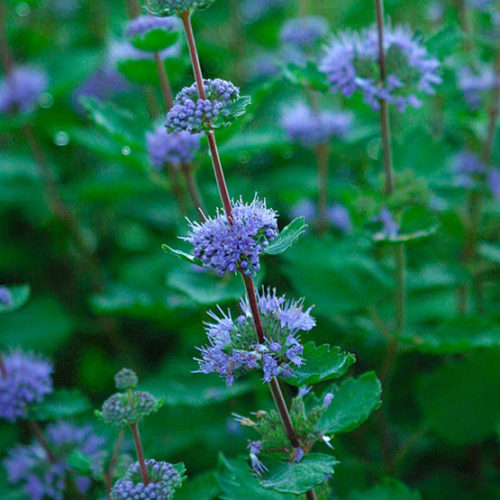
Caryopteris incana 'Jason' (Sunshine blue bluebeard)

Caryopteris incana 'Jason' Caryopteris incana Photo/Illustration: Michelle Gervais


Be the first to rate this plant

Plant Showcase - from our advertisers


Hardiness Zones: 1 2 3 4 5 6 7 8 9 10 11
Botanical Name: Caryopteris incana 'Jason' kare-ee-OP-ter-iss in-KAY-nah Common Name: Sunshine blue bluebeard Synonyms: C. mastacanthus Genus: Caryopteris
'Jason' has bright yellow-green foliage with rich amethyst blue flowers in late summer and fall. It's a vigorous grower for a mixed border or mass planting in sunny areas.
Noteworthy characteristics: Improvement over Caryopteris x clandonensis 'Worcester Gold'.
Care: Grow in well-drained, loose soil that is not overly rich. Tolerates moderately dry conditions. Might die back to the ground in northern zones, but this will not affect flowering, since blooms form on new growth.
Propagation: Separate rooted stems from parent plant and transplant in early spring. Root softwood cuttings in late spring, or greenwood cuttings in early summer.
Problems: Infrequent. Capsid bugs may affect leaves.
Height 1 ft. to 3 ft.
Spread 1 ft. to 3 ft.
Growth Pace Fast Grower
Light Full Sun Only
Moisture Dry to Medium
Maintenance Low
Characteristics Attracts Butterflies; Fragrant Flowers; Fragrant Foliage; Showy Flowers; Showy Foliage
Bloom Time Fall; Late Summer; Summer
Flower Color Blue Flower; Purple/ Lavender Flower
Uses Beds and Borders
Seasonal Interest Summer Interest, Fall Interest
Type Shrubs

Plants you might also like

Caryopteris × clandonensis 'Worcester Gold' Caryopteris × clandonensis 'Worcester Gold'
(Blue beard, Blue-mist shrub)
Be the first to rate this plant
Hardiness Zones: 1 2 3 4 5 6 7 8 9 10 11

'Worcester Gold' is an attractive, mounding, woody shrub with warm yellow to chartreuse foliage and lavender-blue flowers in late summer and early autumn. The flowers are fragrant and attractive to bees and butterflies. The foliage is also aromatic. It is ideal for a mixed or shrub border.

Caryopteris × clandonensis 'First Choice' Caryopteris × clandonensis 'First Choice'
(Blue beard, Blue-mist shrub)
Be the first to rate this plant
Hardiness Zones: 1 2 3 4 5 6 7 8 9 10 11

'First Choice' is ideal for a mixed or shrub border. It's an attractive woody shrub with dark green leaves, dark purplish blue flowers, and a compact habit. Misty blue flowers appear in late summer and early autumn.This plant is relatively drought tolerant and very heat tolerant. The shrub expands as branches that touch the ground form their own roots and may self-seed.

Salvia pachyphylla Salvia pachyphylla
Be the first to rate this plant
Hardiness Zones: 1 2 3 4 5 6 7 8 9 10 11

Giant-flowered purple sage has been winning over gardeners the past few years for its remarkable summer blooms and tough-as-nails demeanor. Native to the dry foothills and mountains of southern California, this sage is considered a woody shrub. It features showy, aromatic silver foliage and bicolored flower spikes with lavender-purple calyces and long, hummingbird-pollinated blue flowers. It grows from 24 to 36 inches high.

Teucrium chamaedrys Teucrium chamaedrys
(Wall germander)
Be the first to rate this plant
Hardiness Zones: 1 2 3 4 5 6 7 8 9 10 11

This evergreen or deciduous subshrub is grown for its attractive, dark green aromatic foliage and its light pink to deep purple flowers, which blossom in summer and early fall. This garden workhorse can be used in troughs, containers, low hedges, knot gardens, rock gardens, or as edging.

Yucca filamentosa ‘Golden Sword’ Yucca filamentosa ‘Golden Sword’
(Adam's needle, Bear grass, Weak-leaf yucca, Golden Sword soapwort)
Be the first to rate this plant
Hardiness Zones: 1 2 3 4 5 6 7 8 9 10 11

This easy to grow evergreen yucca bears dramatic, sword-shaped yellow leaves with a dark green edge. Not as staunchly upright as some yuccas, its leaf tips sometimes droop with age. Its foliage color is best from fall to spring. Plants grow to nearly 2 feet in height and 3 feet in width. In summer, it produces a 6-foot-tall spike covered with nodding, fragrant, white bell-shaped flowers.