Calamintha nepeta (Lesser calamint)

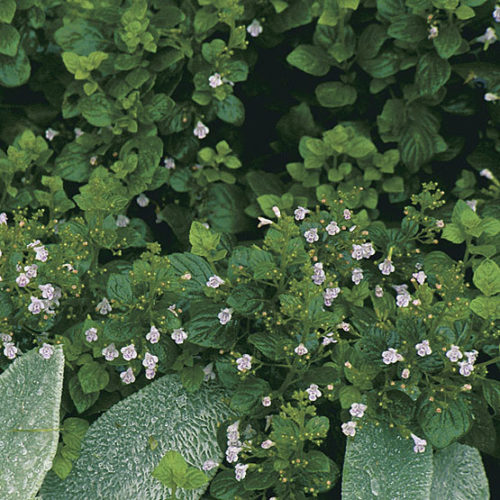
Calamintha nepeta Photo/Illustration: Steve Silk


Be the first to rate this plant

Hardiness Zones: 1 2 3 4 5 6 7 8 9 10 11
Botanical Name: Calamintha nepeta kal-ah-MIN-thah NEP-eh-tah Common Name: Lesser calamint Synonyms: C. nepetoides Genus: Calamintha
Lesser calamint produces fine, upright stems which are covered with small, shiny, dark green leaves, forming a little bush from 12 to 18 inches tall, and twice as wide. In late August, it produces a cloud of infinitesimal pale lavender flowers that continue blooming for up to six weeks. As the days become cooler, the color of the tiny, lipped blossoms deepens.
Noteworthy characteristics: A member of the mint family, it spreads, but is not invasive. Fragrant leaves.
Care: Site in full sun or part shade and moist but well-drained soil.
Propagation: Sow seed in containers in spring, or divide in early spring.
Problems: Powdery mildew.
Height 1 ft. to 3 ft.
Spread 1 ft. to 3 ft.
Growth Habit Spreads
Growth Pace Moderate Grower
Light Full Sun to Part Shade
Moisture Dry to Medium
Tolerance Drought Tolerant
Characteristics Attracts Butterflies; Fragrant Foliage; Self Seeds
Bloom Time Early Fall; Fall; Late Summer; Summer
Flower Color Pink Flower; Purple/ Lavender Flower
Uses Beds and Borders, Naturalizing
Style Cottage Garden, Meadow Garden, Rock Garden
Seasonal Interest Summer Interest, Fall Interest
Type Shrubs

Plants you might also like

Yucca filamentosa ‘Golden Sword’ Yucca filamentosa ‘Golden Sword’
(Adam's needle, Bear grass, Weak-leaf yucca, Golden Sword soapwort)
Be the first to rate this plant
Hardiness Zones: 1 2 3 4 5 6 7 8 9 10 11

This easy to grow evergreen yucca bears dramatic, sword-shaped yellow leaves with a dark green edge. Not as staunchly upright as some yuccas, its leaf tips sometimes droop with age. Its foliage color is best from fall to spring. Plants grow to nearly 2 feet in height and 3 feet in width. In summer, it produces a 6-foot-tall spike covered with nodding, fragrant, white bell-shaped flowers.

Melampodium leucanthum Melampodium leucanthum
(Blackfoot daisy)
Be the first to rate this plant
Hardiness Zones: 1 2 3 4 5 6 7 8 9 10 11

A native perennial shrub that grows to about 2 feet tall and wide and covers itself the whole season with honey-scented, white and yellow daisy flowers. The foliage is typical of the aster family. Plant en masse in a well-drained border or use in a rock garden. Blackfoot daisy can be short-lived.

Clematis texensis 'Duchess of Albany' Clematis texensis 'Duchess of Albany'
(Scarlet clematis, Leather flower, Texas clematis)
Be the first to rate this plant
Hardiness Zones: 1 2 3 4 5 6 7 8 9 10 11

This vigorous climber can easily cover a support of 8 to 10 feet tall once established. Finely textured, dense light-green foliage makes an excellent foil for dainty, pink and carmine teardrop-shaped flowers 2 inches across. Blooms appear in early August and continue well into autumn.

Yucca filamentosa ‘Color Guard’ Yucca filamentosa ‘Color Guard’
(Adam's needle)
Be the first to rate this plant
Hardiness Zones: 1 2 3 4 5 6 7 8 9 10 11

This dramatic architectural plant is one of the most beautiful variegated yuccas on the market. Its sword-shaped leaves bear bold central stripes of bright canary-yellow against a rich celadon edge. In cool weather, margins are tinged pink, and the entire yellow stripe turns rose-colored on many of the leaves, lasting through early spring. Plants grow to 2 feet wide and nearly as tall. Branched clusters of nodding, creamy-white bells open in mid-summer on stout stems that reach 6 feet tall.

Cephalanthus occidentalis Cephalanthus occidentalis
(Buttonbush, Button willow, Honey balls)
Be the first to rate this plant
Hardiness Zones: 1 2 3 4 5 6 7 8 9 10 11

A native small tree found in wetlands from Minnesota to Florida and from New England to California, buttonbush can reach 8 to 15 feet tall and is often wider than it is tall. Prune it into a small multi-trunked tree to reveal the curly bark of its young stems and the punctuated pale spots of its older stems. Blooms are extremely rich in nectar and attract butterflies and other insects.