previous
  • Containers as Focal Points
    Containers as Focal Points
  • Slideshow: Beautiful Clematis
    Slideshow: Beautiful Clematis
  • Dwarf Citrus Trees
    Dwarf Citrus Trees
  • Homegrown / Homemade
    Homegrown / Homemade
  • Fragrant Plants for Pathways
    Fragrant Plants for Pathways
  • In Pursuit of the Perfect Potting Shed
    In Pursuit of the Perfect Potting Shed
  • Elephant's Ears
    Elephant's Ears
  • Garden Confidential: A Plant Walks into a Bar
    Garden Confidential: A Plant Walks into a Bar
  • Stylish Shady Containers
    Stylish Shady Containers
  • Pretty in Pink
    Pretty in Pink
  • Thoughts From a Foreign Field
    Thoughts From a Foreign Field
  • Colorful Selections for Shade
    Colorful Selections for Shade
  • 6 Tips for Weed Control
    6 Tips for Weed Control
  • Make a Succulent Topiary
    Make a Succulent Topiary
  • Plants that Spark!
    Plants that Spark!
  • Building a Compost Bin
    Building a Compost Bin
  • Save Money by Growing Your Own
    Save Money by Growing Your Own
  • Indeterminate or Determinate Tomatoes?
    Indeterminate or Determinate Tomatoes?
  • Mulch for a Healthy Garden
    Mulch for a Healthy Garden
  • Comfortable Alfresco Dining
    Comfortable Alfresco Dining
  • Plant an Easy-to-Water Strawberry Jar
    Plant an Easy-to-Water Strawberry Jar
  • Lawn Alternatives
    Lawn Alternatives
  • NEW Video Series: There's a Better Way
    NEW Video Series: There's a Better Way
  • Designing with Curved Terraces
    Designing with Curved Terraces
  • Fast-Growing Trees for Impatient Gardeners
    Fast-Growing Trees for Impatient Gardeners
next

Composting in Cold Weather

One way to bypass problems with composting kitchen scraps in winter is to do it indoors

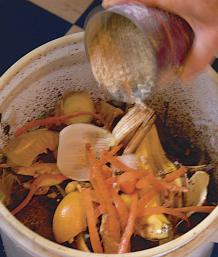
As you add food scraps to the bucket, sprinkle with the sawdust-soil mixture to keep odor and moisture levels low. As you add food scraps to the bucket, sprinkle with the sawdust-soil mixture to keep odor and moisture levels low. Photo/Illustration: Steve Aitken

No matter how particular you are about building your compost pile properly in winter, not much will happen in the cold weather. Mounds of old salad, cooked broccoli, and moldy bread just sit there. There won’t be odors from the pile in winter, but it’s not a pretty sight and may attract animals.

One way to bypass problems with composting kitchen scraps in winter is to do it indoors. To compost indoors, or at least to get materials started composting, all you need is three buckets with loose-fitting lids. (Five-gallon plastic buckets, which are readily available from restaurants, often at no charge, should suffice.) If the lids fit tightly, just keep them loose as you fill the buckets with compost.

Click for diagram Click to enlarge image Click for diagram Photo/Illustration: Erica Marks

First, fill bucket #1 with a mixture of equal parts of dry sawdust or peat moss and dry soil, with a little limestone added. Do not use sawdust from pressure-treated or painted wood.

Then, on the bottom of bucket #2, lay an inch of dry straw, leaves, or shred­ded newspaper. Dump your kitchen scraps into bucket #2 as they become available, each time sprinkling on some of the sawdust-soil mixture from bucket #1 to absorb odors and excess moisture. The sawdust-soil mix also adds carbon to the compost-in-progress, which balances out the high nitrogen concentration in most food scraps. If you have a lot of scraps at once, dump in a portion at a time, covering each layer with the sawdust-soil mixture. Chop up large pieces of scraps and let water drain from anything that is very wet before tossing it into the bucket.

When bucket #2 is full, set it in a warm spot indoors and start filling bucket #3. By the time bucket #3 is full, the contents of bucket #2 should be well on the way to becoming compost, that is, no longer looking like garbage and no longer attractive to scavengers.

When buckets #2 and #3 are full, you can dump the contents of bucket #2 outside on your compost pile. Then start filling that bucket again while bucket #3 sits. I keep the bucket I am filling and the sawdust-soil mixture right in my kitchen. Warmth hastens decomposition, and the whole setup is odor- and fly-free, environmentally sound, and very convenient.
For more on composting techniques and equipment, see All About Compost on VegetableGardener.com.
From Fine Gardening 83 , pp. 24-26

Companion Content

CompostThings you always wanted to know but were afraid to ask

The Jury is Still Out on Compost TeaCompost tea is currently hot in the gardening world, but will it also move beyond fad status?

Building a Compost BinEasy to assemble and disassemble, this bin can adapt to the size of your compost pile