
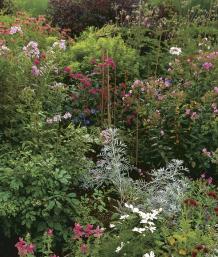
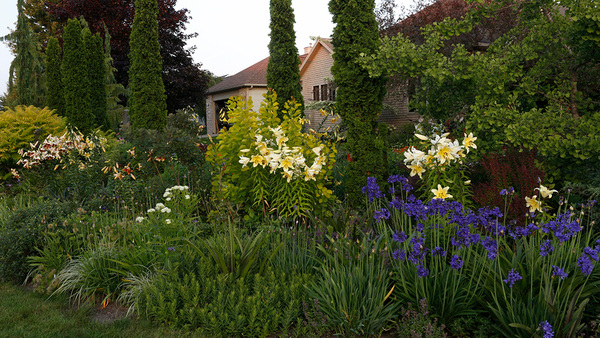
I think of myself as a purist, so when I started my perennial border some years ago, I wanted nothing but perennials. After all, I reasoned, a perennial border should contain only perennials, shouldn’t it? But, as time went by, I added several compatible shrubs to my garden and began calling it a mixed border. That new definition liberated me to add a few annuals. Even so, I felt a lot less conscience-stricken when I learned I wasn’t the first to use annuals in a perennial border. My gardening betters had paved the way long ago.
Ever since the introduction of the herbaceous border in the days when William Robinson and Gertrude Jekyll ruled most of the known horticultural world, it has been considered legal to fill in gaps in a perennial or mixed border with annuals. It is almost inevitable that dull areas—and even blank, empty spots—will occur in a perennial border as the summer wears on. Perennials with nothing to contribute but their blooms stop blooming. Then, there are those perennials that are subject to unsightly afflictions if the summer is too wet—or too dry.
Even when you carefully orchestrate the garden so that delicious combinations of color and texture will provide an ever-delightful symphony from early spring to late autumn, those annoying gaps will occur. Perhaps rabbits ate the blue star (Amsonia tabernaemontana) or deer the delphinium. Maybe the wildly changing spring weather did in some of the roses. Whatever the cause, your symphony has been deprived of important notes and, in some cases, whole themes. It’s then that you need annuals.
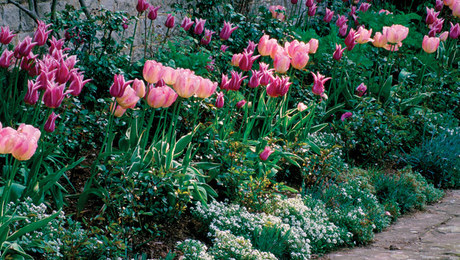
Subtle annuals look right at home in borders
Annuals, yes, but not just any old annuals. The solution won’t be found, unless you are amazingly lucky, in a few six-packs from your local garden center. Most annuals raised for “the trade” are bred for maximum impact. They are, shall we say, “assertive.” Their bold reds, bouncy yellows, and bright oranges are rarely compatible with the soft pastels of a typical perennial garden.
Instead, I look for annuals with more refined hues and, if possible, delicate—or, at least, attractive—foliage. These kinds of annuals are rarely found in garden centers, so I comb through seed and plant catalogs to find new candidates and old favorites, then raise those that I can from seed in early spring under lights. There are countless annuals to choose from, but I’ll discuss those I’ve grown and used in my own garden.
Blend yellows and blues into the border
One of the best annuals I’ve found for blending with other yellows in a border is a chrysanthemum, C. coronarium ‘Primrose Gem’, a 12- to 15-inch-tall plant with lacy foliage whose upright stems hold corymbs of small, soft yellow, semi-double daisies with gold centers. Fresh and lovely, they help carry the garden through the dog days of August. It’s hard to find a perennial with which it doesn’t harmonize.
Another yellow jewel is the Mexican tulip poppy (Hunnemannia fumariifolia). It’s not a very pale yellow, but the effect of its elegantly cut, silver leaves and its 3-inch, silky cups glistening in the sunlight, is one of delicacy and grace. Members of the poppy family don’t like to be moved, so plant their seeds in peat pots or directly in the ground early in May. Thin young plants to stand 7 to 8 inches apart.
Some blue annuals also look stunning and blend well in perennial borders. One spring I planted a flat of sky-blue Chinese forget-me-nots (Cynoglossum amabile). Their gray-green leaves and clouds of tiny, cobalt flowers were such a joy that I saved the seed and sprinkled it along the front of the border in the fall. The plants kept coming up all the next summer.
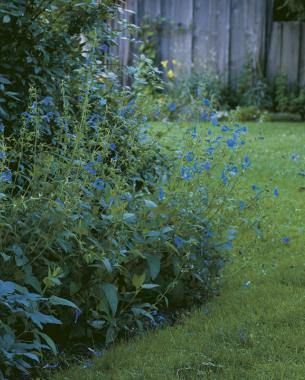
More and more salvias are finding their way into borders, and with good reason. I’m thinking of tender perennials or annuals such as blue mealycup sage (Salvia farinacea), a perennial in USDA Hardiness Zone 8 and south, but an annual in my Zone 5 garden. This branching, 18-inch plant bears never-ending spikes of purple-blue flowers. There are several named varieties, but the best of the lot is ‘Victoria’. Every year I also plant seed of gentian sage (S. patens), perhaps the bluest flower around. Even though it’s not hardy here and I have to gather seeds every autumn, gentian sage has earned a reserved section in my garden.
Other cooperative subjects that I’ve discovered include bachelor’s button (Centaurea cyanus); Tweedia caerulea, with its cerulean stars; and love-in-amist (Nigella damascena).
Some annuals are best at the edge of the border
Pinks (Dianthus spp.) shine at the very edge of the garden. You can find the cushion or taller (12- to 15-inch), tufted sorts in white, pink, and rose, either solids or bicolors, with either green or silvery, blue-gray foliage. Nearly all of them have a spicy fragrance. I think that the best cultivars are from the Ideal and Telstar series. They bloom in the first year from seed but behave otherwise like proper—though rather tender—biennials. They should get through at least a second season in areas where winters are not very severe. You can get seeds for separate colors. This summer I’m trying ‘Ideal Crimson’ and ‘Telstar Dark Purple’.
Having been dazzled by the sight of a sea of blue pimpernels (Anagallis monellii) growing gloriously amongst the gray rocks of the Kabylie Mountains in Algeria, I once tried them on the edge of my border. That summer we broke records for heat, humidity, and drought and my poor pimpernels pined away and died. However, they are most desirable plants, especially for gardeners searching for pure blue. A perennial in Zone 7 and south, it makes a 9-inch mound that will sit chummily amongst your clumps of pinks.
Great foliage earns these annuals their place
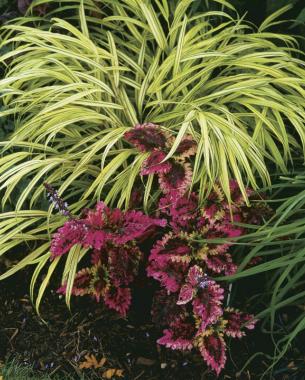
Annuals with good foliage contribute a lot to the perennial garden. I’ve devoted one section of my border to combinations of dark burgundy-red and chartreuse. I used a ruby-foliaged Japanese barberry (Berberis thunbergii ‘Atropurpurea Nana’), and the lovely Japanese forest grass (Hakonechloa macra ‘Aureola’), and enriched the area with annuals including a few sumptuous new coleus (Solenostemon spp.)—wine-colored ones such as velvety ‘Plum Parfait’ and ‘Mars’, a globe-shaped plant with short, maroon leaves. Coleus have come a long way since your grandmother grew those awful red and green things on her windowsill.
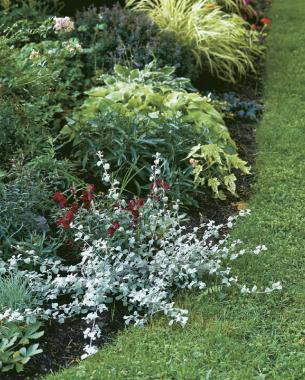
I had another new thrill when I planted a clump of non-hardy red fountain grass (Pennisetum setaceum ‘Rubrum’) against the wonderful gray annual, Plectranthus argentatus, actually a shrub that is hardy in Zone 10.When the grass produced its fluffy, buff-colored flowers, and the tender perennial Salvia microphylla ‘Trinidad Pink’ on its right covered itself with small rosy blossoms, I thought that I’d been very clever indeed. I shouldn’t have been so smug-I failed to give the plectranthus enough room and it squashed another salvia completely. It needs an area 2-1/2 feet tall and wide.
I also used licorice plant (Helichrysum petiolare) last summer. The ordinary silver one, placed in the front of the border, made a stunning companion for a dark-foliaged snapdragon (Antirrhinum majus ‘Black Prince’).
Annuals look best as part of a repeating theme
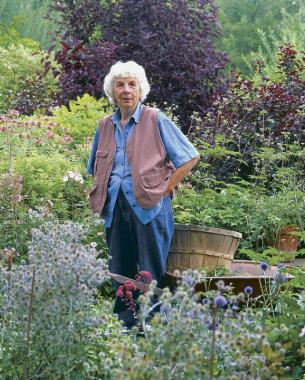
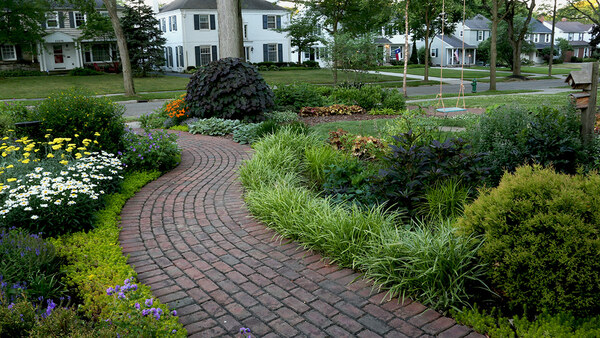
The real challenge of using these temporary tenants of the perennial border is placing them effectively in established plantings. I try to combine color, form, and texture of both annuals and perennials felicitously, keeping in mind rule number one of any successful composition, whether it’s a novel, a painting, a piece of music, or a garden—repetition of theme.




Comments
Log in or create an account to post a comment.
Sign up Log in