

All About Growing Coleus
Choose from colorful trailing, medium-, or large-size plants to add pizzazz to containers and borders
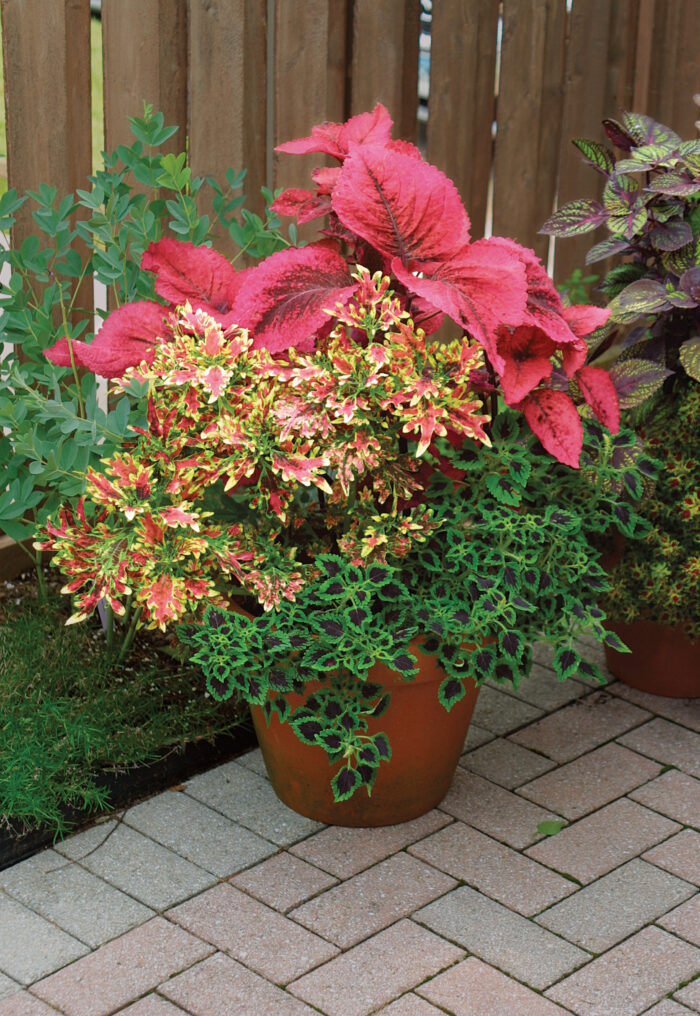
I never intended to grow coleus (Solenostemon scutellarioides, USDA Hardiness Zone 11). In fact, when a friend gave me my first three plants, I tried not to like them. I was already overwintering far too many tender tropicals. Who could be bothered with another one as frivolous as coleus?
Many years and several hundred seedlings, sports, and cultivars later, I admit that the cold shoulder I tried to give coleus was a hoax. In truth, it was love at first sight. What’s not to love about a genus that produces colors from gentle butter yellow to shocking magenta, with leaves that range in shape from simple ovals to frilly triangles—especially when coleus plants are so easy to grow that each pot should bear the slogan, “Just add water”? In fact, with the wide range of selections available, the most difficult part of growing coleus is choosing one.
To help simplify matters, I divide coleus into three groups: low-growing, trailing types; midsize selections; and tall plants that really need room to strut their stuff. While the size of coleus can vary depending on soil fertility, their habits work well in borders or containers. I like to use them as color echoes or as contrasts to perennials, choosing just the right shade to blend with a daylily’s bloom or to accent the dramatic golden edge of an ornamental grass. By selecting from the three different categories, I can find the right coleus plants to balance my container designs. Sometimes I plant pots with nothing but coleus, trusting their contrasting textures and colors to provide plenty of excitement.
Trailers soften edges
|
|
|
|
|
|
|
|
|


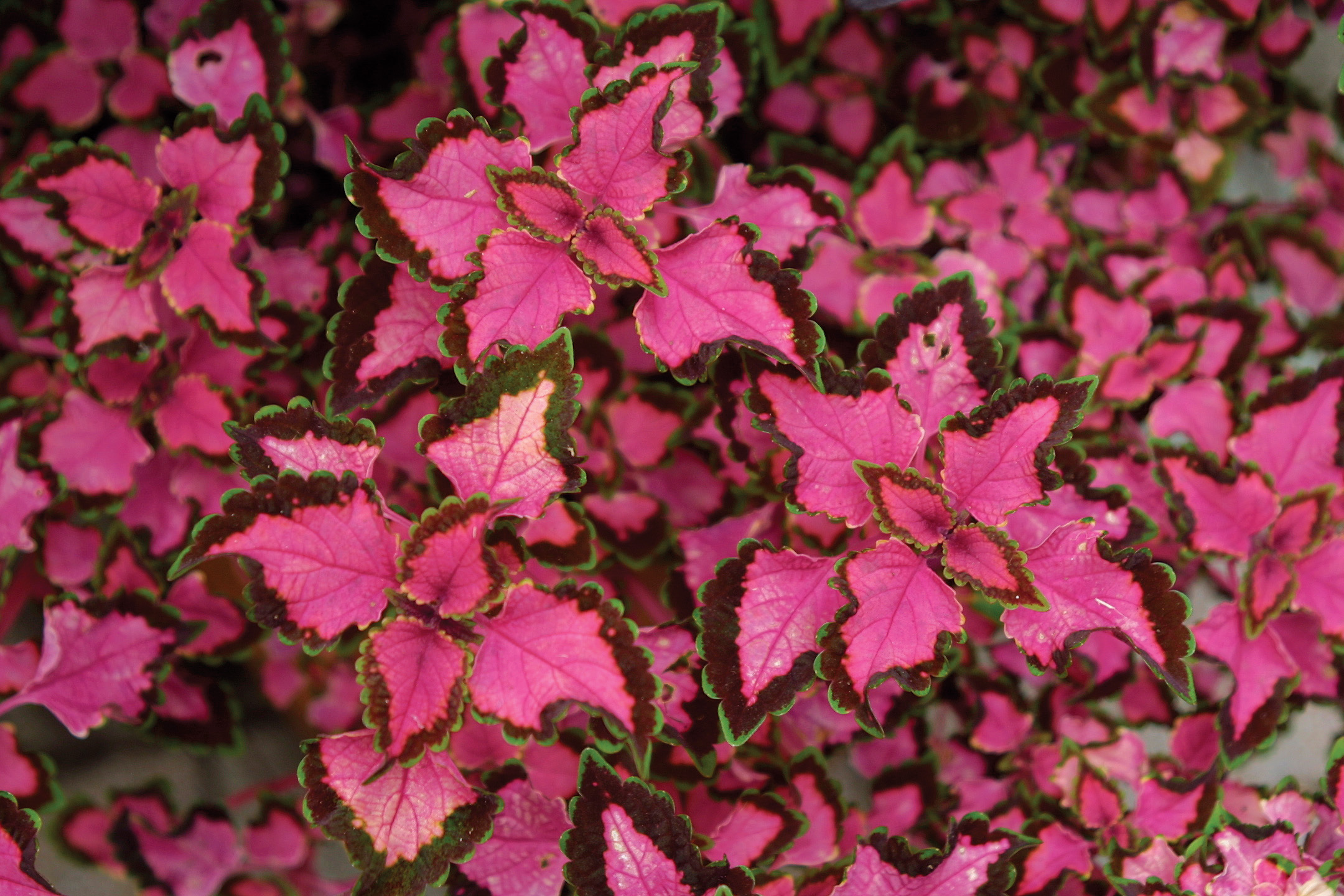


Trailing coleus tend to have leaves that are only an inch long, and the plants typically grow 12 to 18 inches tall. They are custom-made for using in containers or for softening the front edge of a border. As basic as a black dress, 15-inch-tall ‘Red Trailing Queen’ bedecks herself from head to toe—or, rather, from leaf to stem—in regal burgundy. Her simple oval leaf shape and straightforward color complement most shades, except blue and true purple. The subtle strength of the coleus’s burgundy foliage strikes a balance with soft pinks or pale yellows as well as bright fuchsias or bold oranges.
‘Meandering Linda’, a close cousin of ‘Red Trailing Queen’, grows 16 inches tall and bears crinkly, chocolate-purple leaves banded in rich raspberry-pink, with touches of cream along the edges. It makes a scrumptious duo with anything silver, especially the elegant silver-white foliage of dusty miller (Centaurea cineraria ‘Colchester White’, Zones 7–11). ‘Meandering Linda’ appears to be a sport of ‘Red Trailing Queen’, and if planted in less than half-day sun, it sometimes reverts to its plain burgundy form. The 14-inch-tall cultivar ‘Trailing Bleeding Heart’ also appears to descend from the ‘Queen’. Its hot fuchsia-pink leaves are ringed with purple and a band of lime green. It makes a good match for my favorite pink yarrow, Achillea millefolium ‘Montrose Rose’ (Zones 3–9).
‘Trailing Salamander’, which grows 14 inches tall, offers oval, near-black leaves edged in bright lime. Its neutral color scheme makes it a choice filler for containers. Like ‘Red Trailing Queen’, it looks good with almost anything. My favorite match is with black-and-green ‘Illustris’ elephant ear (Colocasia esculenta ‘Illustris’, Zones 7–11). If a red coleus suits your color scheme, you have to try ‘Ruby Ruffles’, whose frilly, fingery foliage bears ruby centers and chartreuse edges, a color scheme many daylilies echo. Planting 12-inch-tall ‘Ruby Ruffles’ with gold-variegated pigeonberry (Duranta erecta ‘Golden Edge’, Zones 9–11) and deep red Texas sage (Salvia coccinea ‘Spanish Dancer’, Zones 9–11) also makes for a winning tropical combo.
Don’t be fooled by the textural delicacy of trailing coleus. Except for the relatively compact ‘Ruby Ruffles’, these are vigorous plants that spread 2 feet or more in a growing season and like to weave through their neighbors. Keep them away from dainty, low-growing treasures such as easily smothered mats of perennial pinks (Dianthus spp. and cvs., Zones 3–10), but don’t be afraid to combine them with larger annuals, perennials, and shrubs. Any trailing coleus also makes a great warm-season ground cover. For quick coverage, plant them 12 inches apart.
These midsize coleus are good for filling gaps
|
|
|
|
|
|
|
|
|


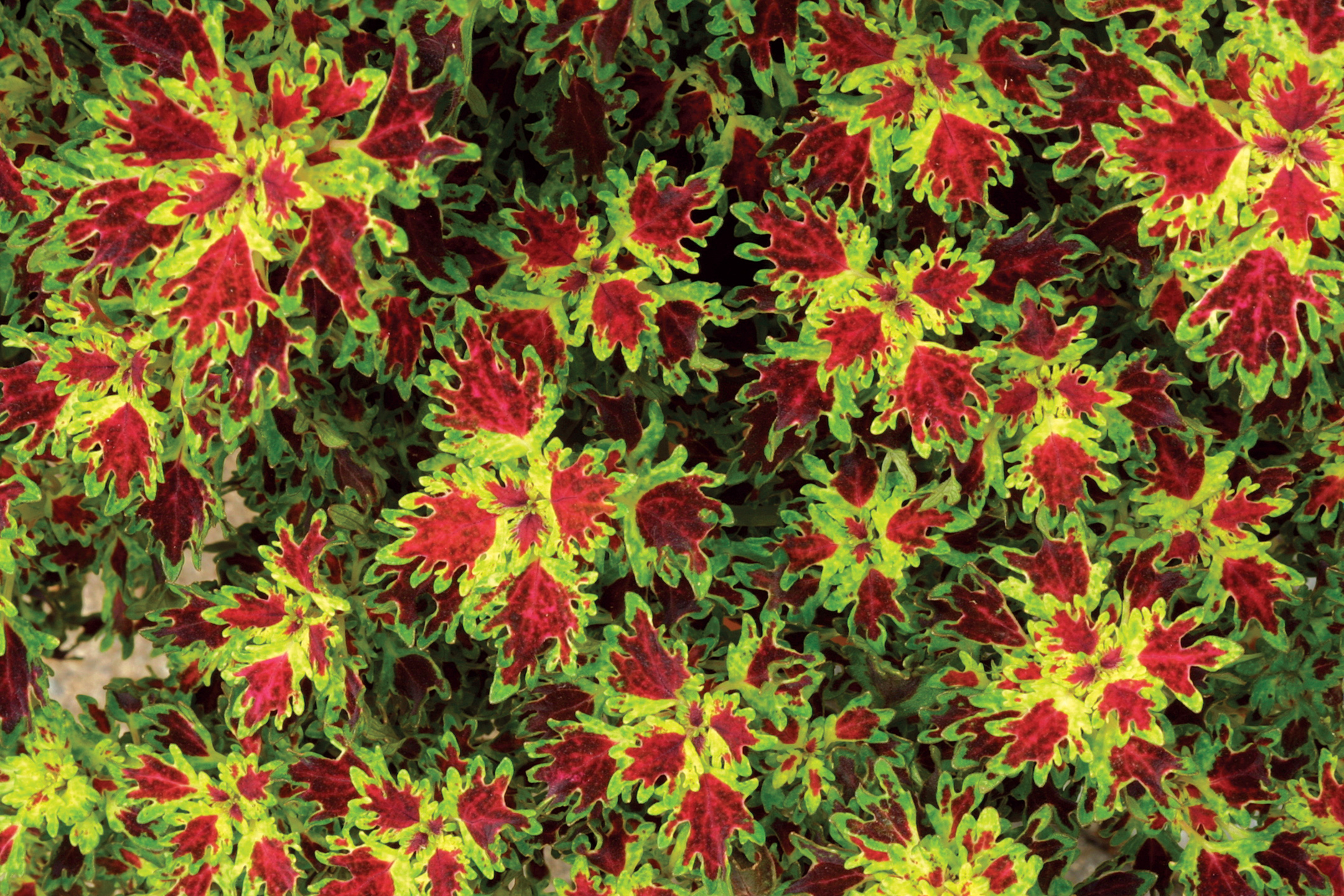
Midsize coleus, 18 to 25 inches in height, are frequently several inches wider than they are tall, and they have short internodes, which makes for bushy, dense-looking plants. Unlike trailers, these coleus tend to keep to themselves, forming tight mounds of foliage.
The simple, indigo-purple leaves of ‘Dark Star’ draw all eyes to its inky depths. Create a starkly dramatic composition by contrasting its color-saturated foliage with white flowers or silver foliage. I also like to use the 20-inch-tall ‘Dark Star’ to emphasize the “blueness” of certain blossoms, such as wild petunias (Ruellia brittoniana and cvs., Zones 7–10) or blue-violet Verbena × hybrida ‘Blue Princess’ (Zones 7–11).
‘Amazon’ is as different from ‘Dark Star’ as night is from day. Its ruffly chartreuse leaves glow like fireflies after dusk. It is, without a doubt, the best coleus of this shade that I have ever grown. Even in the scorching midsummer sun, ‘Amazon’ neither burns nor develops the russet streaks common in other chartreuse coleus. Strong stems and a full look make 24-inch-tall ‘Amazon’ a Top 10 plant, one I love to combine with green-and-gold variegated shell ginger (Alpinia zerumbet ‘Variegata’, Zones 8–11). ‘Swallowtail’ puts on a fantastic display of texture and color. Its rippled and deeply scalloped leaves are a remarkable lemon yellow, with a lettuce-green-and-wine-red river flowing through the center of each one. Four-foot-tall Salvia vanhouttei (Zones 10–11) looks magnificent dangling its burgundy blossoms over 24-inch-tall ‘Swallowtail’.
Having trialed hundreds of new coleus seedlings, I can safely say that ‘Little Twister’ is one of my best finds. I love its crimped, fingery leaves that emerge inky purple, then gradually change to predominantly yellow with lime edges and purple veins. Its 20-inch-long, deep purple stems and compact growth make ‘Little Twister’ a fabulous component of mixed containers.
If too many of your favorite flowering plants have plain, rounded leaves, contrast their simple texture with the visual equivalent of a garden explosion: 25-inch-tall ‘New Hurricane’. Picture its fiery, red-and-yellow foliage, as intricately cut as paper snowflakes, mingling with mounds of black-eyed Susans (Rudbeckia spp. and cvs., Zones 3–11), simmering next to ‘Autumn Joy’ stonecrop (Sedum ‘Autumn Joy’, Zones 3–11), or backed by mounds of burgundy fountain grass (Pennisetum setaceum ‘Rubrum’, Zones 8–11).
Tall, upright coleus are best as backdrops
|
|
|
|
|
|
|
|
|
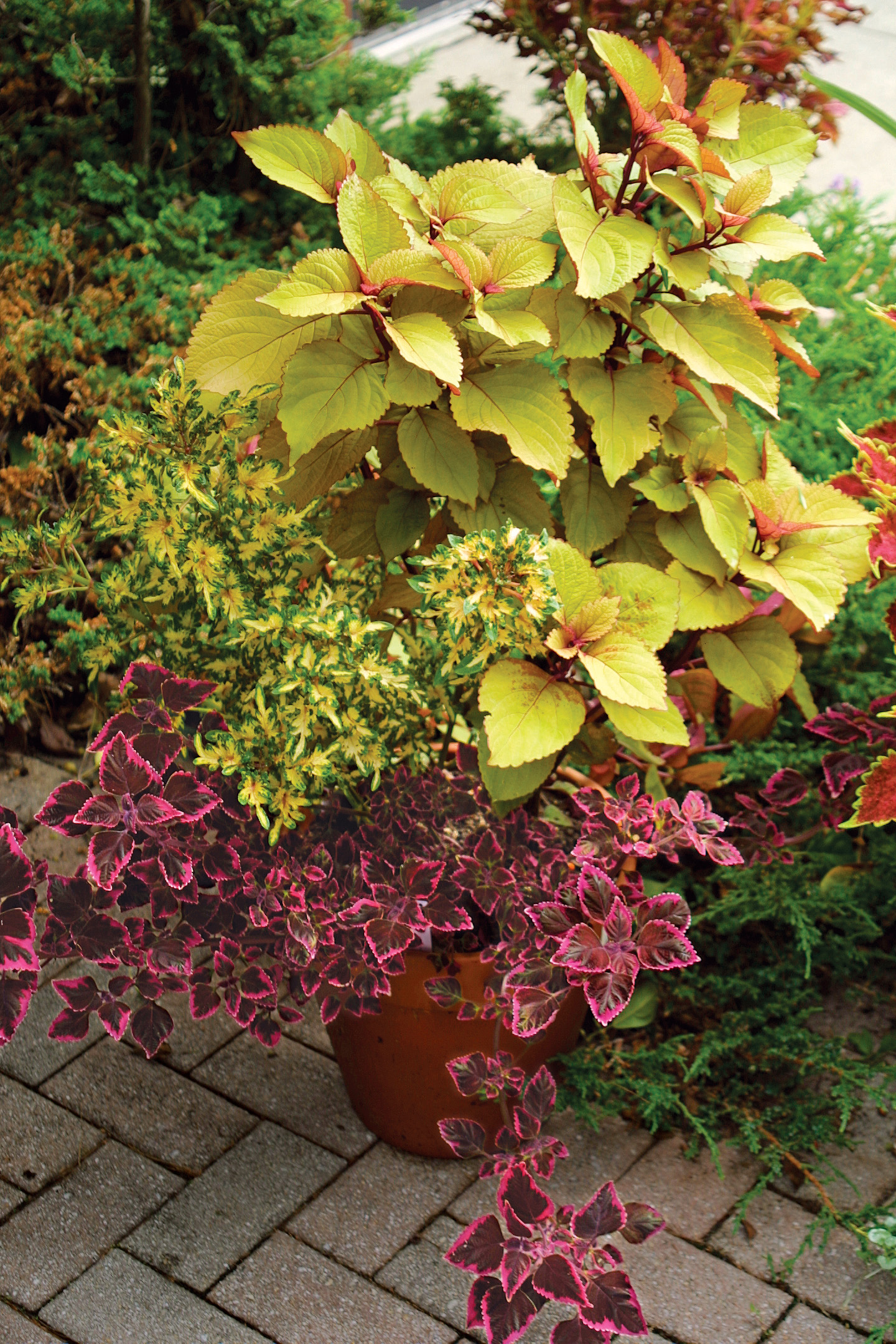

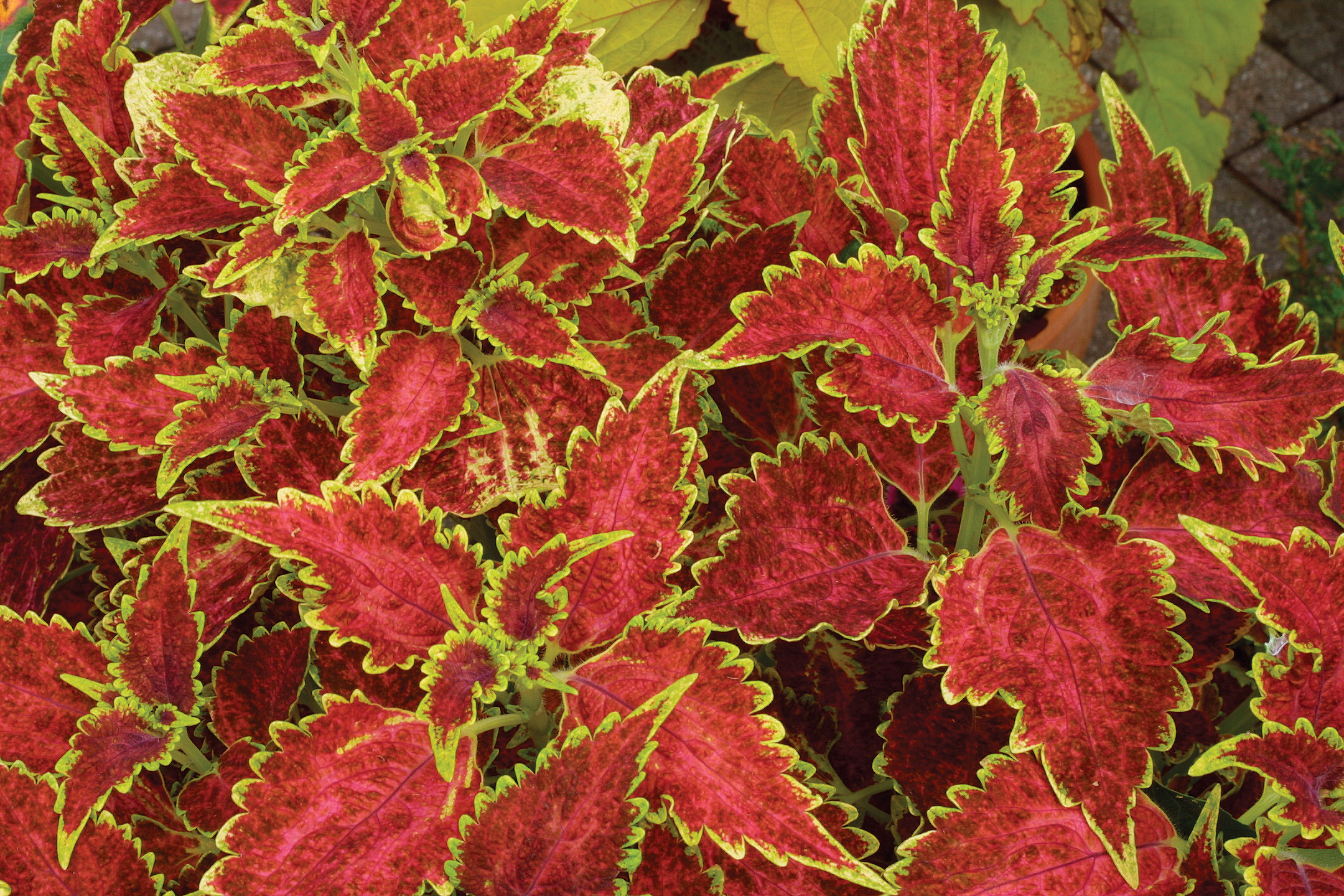


Lofty coleus plants that reach more than 25 inches in height make up my third category. These tend to be taller than they are wide and have an ambitiously upright look. The biggest, most eye-catching coleus I have ever grown is 32-inch-tall ‘Mariposa’. Its huge, 6- to 8-inch-long leaves drape downward, allowing a clear view of their magnificent crimson-pink color. A single plant makes an imposing specimen, which I like to grow with the marbled pink-and-cream leaves of snowbush (Breynia disticha ‘Roseopicta’, Zones 9–11) and variegated sweet potato vine (Ipomoea batatas ‘Pink Frost’, Zone 11).
For a different shade of pink, consider ‘Candy Store’, whose leaves bear blocks of raspberry-pink, sour apple, grape, and cream soda. I love its extravagant color patterns, and 28-inch-tall ‘Candy Store’ also has near-perfect form: a lovely, rounded shape and short internodes that make for strong stems thick with foliage. In containers, the black cherry blossoms of one of my favorite vines, Allamanda ‘Cherries Jubilee’ (Zones 10–11), look wonderful combined with ‘Candy Store’. In the perennial border, regal lily (Lilium regale, Zones 4–7) is a great companion.
At a glance, you might call 26-inch-tall ‘Vulcan’ simply red, but if you look closely, you’ll see that its colors are far more complex: crimson with an undercurrent of reddish rose, enhanced by brushes of black that heighten the richness of its crimped, puckered leaves. A defining edge of lemon yellow causes the leaves to stand out from one another instead of blurring into a solid mass of color. ‘Vulcan’ makes such a dramatic statement that a single plant can carry a scene for the entire season. Use it to brighten a dull stretch of spring-blooming plants when the main show is over, or combine ‘Vulcan’ with asters (Aster spp. and cvs., Zones 4–8) and mums (Chrysanthemum cvs., Zones 4–9) that have little to say until late summer.
‘Orange King’ illustrates one of the loveliest characteristics of coleus, their ability to glow like stained glass when struck by sunlight. On a dull day, I’d describe ‘Orange King’ as parchment gold, not orange. Add sunshine, though, and miraculously the entire plant takes on a warm, orange glow. I like growing 26-inch-tall ‘Orange King’ with 4-foot-tall Salvia splendens ‘Paul’ (Zones 10–11), whose wine-purple flowers and bracts match the coleus’s dark stems and leaf undersides.
While it’s not unusual for a coleus to have leaf veins etched in dark ink, I have never seen one with such vivid lime green leaves and strong veining as ‘Fishnet Stockings’. Inky black lines extend throughout the foliage, tracing the pattern of each and every vein. The leaves are neatly notched along the edges, which are also outlined in black. My favorite combo? Take ‘Trailing Salamander’ coleus and ‘Illustris’ elephant ear, add 28-inch-tall ‘Fishnet Stockings’, and you have a dynamite black-green trio. In fact, anywhere you need to spice things up, ‘Fishnet Stockings’ is a sure bet.
It’s hard not to love coleus—believe me, I’ve tried. Fast-growing and full of color from spring planting to fall frost, these plants perform like fireworks on the Fourth of July, from Milwaukee to Miami to Malibu. It’s no wonder they’ve been popular plants in American gardens since the 1850s. Judging by the new seedlings I’ve been finding, I predict they’ll continue to be popular for many years to come.
Coleus
Solenostemon scutellarioides cvs.
(sol-en-oh-STEM-on skoot-el-lar-ee-OY-deez)
Origins: Coleus are native to Southeast Asia. There are hundreds of cultivars available, in a wide range of colors, sizes, and leaf shapes.
Conditions: Coleus are tender tropicals that are generally grown as annuals because they are hardy only in USDA Hardiness Zone 11. They like warm soils with decent drainage. They are not happy in overly dry conditions. Coleus will grow in full sun to medium shade, but their colors are most vivid in full sun. Half-day sun produces softer colors that are still very appealing.
Fertility: Coleus heights can vary, sometimes widely, depending on the soil-fertility level or the amount of fertilizer being applied. Because coleus colors are richest when plants are not overfed, I recommend maintaining a moderate level of nutrients.
Propagation: Coleus are easy to grow from cuttings. Wait to put plants outdoors until spring nights remain above 50°F. I give midsize plants and trailing types 18 inches of space. Larger coleus get 2 feet if I can spare it; if not, I confine them to the available area with judicious pruning.
Maintenance: Pinch stem tips if you want to control height and increase bushiness. Remove flower shoots as they appear unless you want to collect seed. To overwinter coleus, root stem cuttings before autumn nights drop below 50°F and keep cuttings in a sunny window at temperatures above 60°F all winter.
Pests and diseases: Coleus pests and diseases are rare in my garden, but I sometimes find mealybugs, spider mites, or aphids on overwintered plants.



Comments
is there such a thing as a master list of public domain or heirloom coleus that i am free to propagate and give away ir sell?
are sports and seeds free from patented varieties?
My coleus started wilting and breaking off. Any ideas why?
Log in or create an account to post a comment.
Sign up Log in