
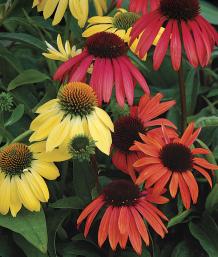
By now, most gardeners have heard of the color explosion that is happening with echinaceas (Echinacea spp. and cvs.). Plants that once only displayed purple- and rose-colored blooms are now strutting their stuff in shades of orange, yellow, white, and even green. Since the development of these new hues, it seems the common name, purple coneflower, no longer applies. Among the rising stars is a group of new echinaceas that belong to the Big Sky™ series (USDA Hardiness Zones 4–9).
Not derived from the magical workings of prairie gnomes nor the birds, bees, or butterflies, the Big Sky™ series comes to us through the breeding efforts of Richard Saul of ItSaul Plants in Atlanta, Georgia. The classic purple coneflower (E. purpurea) is the predominant parent, but the yellow-flowering Ozark prairie native coneflower (E. paradoxa) is responsible for the wonderful new flower colors.
There are currently five members of the Big Sky™ series, all of which are sweetly scented. The 36-inch-tall ‘Sunrise’ was the first, and immediately won gardeners over with its sprightly reflexed, citrus yellow petals. Next came ‘Sunset’, which features vibrant salmon-orange petals and a prominent brown cone on 30-inch-tall stems. Then the 24-inch-tall ‘Twilight’ jumped on board, offering a stunning red cone surrounded by rose petals. ‘Matthew Saul’, also known as Harvest Moon™, marched on to the scene next with bright golden petals and a golden orange cone reaching 30 inches tall. Last, but certainly not least, is the latest introduction ‘Evan Saul’, commonly referred to as Sundown™. Reaching 36 inches in height, this coneflower has unforgettable orange-red petals and a deep red cone.
These wonderful hybrids have all inherited the large green leaves, strong branching stems, wide flower petals, and profuse blooming tendencies of E. purpurea. Once they become established, they are fairly drought tolerant—even in hot, windy conditions. They do their best in full sun and average, well-drained garden soil, and they bloom from midsummer until early fall with deadheading.
Favored by the butterflies and bees in summer, the flowers produce attractive seed heads that are a valuable food source for small birds in winter. Like the “old-fashioned” purple coneflowers, the members of the Big Sky™ series make superb cut flowers and are great in formal borders, cottage gardens, naturalized meadows, and containers. Just be sure to place them close enough to where you can enjoy their fragrance as it wafts by on a summer breeze.






Comments
The colors in this series are amazing. If you have trouble making up your mind, you will have a panic attack with this series. Too much beauty.
Log in or create an account to post a comment.
Sign up Log in