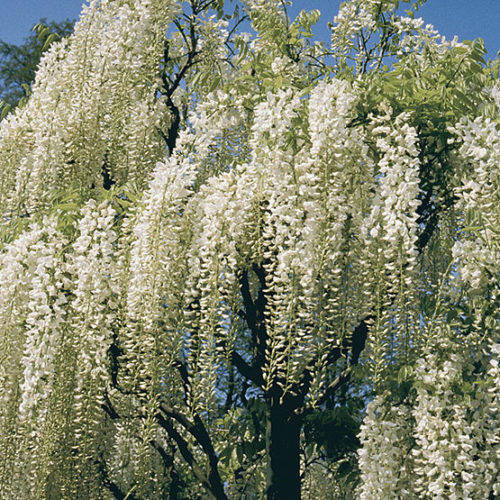
Wisteria floribunda (Japanese wisteria)

Wisteria floribunda Wisteria floribunda Photo/Illustration: Peter Lindtner

(Based on 1 user review)

Rate this plant

Plant Showcase - from our advertisers


Hardiness Zones: 1 2 3 4 5 6 7 8 9 10 11
Botanical Name: Wisteria floribunda wis-TEER-ee-ah floor-ih-BUN-dah Common Name: Japanese wisteria Genus: Wisteria
Dramatic clusters of blue-violet to red-violet flowers with an intoxicating fragrance grace this vigorous twining climber. Its springtime cascading flower clusters can grow to 3 feet long or more in some cultivars. Blooms typically open first at the base and last at the tip of each cluster. Trunk diameter can reach 7 to 8 inches after 20 years, and the plant can climb to 35 or more feet in height, though its size is easily contolled by pruning.
Care: Provide rich, well-drained soil with plenty of space. Wisteria needs strong support and can be trained as a tree, vertically on a wall or arbor, or horizontally on the ground. Growth can be restricted to a few limbs or allowed to spread vigorously to completely cover a wall. Early blooms can be damaged by freezing temperatures. Prune as needed when growth is active, but ideally in early, mid- and late summer. Can be difficult to get to bloom.
Propagation: Not practical for most home gardeners.
Problems: Dieback, crown gall, leaf spots, viral diseases, Japanese beetles, aphids, leaf miners, scale insects, and mealybugs.
Height 15 ft. to 30 ft.
Growth Habit Spreads
Growth Pace Fast Grower;Invasive/Aggressive Grower
Light Full Sun to Part Shade
Moisture Medium Moisture
Maintenance Moderate
Characteristics Attracts Hummingbirds; Fragrant Flowers; Showy Flowers; Showy Foliage
Bloom Time Spring
Flower Color Blue Flower; Purple/ Lavender Flower
Uses , Specimen Plant/ Focal Point, Trellis
Style , Cottage Garden, Formal Garden
Seasonal Interest , Spring Interest, Summer Interest
Type ,Vines

Plants you might also like

Clematis macropetala Clematis macropetala
(Downy clematis)
(1 user review)
Hardiness Zones: 1 2 3 4 5 6 7 8 9 10 11

Downy clematis is a hardy, deciduous early bloomer that can flourish in Zone 4. The species will climb to 10 feet with a little support, and it has bell-shaped, purple-blue, almost columbine-like flowers about 1 to 2 inches, sometimes up to 4 inches in diameter, that mature to fluffy, pinkish seed heads. Blooms appear in spring and early summer, sometimes followed by a second flush in late summer to early autumn

Clematis ‘Nelly Moser’ Clematis ‘Nelly Moser’
(2 user reviews)
Hardiness Zones: 1 2 3 4 5 6 7 8 9 10 11

'Nellie Moser' is easy to grow, producing large, flat flowers 6 to 8 inches in diameter with distinctive, gleaming lilac bars on each petal. This clematis blooms from May to late June, with a second, less profuse bloom in mid-August. Planted in a shady spot, the cheery pink-and-mauve-striped blossoms last for weeks instead of days.

no image available Lonicera japonica
(Japanese honeysuckle)
(1 user review)
Hardiness Zones: 1 2 3 4 5 6 7 8 9 10 11

This vigorous, woody evergreen or semi-evergreen trailing vine has dark green leaves to 3 inches long. Tubular, two-lipped, fragrant white flowers are sometimes flushed with purple, aging to yellow. Blooms appear from spring to late summer. Flowers mature to blue-black fruit.

no image available Clematis alpina
(Alpine clematis)
(1 user review)
Hardiness Zones: 1 2 3 4 5 6 7 8 9 10 11

Alpine clematis is one of the earliest clematises to bloom, in early May. It bears relatively small but delightful nodding, bell-shaped flowers, 1 to 1.5 inches in diameter, in a great variety of colors.

Lonicera sempervirens Lonicera sempervirens
(Coral honeysuckle, Trumpet honeysuckle)
Be the first to rate this plant
Hardiness Zones: 1 2 3 4 5 6 7 8 9 10 11

This woody, twining climber has two-lipped, tubular scarlet-orange flowers, yellow inside, in terminal whorls in summer and autumn. Bright red fruit appears in autumn.