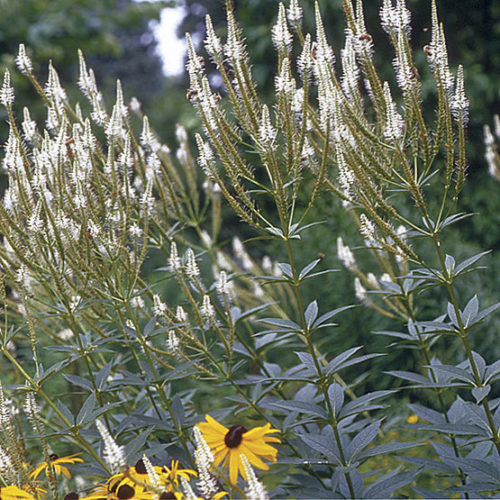
Veronicastrum virginicum (Culver's root, Bowman's root)

Veronicastrum virginicum Photo/Illustration: Barbara Blossom Ashmun


Be the first to rate this plant

Plant Showcase - from our advertisers


Hardiness Zones: 1 2 3 4 5 6 7 8 9 10 11
Botanical Name: Veronicastrum virginicum ver-on-ih-KAS-trum ver-JIN-ih-kum Common Name: Culver's root, Bowman's root Synonyms: Veronica virginica Genus: Veronicastrum
This species has multiple tapering, soft spikes of white to pale pink or bluish purple flowers that look like elegant, living candelabras. The blooms reach 4 feet or more, adding a vertical accent to the back of a mixed border or wild garden from mid-summer to early autumn. Plants spread to about 3 feet.
Noteworthy characteristics: Culver's root's lance-shaped, whorled leaves are deep green and remain attractive through the season. It is a widespread native of eastern North America, occurring in prairies, meadows, open woodlands, and grassy mountains. 
Care: Provide moderately fertile, moist soil in full sun or partial shade. 
Propagation: Sow seed in a cold frame in autumn; divide in spring or fall.
Problems: Downy mildew, powdery mildew, leaf spot.
Height 3 ft. to 6 ft.
Spread 1 ft. to 3 ft.
Growth Habit Clumps
Growth Pace Moderate Grower
Light Full Sun to Part Shade
Moisture Medium Moisture
Maintenance Low
Tolerance Frost Tolerant
Characteristics Attracts Butterflies; Native; Showy Flowers
Bloom Time Early Summer; Late Summer; Summer
Flower Color Blue Flower; Pink Flower; Purple/ Lavender Flower; White Flower
Uses , Beds and Borders, Naturalizing
Style , Herb Garden, Cottage Garden, Meadow Garden, Woodland Garden
Seasonal Interest , Summer Interest

Type ,Perennials

Plants you might also like

Echinacea purpurea Echinacea purpurea
(Purple coneflower)
(2 user reviews)
Hardiness Zones: 1 2 3 4 5 6 7 8 9 10 11

Because of its carefree performance, this native meadow perennial with daisy-like flowers appropriately inhabits the gardens of many. It blooms from midsummer into early autumn, with prominent, copper-orange central cones surrounded by rose-purple, ray petals (to 5 inches across).

Salvia pratensis Salvia pratensis
(Meadow clary)
Be the first to rate this plant
Hardiness Zones: 1 2 3 4 5 6 7 8 9 10 11

This woody-stemmed perennial produces sticky spikes of deep violet or, rarely, white to pink flowers. It blooms from early summer to autumn; reblooming is most reliable if spent flowers are deadheaded promptly. It has wrinkled leaves and forms an upright clump 3 feet tall by 1 foot wide. This salvia is most noted for its many hybirds with S. nemerosa.  

Eupatorium purpureum Eupatorium purpureum
(Joe Pye weed)
Be the first to rate this plant
Hardiness Zones: 1 2 3 4 5 6 7 8 9 10 11

Large, domed flowerheads of pink, light purple, or off-white add soft color and texture to the summer and fall garden. The leaves are purple-tinged on thick stems suffused with maroon. This eastern U.S. native attracts butterflies from mid-summer to early fall.

Echinacea purpurea 'Kim's Knee High' Echinacea purpurea 'Kim's Knee High'
(Purple coneflower)
(3 user reviews)
Hardiness Zones: 1 2 3 4 5 6 7 8 9 10 11

This native meadow derivative is a compact version of the species. It blooms from midsummer into early autumn, with prominent, copper-orange central cones surrounded by drooping, rose- or purple-pink ray petals. It will reach 24 inches if not cut back.

Echinacea purpurea 'Magnus' Echinacea purpurea 'Magnus'
(Purple coneflower)
(12 user reviews)
Hardiness Zones: 1 2 3 4 5 6 7 8 9 10 11

This native meadow derivative has vibrant, daisy-like flowers that bloom from midsummer into early autumn. Its prominent, dark orange central cones are surrounded by larger (to 7 inches across) and more horizontal, reddish-pink, ray petals than the species.