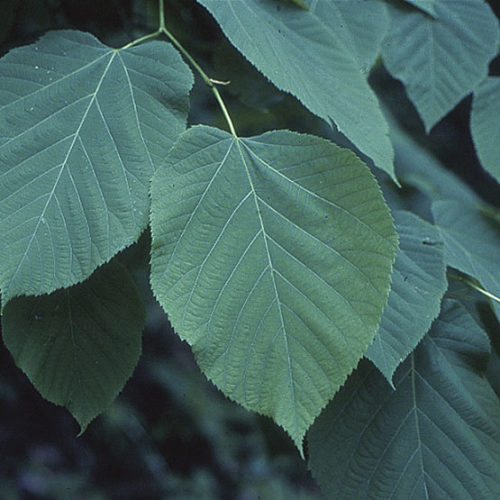
Tilia americana (American linden, Basswood)

Tilia americana Photo/Illustration: Michael Dirr


Be the first to rate this plant

Plant Showcase - from our advertisers


Hardiness Zones: 1 2 3 4 5 6 7 8 9 10 11
Botanical Name: Tilia americana TIL-ee-ah ah-mer-ih-KAH-nah Common Name: American linden, Basswood Genus: Tilia
This deciduous tree with dense foliage and a stately habit produces hanging clusters of fragrant yellow flowers in mid-summer. It grows in a broadly columnar shape and has dark green leaves that are glossy underneath. Basswood makes a good specimen or street tree, although it doesn't tolerate pollution. It can grow as tall as 80 feet with a width of 50 feet. It attracts bees; basswood honey is a sought-after gourmet food.
Noteworthy characteristics: Fragrant flowers and dense foliage.
Care: Provide moist but well-drained soil in full sun or part shade. Protect from very dry conditions and strong winds. It prefers alkaline to neutral soil, but can tolerate acidic soil.
Propagation: Sow seed as soon as ripe in a seedbed in fall. Or stratify for several months and sow in spring in a cold frame. (Garden-collected seed may yield hybrids of variable quality.)
Problems: Anthracnose, butt rot, canker, powdery mildew, bacterial leaf spot, caterpillars (including gypsy moth larvae), lace bugs, aphids, borers, Japanese beetles, mites. Verticillium wilt is infrequent, but fatal.
Height Over 30 ft.
Spread Over 30 ft.
Growth Pace Moderate Grower
Light Full Sun to Part Shade
Moisture Medium Moisture
Maintenance Moderate
Characteristics Attracts Butterflies; Fragrant Flowers; Showy Flowers; Showy Foliage; Showy Fruit
Bloom Time Summer
Flower Color Yellow Flower
Uses , Roadside, Specimen Plant/ Focal Point
Style , Woodland Garden
Seasonal Interest , Summer Interest
Type ,Trees

Plants you might also like

no image available Magnolia denudata 'Forrest's Pink'
(Lily tree, Magnolia, Yulan)
Be the first to rate this plant
Hardiness Zones: 1 2 3 4 5 6 7 8 9 10 11

This cultivar creates a fragrant cloud of rich bubblegum-pink blossoms on bare branches in spring. It grows to 40 feet tall and wide.

Rhus typhina 'Tigereye Bailtiger' Rhus typhina 'Tigereye Bailtiger'
(Tiger eyes sumac, Staghorn sumac, Velvet sumac)
(1 user review)
Hardiness Zones: 1 2 3 4 5 6 7 8 9 10 11

Lemon-lime foliage, fuzzy stems, and intense fall color make this sumac cultivar a standout. It grows into an upright, rounded form about 6 feet tall and as wide. New growth emerges chartreuse. Fall brings leaves of yellow, scarlet, and orange. Flowers are yellowish green and followed, on female plants, by hairy, dark red fruit. This plant spreads by suckers and can be invasive. The species is native to North America.

Prunus virginiana 'Schubert' Prunus virginiana 'Schubert'
('Schubert' choke cherry)
Be the first to rate this plant
Hardiness Zones: 1 2 3 4 5 6 7 8 9 10 11

'Schubert' choke cherry, with its vivid foliage and pyramidal form, makes a fine focal point. Ephemeral, light pink flowers are followed by abundant, dark red-purple fruit that birds love. (Don't plant it near patios or walks, as they'll quickly be covered by bird droppings.) If the tree you buy isn't grafted onto nonsuckering rootstock; otherwise, suckers could become problematic as the years go by.

Viburnum prunifolium Viburnum prunifolium
(Blackhaw Viburnum)
Be the first to rate this plant
Hardiness Zones: 1 2 3 4 5 6 7 8 9 10 11

Blackhaw Viburnum is a large shrub or small tree with clusters of creamy white flowers followed by pink-rose berries, which birds love to eat. Its distinctive bronze-green foliage on reddish purple stems turns blue-black in the fall. Blackhaw grows to 12 to 15 feet high and 8 to12 feet wide.

Acer rubrum ‘Red Sunset’ Acer rubrum ‘Red Sunset’
(Red maple, Scarlet maple)
Be the first to rate this plant
Hardiness Zones: 1 2 3 4 5 6 7 8 9 10 11

This is a rounded to open-crown deciduous tree up to 70 feet tall and 30 feet wide with early, brilliant red fall coloring.