previous
  • Thoughts From a Foreign Field
    Thoughts From a Foreign Field
  • Slideshow: Beautiful Clematis
    Slideshow: Beautiful Clematis
  • 6 Tips for Weed Control
    6 Tips for Weed Control
  • Stylish Shady Containers
    Stylish Shady Containers
  • Pretty in Pink
    Pretty in Pink
  • Designing with Curved Terraces
    Designing with Curved Terraces
  • Homegrown / Homemade
    Homegrown / Homemade
  • Indeterminate or Determinate Tomatoes?
    Indeterminate or Determinate Tomatoes?
  • Plants that Spark!
    Plants that Spark!
  • Plant an Easy-to-Water Strawberry Jar
    Plant an Easy-to-Water Strawberry Jar
  • Mulch for a Healthy Garden
    Mulch for a Healthy Garden
  • NEW Video Series: There's a Better Way
    NEW Video Series: There's a Better Way
  • Make a Succulent Topiary
    Make a Succulent Topiary
  • Elephant's Ears
    Elephant's Ears
  • Containers as Focal Points
    Containers as Focal Points
  • Fragrant Plants for Pathways
    Fragrant Plants for Pathways
  • Building a Compost Bin
    Building a Compost Bin
  • Save Money by Growing Your Own
    Save Money by Growing Your Own
  • Lawn Alternatives
    Lawn Alternatives
  • Fast-Growing Trees for Impatient Gardeners
    Fast-Growing Trees for Impatient Gardeners
  • In Pursuit of the Perfect Potting Shed
    In Pursuit of the Perfect Potting Shed
  • Comfortable Alfresco Dining
    Comfortable Alfresco Dining
  • Colorful Selections for Shade
    Colorful Selections for Shade
  • Garden Confidential: A Plant Walks into a Bar
    Garden Confidential: A Plant Walks into a Bar
  • Dwarf Citrus Trees
    Dwarf Citrus Trees
next

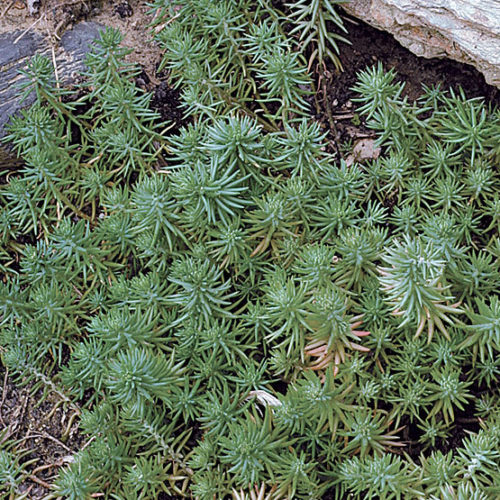
Sedum rupestre (Rocky stonecrop, Stone orpine)

Sedum rupestre Photo/Illustration: Virginia Small


Be the first to rate this plant

Plant Showcase - from our advertisers


Hardiness Zones: 1 2 3 4 5 6 7 8 9 10 11
Botanical Name: Sedum rupestre SEE-dum roo-PES-tree Common Name: Rocky stonecrop, Stone orpine Synonyms: S. reflexum Genus: Sedum
This is a vigorous, mat-forming evergreen species with small gray-green leaves and terminal clusters of star-shaped, vibrant yellow flowers in summer. The drooping buds face upward when they open. It grows to 4 inches tall and 2 feet across.
Noteworthy characteristics: Give this freely spreading plant room to grow; it makes a great groundcover and spills over walls.
Care: Provide well-drained, gravelly soil in full sun. It can also take a bit of shade.
Propagation: Take stem cuttings or root leaves in early summer; start seed in fall; divide in spring.
Problems: Mealybugs, scale, slugs, and snails.
Height Less than 6 in.
Spread 1 ft. to 3 ft.
Growth Habit Spreads
Growth Pace Fast Grower
Light Full Sun to Part Shade
Moisture Dry to Medium
Maintenance Low
Tolerance Frost Tolerant
Characteristics Showy Flowers
Bloom Time Early Summer; Late Summer; Summer
Flower Color Yellow Flower
Uses Beds and Borders, Container, Ground Covers, Naturalizing
Style Cottage Garden, Rock Garden
Seasonal Interest Summer Interest
Type Perennials

Plants you might also like

Sedum rupestre 'Angelina' Sedum rupestre 'Angelina'
(Stone orpine)
(2 user reviews)
Hardiness Zones: 1 2 3 4 5 6 7 8 9 10 11

This vigorous, mat-forming, evergreen species has electric golden-yellow foliage that holds its color through the heat of summer. The foliage tips sometimes develop an orangey hue. In June and July, 'Angelina' has terminal clusters of star-shaped, vibrant yellow flowers. The drooping buds face upward when they open and the plant can grow to 6 inches tall and 12 inches wide. It is superlative as a groundcover, spilling over rock walls, and in containers. It also makes an excellent accent for plants with dark foliage.

Solidago cutleri 'Goldrush' Solidago cutleri 'Goldrush'
(Goldenrod, Alpine goldenrod, Cutler's alpine goldenrod)
Be the first to rate this plant
Hardiness Zones: 1 2 3 4 5 6 7 8 9 10 11

'Goldrush' heralds the coming of fall with masses of tiny, yellow flowers for four weeks in August and September. Its compact size—about a foot tall—makes it a great candidate for a rock garden or border edge.

no image available Salvia nemorosa
(Sage)
Be the first to rate this plant
Hardiness Zones: 1 2 3 4 5 6 7 8 9 10 11

This drought-tolerant perennial produces flower spikes in shades of violet, purple, or white to pink, with purple bracts. It blooms from early summer to autumn; reblooming is most reliable if spent flowers are promptly deadheaded. It has wrinkled leaves and forms an erect clump 3 feet tall by 2 feet wide. This species is most noted for its many S. sylvestris hybrids.

Salvia pratensis Salvia pratensis
(Meadow clary)
Be the first to rate this plant
Hardiness Zones: 1 2 3 4 5 6 7 8 9 10 11

This woody-stemmed perennial produces sticky spikes of deep violet or, rarely, white to pink flowers. It blooms from early summer to autumn; reblooming is most reliable if spent flowers are deadheaded promptly. It has wrinkled leaves and forms an upright clump 3 feet tall by 1 foot wide. This salvia is most noted for its many hybirds with S. nemerosa.  

Corydalis lutea Corydalis lutea
(Yellow corydalis)
(3 user reviews)
Hardiness Zones: 1 2 3 4 5 6 7 8 9 10 11

This species has bluntly spurred golden yellow flowers from late spring to early fall. Its pale green, glaucous leaves form compact, ferny mounds.