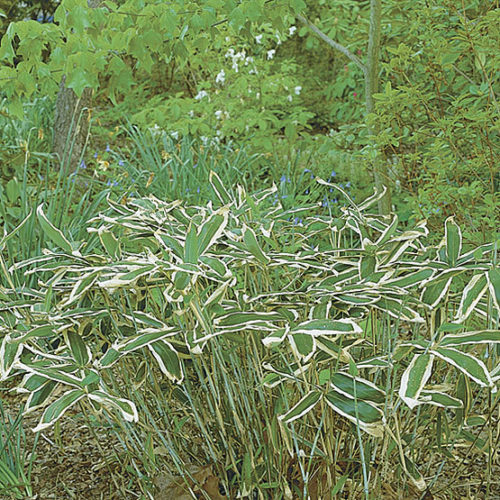
Sasa veitchii (Kuma bamboo grass, Kuma zasa)

Sasa veitchii Photo/Illustration: Chris Curless

(Based on 1 user review)

Rate this plant

Plant Showcase - from our advertisers


Hardiness Zones: 1 2 3 4 5 6 7 8 9 10 11
Botanical Name: Sasa veitchii Common Name: Kuma bamboo grass, Kuma zasa Genus: Sasa
This dwarf bamboo has deep-green leaves that become bicolored with the onset of autumn. The leaves then exhibit straw-colored margins, which persist into spring in warmer zones. It is a striking plant en masse or as groundcover in a woodland garden. It usually grows to 2 or 3 feet tall, but may reach 5 feet tall in deep shade.
Noteworthy characteristics: These Southeast Asian bamboos thrive in moist, deep woodlands, and thus are at home in shady gardens. Use in both formal and naturalistic plantings: as groundcovers at the base of trees and shrubs, isolated or planted en masse, and next to other plants that contrast and highlight Sasa foliage. 
Care: Plants may spread by 1 foot per year; curb growth by planting a 2-foot deep barrier around desired area. Grow in rich, moist, well-drained soil in sun to deep shade.
Propagation: Divide young rhizomes or sections of rhizomes in spring.
Problems: Slugs, snails.
Height 3 ft. to 6 ft.
Spread Over 30 ft.
Growth Habit Runs
Growth Pace Fast Grower;Invasive/Aggressive Grower
Moisture Medium Moisture
Maintenance Low
Tolerance Frost Tolerant
Characteristics Showy Foliage
Foliage Color Evergreen
Uses , Beds and Borders, Ground Covers, Naturalizing, Specimen Plant/ Focal Point
Style , Shade, Woodland Garden
Seasonal Interest , Winter Interest, Spring Interest, Summer Interest, Fall Interest
Type ,Grasses

Plants you might also like

Schizachyrium scoparium Schizachyrium scoparium
(Little bluestem, Prairie beard grass)
(1 user review)
Hardiness Zones: 1 2 3 4 5 6 7 8 9 10 11

Little bluestem is a tidy, finely textured clumping grass with a blue-green summer color. Its silvery seed heads rise to a height of nearly 2 feet in late summer and are at their best when backlit in the morning or afternoon sun. In fall, the grass turns a rosy rust color that lasts all winter.

Pennisetum alopecuroides Pennisetum alopecuroides
(Fountain grass)
(1 user review)
Hardiness Zones: 1 2 3 4 5 6 7 8 9 10 11

This species produces 2- to 5-foot-tall mounds of narrow green foliage and bottle brush-like silvery-pink to purple flowers, both of which mature to shades of brown. It is the parent of numerous cultivars with notable flowers that range from purple to gray/black. It and some of its cultivars self-sow plentifully in warm climates. It is marginally hardy in Zone 5.

Pleioblastus variegatus Pleioblastus variegatus
(Dwarf white-stripe)
Be the first to rate this plant
Hardiness Zones: 1 2 3 4 5 6 7 8 9 10 11

Dwarf white-stripe has 5-inch-long, upward-pointing green leaves strongly variegated with white. It grows up to 3 feet tall in either sun or shade, forming a striking contrast to less flamboyant neighbors.

Muhlenbergia lindheimeri Muhlenbergia lindheimeri
(Lindheimer's muhly)
Be the first to rate this plant
Hardiness Zones: 1 2 3 4 5 6 7 8 9 10 11

This beautiful warm-season grass produces attractive, pale purplish-gray plumes in autumn and goes dormant in the cold season. It forms a neat, upright clump with fine blue-gray foliage.

Deschampsia cespitosa 'Northern Lights' Deschampsia cespitosa 'Northern Lights'
(Tufted hair grass, Tussock grass)
(2 user reviews)
Hardiness Zones: 1 2 3 4 5 6 7 8 9 10 11

A tuft of thin grassy foliage with gray and gold variegation distinguishes this cultivar. Early summer brings 3-foot-tall, airy plumes of tiny flowers that look beautiful when backlit by the sun. As fall approaches, the foliage turns golden with pink-coral tips. This grass even grows well in shadier sites. Plant in a border, woodland garden, or shaded rock garden.