previous
  • Colorful Selections for Shade
    Colorful Selections for Shade
  • Indeterminate or Determinate Tomatoes?
    Indeterminate or Determinate Tomatoes?
  • Lawn Alternatives
    Lawn Alternatives
  • Containers as Focal Points
    Containers as Focal Points
  • Thoughts From a Foreign Field
    Thoughts From a Foreign Field
  • 6 Tips for Weed Control
    6 Tips for Weed Control
  • Dwarf Citrus Trees
    Dwarf Citrus Trees
  • Plant an Easy-to-Water Strawberry Jar
    Plant an Easy-to-Water Strawberry Jar
  • Plants that Spark!
    Plants that Spark!
  • Stylish Shady Containers
    Stylish Shady Containers
  • Garden Confidential: A Plant Walks into a Bar
    Garden Confidential: A Plant Walks into a Bar
  • Make a Succulent Topiary
    Make a Succulent Topiary
  • Fragrant Plants for Pathways
    Fragrant Plants for Pathways
  • Fast-Growing Trees for Impatient Gardeners
    Fast-Growing Trees for Impatient Gardeners
  • Elephant's Ears
    Elephant's Ears
  • NEW Video Series: There's a Better Way
    NEW Video Series: There's a Better Way
  • Homegrown / Homemade
    Homegrown / Homemade
  • Slideshow: Beautiful Clematis
    Slideshow: Beautiful Clematis
  • Save Money by Growing Your Own
    Save Money by Growing Your Own
  • In Pursuit of the Perfect Potting Shed
    In Pursuit of the Perfect Potting Shed
  • Mulch for a Healthy Garden
    Mulch for a Healthy Garden
  • Pretty in Pink
    Pretty in Pink
  • Building a Compost Bin
    Building a Compost Bin
  • Comfortable Alfresco Dining
    Comfortable Alfresco Dining
  • Designing with Curved Terraces
    Designing with Curved Terraces
next

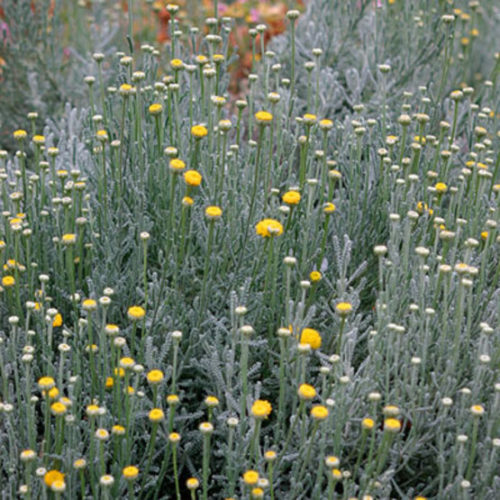
Santolina chamaecyparissus (Lavender cotton)

Santolina chamaecyparissus Photo/Illustration: Steve Aitken


Be the first to rate this plant

Plant Showcase - from our advertisers


Hardiness Zones: 1 2 3 4 5 6 7 8 9 10 11
Botanical Name: Santolina chamaecyparissus san-toe-LEE-nah kam-ah-sip-ar-ISS-us Common Name: Lavender cotton Genus: Santolina
This fine-textured, mound-forming shrub has gray foliage and yellow, button-like flowerheads formed by tubular flowers appearing in summer.
Noteworthy characteristics: Santolina looks great in Mediterranean gardens and as edging.
Care: Grow in sandy or loamy soil with good drainage, and full sun. Santolina may need to be cut back severely every year or it becomes long and woody.
Propagation: Root semi-ripe cuttings in late summer.
Problems: Infrequent.
Height 1 ft. to 3 ft.
Spread 1 ft. to 3 ft.
Growth Habit Clumps
Light Full Sun Only
Moisture Dry to Medium
Tolerance Deer Tolerant
Characteristics Fragrant Foliage
Bloom Time Summer
Foliage Color Silver/Grey
Flower Color Yellow Flower
Uses Beds and Borders
Style Rock Garden
Seasonal Interest Summer Interest
Type Shrubs

Plants you might also like

Salvia pachyphylla Salvia pachyphylla
Be the first to rate this plant
Hardiness Zones: 1 2 3 4 5 6 7 8 9 10 11

Giant-flowered purple sage has been winning over gardeners the past few years for its remarkable summer blooms and tough-as-nails demeanor. Native to the dry foothills and mountains of southern California, this sage is considered a woody shrub. It features showy, aromatic silver foliage and bicolored flower spikes with lavender-purple calyces and long, hummingbird-pollinated blue flowers. It grows from 24 to 36 inches high.

Salvia dorrii Salvia dorrii
(Desert purple sage)
Be the first to rate this plant
Hardiness Zones: 1 2 3 4 5 6 7 8 9 10 11

Found in the Great Basin deserts of the western U.S., Salvia dorrii is by far one of the most beautiful native Salvia species. A small, woody shrub, it comes into bloom in late spring with short spikes of showy purple bracts and blue flowers. The semievergreen foliage is distinctively silvery gray and highly aromatic. It grows to 18 inches high.

Melampodium leucanthum Melampodium leucanthum
(Blackfoot daisy)
(1 user review)
Hardiness Zones: 1 2 3 4 5 6 7 8 9 10 11

A native perennial shrub that grows to about 2 feet tall and wide and covers itself the whole season with honey-scented, white and yellow daisy flowers. The foliage is typical of the aster family. Plant en masse in a well-drained border or use in a rock garden. Blackfoot daisy can be short-lived.

Yucca filamentosa ‘Golden Sword’ Yucca filamentosa ‘Golden Sword’
(Adam's needle, Bear grass, Weak-leaf yucca, Golden Sword soapwort)
Be the first to rate this plant
Hardiness Zones: 1 2 3 4 5 6 7 8 9 10 11

This easy to grow evergreen yucca bears dramatic, sword-shaped yellow leaves with a dark green edge. Not as staunchly upright as some yuccas, its leaf tips sometimes droop with age. Its foliage color is best from fall to spring. Plants grow to nearly 2 feet in height and 3 feet in width. In summer, it produces a 6-foot-tall spike covered with nodding, fragrant, white bell-shaped flowers.

Salvia 'Maraschino' Salvia 'Maraschino'
('Maraschino' bush sage)
(2 user reviews)
Hardiness Zones: 1 2 3 4 5 6 7 8 9 10 11

'Maraschino' bush sage is a superb Salvia that is irresistible to hummingbirds and gardeners alike. Even after dying back to the ground in winter in the cooler zones, this plant comes back in full force each spring, reaching its full height and covering itself with cherry red blooms by midsummer. The flowers bloom nonstop through the first hard frost, and the leaves are sweetly fragrant. Plants do best when given afternoon shade. 'Maraschino' grows to 3 feet tall.