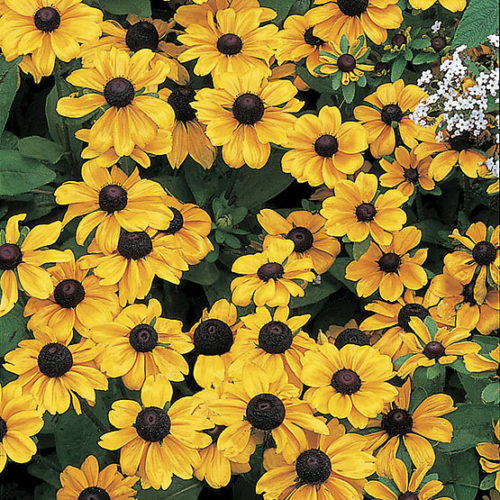
Rudbeckia hirta (Black-eyed Susan, Gloriosa daisy, Coneflower)

Rudbeckia hirta Rudbeckia hirta 'Toto' Photo/Illustration: Courtesy of White Flower Farm


Be the first to rate this plant

Plant Showcase - from our advertisers


Hardiness Zones: 1 2 3 4 5 6 7 8 9 10 11
Botanical Name: Rudbeckia hirta rud-BEK-ee-ah HER-tah Common Name: Black-eyed Susan, Gloriosa daisy, Coneflower Synonyms: R. gloriosa Genus: Rudbeckia
This biennial or short-lived perennial has given rise to numerous cultivars which are often grown as annuals. From summer into early autumn, it bears daisy-like blossoms (to 3 inches across) with light or deep yellow rays and brownish-purple centers. The flowers are a staple in late summer bouquets.
Noteworthy characteristics: Rudbeckias hail from the moist meadows and dappled woods of North America. They are suitable for mixed borders, meadows, native gardens, open woods, and large annual displays. 
Care: Grow in average, slightly heavy but well-drained soil in full sun to partial shade.
Propagation: Sow seeds of annuals and biennials in spring; sow perennial seeds in a cold frame in early spring, or divide plants in spring or fall.
Problems: Aphids, powdery mildew, smut, rust, Ramularia and Septoria leaf spots, snails, slugs.
Height 1 ft. to 3 ft.
Spread 1 ft. to 3 ft.
Growth Habit Clumps
Growth Pace Fast Grower
Light Full Sun to Part Shade
Moisture Medium Moisture
Maintenance Low
Characteristics Attracts Birds; Attracts Butterflies; Native; Self Seeds; Showy Flowers; Showy Seed Heads
Bloom Time Early Fall; Late Summer; Summer
Flower Color Brown Flower; Orange/ Salmon Flower; Red Flower; Yellow Flower
Uses , Beds and Borders, Cut Flower, Hedge, Naturalizing, Roadside, Suitable as Annual, Meadow Garden
Style , Cottage Garden
Seasonal Interest , Summer Interest, Fall Interest
Type ,Perennials

Plants you might also like

Rudbeckia fulgida var. sullivantii 'Goldsturm' Rudbeckia fulgida var. sullivantii 'Goldsturm'
(Orange Coneflower, Black-eyed Susan)
(12 user reviews)
Hardiness Zones: 1 2 3 4 5 6 7 8 9 10 11

Large flowers consisting of brassy orange-yellow rays surrounding brown cones are what make this plant so popular. It blooms for 7 or 8 weeks beginning in midsummer. The flowers top 18- to 30-inch-tall plants that will readily self sow in cultivated soils. 

Echinacea purpurea ‘Bright Star’ Echinacea purpurea ‘Bright Star’
(Purple coneflower)
Be the first to rate this plant
Hardiness Zones: 1 2 3 4 5 6 7 8 9 10 11

This native meadow derivative with daisy-like flowers blooms from early summer into early autumn. 'Bright Star' has prominent, copper-orange central cones surrounded by red-purple ray petals (to 5 inches across), and grows to less than 3 feet tall.

Echinacea purpurea 'Kim's Knee High' Echinacea purpurea 'Kim's Knee High'
(Purple coneflower)
(3 user reviews)
Hardiness Zones: 1 2 3 4 5 6 7 8 9 10 11

This native meadow derivative is a compact version of the species. It blooms from midsummer into early autumn, with prominent, copper-orange central cones surrounded by drooping, rose- or purple-pink ray petals. It will reach 24 inches if not cut back.

Echinacea purpurea 'Magnus' Echinacea purpurea 'Magnus'
(Purple coneflower)
(12 user reviews)
Hardiness Zones: 1 2 3 4 5 6 7 8 9 10 11

This native meadow derivative has vibrant, daisy-like flowers that bloom from midsummer into early autumn. Its prominent, dark orange central cones are surrounded by larger (to 7 inches across) and more horizontal, reddish-pink, ray petals than the species.

Echinacea purpurea Echinacea purpurea
(Purple coneflower)
(2 user reviews)
Hardiness Zones: 1 2 3 4 5 6 7 8 9 10 11

Because of its carefree performance, this native meadow perennial with daisy-like flowers appropriately inhabits the gardens of many. It blooms from midsummer into early autumn, with prominent, copper-orange central cones surrounded by rose-purple, ray petals (to 5 inches across).