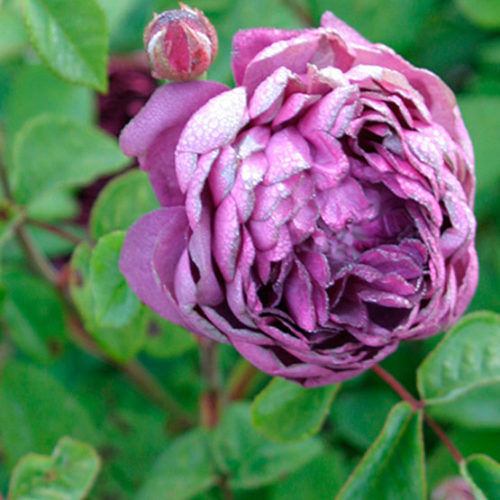
Rosa 'Cardinal de Richelieu' (Rose)

Rosa 'Cardinal de Richelieu' Photo/Illustration: Michelle Gervais


Be the first to rate this plant

Plant Showcase - from our advertisers


Hardiness Zones: 1 2 3 4 5 6 7 8 9 10 11
Botanical Name: Rosa 'Cardinal de Richelieu' ROE-sah Common Name: Rose Genus: Rosa
This is one of the darkest-flowered roses from the oldest class of garden roses, the gallicas. 'Cardinal de Richelieu' is a strong grower with a compact, lax habit. The rounded, double, fragrant, deeply colored flowers are a deep burgundy-purple. They are in bloom from spring to early summer. Introduced in 1840.
Noteworthy characteristics: Vigorous growth; casual habit. Fully double, fragrant, deep burgundy-purple flowers.
Care: Very tolerant, but prefers an open site in full sun. Best in moderately fertile, humus-rich, moist but well-drained soil. Plant in late fall or early spring, when the ground is not frozen. Remove suckers from rootstock as soon as they appear.
Propagation: Root softwood cuttings from begining of bloom in spring to summer; root hardwood cuttings in autumn. Bud in summer. Sow seed in containers in autumn.
Problems: Susceptible to aphids, leafhoppers, spider mites, scale insects, caterpillars, sawfly larvae, cane borers, Japanese beetles, rose stem girdlers, thrips, rose chafers, rose midges, rose slugs, and leaf cutting bees. Rabbits and deer can also cause damage. Prone to black spot, rust, powdery mildew, dieback, canker, crown gall, viruses, and downy mildew.
Height 1 ft. to 3 ft.
Spread 3 ft. to 6 ft.
Growth Pace Fast Grower
Light Full Sun Only
Moisture Medium Moisture
Maintenance Moderate
Characteristics Fragrant Flowers; Showy Flowers
Bloom Time Early Summer; Late Spring; Spring; Summer
Flower Color Purple/ Lavender Flower; Red Flower
Uses , Beds and Borders
Style , Cottage Garden
Seasonal Interest , Spring Interest, Summer Interest
Type ,Shrubs

Plants you might also like

Rosa rugosa 'Purple Pavement' Rosa rugosa 'Purple Pavement'
('Purple Pavement' rugosa rose)
Be the first to rate this plant
Hardiness Zones: 1 2 3 4 5 6 7 8 9 10 11

'Purple Pavement' has large, ruffled blossoms with a  purple-red color and strong fragrance. In the fall, the blossoms give way to large, handsome hips, and the foliage turns from green to shades of yellow and maroon. This shapely shrub with dependable repeat bloom it is especially good for a late display, when the hips appear alongside fall asters and other perennials with assertive autumn colors.

Rosa rugosa'Wasagaming' Rosa rugosa 'Wasagaming'
('Wasagaming' rugosa rose)
(1 user review)
Hardiness Zones: 1 2 3 4 5 6 7 8 9 10 11

'Wasagaming' (pronounced "wah-SAG-ah-ming") is a prolific bloomer that has the charm of the antique roses but with greater vigor and better growth habit. Cascading rich pink blossoms with an old-rose scent spill across the shrub. 'Wasagaming' will thrive in less sunny but bright conditions.

Rosa rugosa 'Polar Ice' Rosa rugosa 'Polar Ice'
('Polar Ice' rugosa rose)
Be the first to rate this plant
Hardiness Zones: 1 2 3 4 5 6 7 8 9 10 11

'Polar Ice' is one of the most vigorous and densely growing rugosa roses and features clusters of double, slightly nodding flowers. Green buds open to creamy white blooms with pink petals and deeper pink centers. The flowers smell lightly of baby powder, and the new lime green foliage smells like strawberries and sweet grass. In autumn, the foliage turns bright yellow.

Rosa rugosa 'Foxi' Rosa rugosa 'Foxi'
('Foxi' rugosa rose)
Be the first to rate this plant
Hardiness Zones: 1 2 3 4 5 6 7 8 9 10 11

Large, open, semi-double pink flowers with yellow stamens and an intoxicating scent make 'Foxi' an outstanding rugosa rose. The relatively small height of the shrub makes the blossoms appear larger. This is a relatively new rugosa rose.

Rosa rugosa 'Agnes' Rosa rugosa 'Agnes'
('Agnes' rugosa rose)
(1 user review)
Hardiness Zones: 1 2 3 4 5 6 7 8 9 10 11

'Agnes'  is one of the few yellow rugosa roses, and it epitomizes the finest rugosa attributes in both leaf and overall form. Doubled blooms give this selection an old-fashioned aspect, as does its delightful fragrance, which is reminiscent of antique roses. Bloom color changes somewhat with the temperature: in cool temperatures, the flowers are an apricot hue, but as the weather warms, they turn a soft yellow.