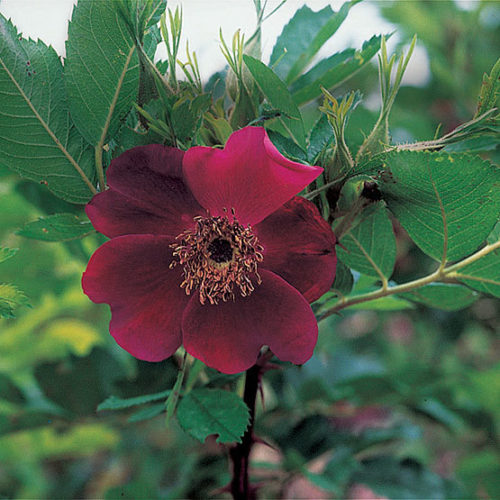
Rosa 'Basye's Purple'

Rosa 'Basye's Purple' Photo/Illustration: L. Beutler


Be the first to rate this plant

Hardiness Zones: 1 2 3 4 5 6 7 8 9 10 11
Botanical Name: Rosa 'Basye's Purple' ROE-sah Synonyms: R. 'Basye's Purple Rose' Genus: Rosa
This outstanding rose has single, fragrant blossoms of rich cabernet-red. The young foliage emerges chartreuse, while the new stems and small thorns are claret. The flowers are followed by hips the color of ripe grapes, which contrast with the amber autumn foliage. This rose grows up to 8 feet high.
Noteworthy characteristics: This shrub rose was bred from R. rugosa and R. foliolosa, making it highly disease-resistant. It grows well in mixed borders, hedges, as a specimen, or trained as a small climber. 
Care: Grow in fertile, moist, well-drained soil in full sun or partial shade. Provide good air circulation and remove fallen leaves to help prevent disease. It requires little, if any pruning. In late winter or early spring, prune lightly or back by up to 1/3, reducing side shoots by 1/2 to 1/3. To renovate, prune one in four or five shoots from the base.
Propagation: Take softwood cuttings when bloom initiates in spring to summer; take hardwood cuttings in fall.
Problems: Aphids, leafhoppers, spider mites, scale, caterpillars, sawfly larvae, cane borers, Japanese beetles, rose stem girders, rose midges, rose slugs, rose chafers, leaf-cutting bees, black spot, rust, powdery mildew, crown gall, canker, dieback, downy mildew, viruses.
Height 6 ft. to 10 ft.
Spread 3 ft. to 6 ft.
Growth Habit Clumps
Growth Pace Moderate Grower
Light Full Sun to Part Shade
Moisture Medium Moisture
Maintenance Low
Characteristics Attracts Birds; Attracts Butterflies; Fragrant Flowers; Showy Flowers; Showy Foliage; Showy Fruit
Bloom Time Early Summer; Late Spring; Spring; Summer
Flower Color Red Flower
Uses Beds and Borders, Cut Flower, Hedge, Screening, Specimen Plant/ Focal Point
Style Cottage Garden, Formal Garden
Seasonal Interest Spring Interest, Summer Interest, Fall Interest
Type Shrubs

Plants you might also like

Rosa chinensis 'Mutabilis' Rosa chinensis 'Mutabilis'
Be the first to rate this plant
Hardiness Zones: 1 2 3 4 5 6 7 8 9 10 11

This beauty is prized for the unusual qualities of its flowers, which bloom continuously from spring until frost. The single cupped flowers open a honey-yellow, then they become coppery-pink, then watermelon, and finally a rich mahogany. The foliage is reddish purple, disease-resistant, and is evergreen in warm climates. This rose can be treated as a shrub or trained as a climber, reaching 10 feet high and 6 feet wide.

Rosa rugosa var. alba Rosa rugosa var. alba
(Hedgehog rose, Ramanas rose, Japanese rose, Sea tomato)
Be the first to rate this plant
Hardiness Zones: 1 2 3 4 5 6 7 8 9 10 11

This variety has single, papery white blossoms that open from light pink buds and have contrasting yellow stamens. The heavily-scented flowers are followed by reddish-orange hips. It grows up to 6 feet high.

Rosa 'Blanc Double de Coubert' Rosa 'Blanc Double de Coubert'
(Hedgehog rose, Ramanas rose, Japanese rose, Sea tomato)
(1 user review)
Hardiness Zones: 1 2 3 4 5 6 7 8 9 10 11

The white of this rose has a purity of color that is without equal. It produces semi-double, very fragrant flowers from spring to fall, which are sometimes followed by orange hips. It grows to 6 feet high and wide.   

Rosa 'Frau Dagmar Hastrup' Rosa 'Frau Dagmar Hastrup'
(Hedgehog rose, Ramanas rose, Japanese rose, Sea tomato)
(1 user review)
Hardiness Zones: 1 2 3 4 5 6 7 8 9 10 11

This choice rose has single, gently cupped light-pink flowers that exude an intense, clove-scented perfume. It blooms in spring and sporadically throughout the season, and produces red hips. In autumn, the foliage turns deep maroon, which changes to yellow tinged with coppery highlights. It grows to 3 to 4 feet high and wide.   

Rosa 'Buff Beauty' Rosa 'Buff Beauty'
(Hybrid musk rose)
Be the first to rate this plant
Hardiness Zones: 1 2 3 4 5 6 7 8 9 10 11

This fragrant rose produces generous clusters of double apricot flowers that fade to a soft yellow. It usually grows to 5 feet and taller when trained, making it an ideal candidate for screening or growing up a wall, arch, or trellis. It blooms from spring to autumn.