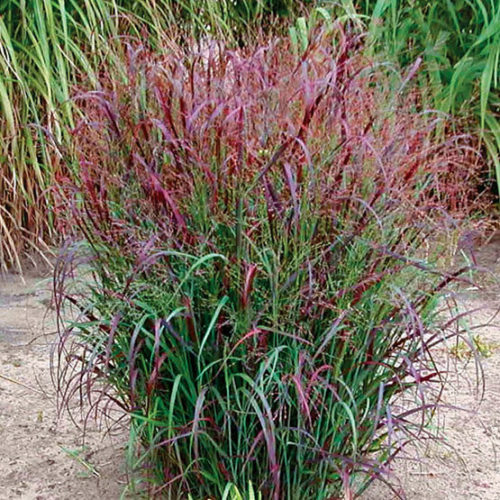
Panicum virgatum 'Prairie Fire' (‘Prairie Fire’ red switchgrass)

Panicum virgatum 'Prairie Fire' Photo/Illustration: courtesy of Amber Wave Nursery


Be the first to rate this plant

Hardiness Zones: 1 2 3 4 5 6 7 8 9 10 11
Botanical Name: Panicum virgatum 'Prairie Fire' PAN-ih-kum ver-GAY-tum Common Name: ‘Prairie Fire’ red switchgrass Genus: Panicum
'Prairie Fire' is a distinctly red form from this popular species. The foliage emerges blue-green in spring, but by early summer, the leaves begin to turn shades of deep red. It is unique among switchgrasses because most varieties don't peak until late summer. ‘Prairie Fire’ gradually turns butter yellow in late fall and lingers into winter.
Care: It needs all-day sun and has a fibrous root system that grows to more than 10 feet deep, making it drought tolerant. All switchgrasses need to be divided every three years because they are so vigorous.
Propagation:

 By division.


Problems:

 Black ring, rust, smut, leaf spots, damping off.


Height 3 ft. to 6 ft.
Spread 1 ft. to 3 ft.
Growth Habit Clumps
Growth Pace Fast Grower
Light Full Sun Only
Moisture Medium Moisture
Maintenance Moderate
Tolerance Drought Tolerant
Characteristics Native; Showy Fall Foliage; Showy Foliage

Foliage Color Colorful/Burgundy Foliage
Uses Beds and Borders, Container, Screening
Style Meadow Garden
Seasonal Interest Winter Interest, Summer Interest, Fall Interest
Type Grasses,Natives

Plants you might also like

Sorghastrum nutans 'Indian Steel' Sorghastrum nutans 'Indian Steel'
(Indian grass)
Be the first to rate this plant
Hardiness Zones: 1 2 3 4 5 6 7 8 9 10 11

This vase-shaped indian grass produces golden yellow plumes, giving 'Indian Steel' a refined appearance. Each flower spike has tiny, bright yellow pollen sacs that stand out on the darker seed heads. From early spring to fall, the foliage is metallic blue, mellowing to a copper-tan after the first frost.

Tripsacum dactyloides

Tripsacum dactyloides


(Eastern gamagrass)
Be the first to rate this plant
Hardiness Zones: 1 2 3 4 5 6 7 8 9 10 11

This grass is easy to grow and always beautiful. In early summer, slender stems are topped with flowers that produce a crop of jointed seeds. Clumps get large and die out in the center, so division every three or four years is necessary. Autumn frosts turn the leaves shades of red-bronze.

Bouteloua gracilis 'Hachita' Bouteloua gracilis 'Hachita'
('Hachita' Blue Grama Grass)
Be the first to rate this plant
Hardiness Zones: 1 2 3 4 5 6 7 8 9 10 11

'Hachita' is a vigorous plant with narrow, blue-green leaves that form dense mounds. During summer, the clumps are punctuated by intricate seed heads that resemble eyelashes. This tough, drought-tolerant grass thrives in sand or clay soil with full-sun exposure. It needs good drainage for the best growth. Too much water is often its downfall.

Andropogon gerardii 'Pawnee' Andropogon gerardii 'Pawnee'
(Big bluestem, turkeyfoot)
Be the first to rate this plant
Hardiness Zones: 1 2 3 4 5 6 7 8 9 10 11

From the prairies of Nebraska comes a refined variety of big bluestem: 'Pawnee'. It has an upright habit and warm fall colors that persist into winter. Each stiffly vertical stem has the characteristic bluish purple cast of this genus. In late summer, 'Pawnee' develops purplish red flowers in groups of three or six, which resemble the foot of a turkey—hence its nickname: "Turkey Foot Grass." Big bluestem has an extensive root system that can extend down more than 10 feet. Each year, a third of these roots die, opening up channels for water.

Panicum virgatum 'Shenandoah' Panicum virgatum 'Shenandoah'
('Shenandoah' red switchgrass)
Be the first to rate this plant
Hardiness Zones: 1 2 3 4 5 6 7 8 9 10 11

This compact selection of an American native prairie grass turns heads in early summer, with its leaf blades tipped in rich red. The color builds into autumn, when the entire leaf blade is drenched in burgundy and gossamer clouds of misty pink plumes hover overhead, providing irresistible texture. Winter brings papery beige leaf blades that rustle in the wind and provide cover for birds.