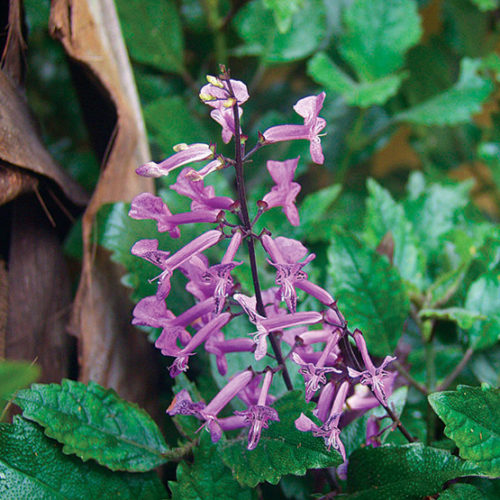
Plectranthus ‘Mona Lavender’

Plectranthus ‘Mona Lavender’ Photo/Illustration: Courtesy of San Marcos Growers


Be the first to rate this plant

Hardiness Zones: 1 2 3 4 5 6 7 8 9 10 11
Botanical Name: Plectranthus ‘Mona Lavender’ plek-TRAN-thus Genus: Perennials

Many cultivars of Plectranthus are popular in our local gardens. Though they are grown mostly for their interesting and beautiful foliage, some gardeners grow them for their blooms. The plants are easy and undemanding, and thrive in light to deep shade. One of the best varieties is ‘Mona Lavender’, which has beautiful, dark green leaves with purple undersides and stems, as well as abundant lavender-purple flowers.


Care: Fertile, well-drained soil.
Propagation:

 From cuttings.


Problems:

 No serious problems.


Height 1 ft. to 3 ft.
Spread 1 ft. to 3 ft.
Growth Pace Moderate Grower
Light Full Shade Only;Part Shade Only;Part Shade to Full Shade
Moisture Medium Moisture
Maintenance Moderate
Characteristics Showy Fall Foliage; Showy Foliage

Bloom Time Early Fall; Early Spring; Early Summer; Fall; Late Fall; Late Spring; Late Summer
Flower Color Purple/ Lavender Flower
Uses Beds and Borders, Container, Shade, Indoor Plant
Seasonal Interest Spring Interest, Summer Interest, Fall Interest
Type Plectranthus

Plants you might also like

Ruellia brittoniana 'Purple Showers' Ruellia brittoniana 'Purple Showers'
(Mexican petunia, Common ruellia, Wild petunia)
(6 user reviews)
Hardiness Zones: 1 2 3 4 5 6 7 8 9 10 11

This three-foot-tall evergreen shrub bears many tubular, blue or purple, petunia-like flowers on dark stems over a long period. Each flower lasts for just one day. It is a fast grower that may self-seed aggressively. Use in a border, container, or at waterside. Can be grown as an annual in cooler areas.

no image available Pelargonium sidoides
(Kalwerbossie geranium , Silverleaf geranium)
Be the first to rate this plant
Hardiness Zones: 1 2 3 4 5 6 7 8 9 10 11

This exemplary species has felted, gray, crinkled leaves. Over a long period, it exhibits sprays of butterfly-shaped, rich wine-red flowers, which contrast dramatically with the foliage. Its small stature makes it a perfect candidate for a container or a walkway edge. It has been used medicinally for the treatment of various infections, including bronchitis. It is a native of Africa.

Oxalis vulcanicola 'Zinfandel' Oxalis vulcanicola 'Zinfandel'
(Volcanic sorrel)
Be the first to rate this plant
Hardiness Zones: 1 2 3 4 5 6 7 8 9 10 11

The old-fashioned shamrock house­plant is now high fashion. Several introductions from Proven Winners push this group to the fore for its elegant foliage; abundant, delicate flowers; and vigor. Only 6 to 10 inches high with a spread to 12 inches, this plant’s tiny, ¾-inch-wide, bronze-colored leaf clusters and bright yellow flowers are massed on trailing stems that spill over the sides of shaded window boxes and containers.

no image available Euphorbia rigida
Be the first to rate this plant
Hardiness Zones: 1 2 3 4 5 6 7 8 9 10 11

This species is similar to E. myrsinites, but its habit is first erect before spreading, and its steely blue leaves are more narrow and pointed. It also bears terminal yellow bracts from early spring to summer.

no image available Eucomis comosa
(Pineapple lily, Pineapple flower)
Be the first to rate this plant
Hardiness Zones: 1 2 3 4 5 6 7 8 9 10 11

This species boasts stems and undersides of leaves with maroon spotting, and white flowers tinged with maroon. The flowers form on 24-inch-long, thick stalks bearing bottle-brush-like wands of tightly-clung florets, which are crowned by tufts of green bracts. As the common name implies, these unusual and magnificent inflorescences are reminiscent of pineapples.