previous
  • 6 Tips for Weed Control
    6 Tips for Weed Control
  • Building a Compost Bin
    Building a Compost Bin
  • In Pursuit of the Perfect Potting Shed
    In Pursuit of the Perfect Potting Shed
  • Designing with Curved Terraces
    Designing with Curved Terraces
  • Thoughts From a Foreign Field
    Thoughts From a Foreign Field
  • Plant an Easy-to-Water Strawberry Jar
    Plant an Easy-to-Water Strawberry Jar
  • Make a Succulent Topiary
    Make a Succulent Topiary
  • Dwarf Citrus Trees
    Dwarf Citrus Trees
  • Elephant's Ears
    Elephant's Ears
  • Homegrown / Homemade
    Homegrown / Homemade
  • Fragrant Plants for Pathways
    Fragrant Plants for Pathways
  • Pretty in Pink
    Pretty in Pink
  • Colorful Selections for Shade
    Colorful Selections for Shade
  • Slideshow: Beautiful Clematis
    Slideshow: Beautiful Clematis
  • NEW Video Series: There's a Better Way
    NEW Video Series: There's a Better Way
  • Indeterminate or Determinate Tomatoes?
    Indeterminate or Determinate Tomatoes?
  • Meet Our Mini-Magazines
    Meet Our Mini-Magazines
  • Comfortable Alfresco Dining
    Comfortable Alfresco Dining
  • Fine Gardening's Tip Off!
    Fine Gardening's Tip Off!
  • Stylish Shady Containers
    Stylish Shady Containers
  • Mulch for a Healthy Garden
    Mulch for a Healthy Garden
  • Containers as Focal Points
    Containers as Focal Points
  • Save Money by Growing Your Own
    Save Money by Growing Your Own
  • Fast-Growing Trees for Impatient Gardeners
    Fast-Growing Trees for Impatient Gardeners
  • Garden Confidential: A Plant Walks into a Bar
    Garden Confidential: A Plant Walks into a Bar
next

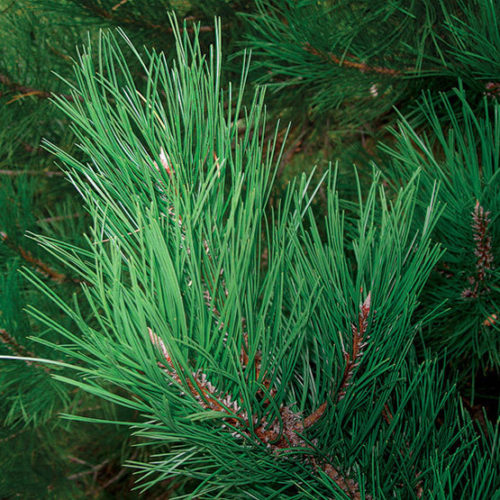
Pinus nigra (Austrian pine, European black pine)

Pinus nigra Photo/Illustration: Courtesy of Nancy Matthews


Be the first to rate this plant

Plant Showcase - from our advertisers


Hardiness Zones: 1 2 3 4 5 6 7 8 9 10 11
Botanical Name: Pinus nigra PY-nus NY-grah Common Name: Austrian pine, European black pine Genus: Pinus
Dark green, 4- to 6-inch-long needles and furrowed bark (on mature trees) make Austrian pine an attractive large specimen tree. It can also be used as screening, although its growth habit becomes more open with age.
Care: Provide full sun and deep, moist but well-drained soil. Once trees are established, they are somewhat drought tolerant. They also tolerate urban conditions.
Propagation: From seed.
Problems: Sphaeropis (Diplodia) tip blight is a severe disease problem in some areas of the country. It kills entire branches and, if left unchecked, entire stands of trees.
Height Over 30 ft.
Spread 15 ft. to 30 ft.
Growth Habit Clumps
Light Full Sun Only
Moisture Medium Moisture
Maintenance Moderate
Characteristics Attracts Birds
Foliage Color Evergreen
Uses Screening, Specimen Plant/ Focal Point
Seasonal Interest Winter Interest, Spring Interest, Summer Interest, Fall Interest
Type Trees

Plants you might also like

Chamaecyparis obtusa 'Aurea' Chamaecyparis obtusa 'Aurea'
(Hinoki cypress)
Be the first to rate this plant
Hardiness Zones: 1 2 3 4 5 6 7 8 9 10 11

Hinoki cypress is a conical, evergreen, coniferous tree with leaves that are actually minute scales on tiny branches in the form of fans. The outer foliage of 'Aurea' is golden and the inner is green. Growth can be slow. Use as a specimen or use several as screening.

no image available Pinus strobus 'Fastigiata'
(Eastern white pine)
Be the first to rate this plant
Hardiness Zones: 1 2 3 4 5 6 7 8 9 10 11

This robust evergreen tree has a narrowly columnar crown with ascending branches, slender gray-green leaves, and smooth gray bark. Tapered green female cones ripen to brown.

Sciadopitys verticillata Sciadopitys verticillata
(Japanese umbrella pine)
Be the first to rate this plant
Hardiness Zones: 1 2 3 4 5 6 7 8 9 10 11

This glorious conifer constitutes the sole member of both its genus and plant family. It is without a peer in its beauty; on a mature specimen, its rich needles compose a sculpture of form, texture, and color that is unrivaled. The foliage develops a bronzy tint in winter. While it often grows to 30 feet in cultivation and 90 feet in the wild, its slow-growing nature inspires patience.

Cornus florida Cornus florida
(Flowering dogwood)
Be the first to rate this plant
Hardiness Zones: 1 2 3 4 5 6 7 8 9 10 11

This native flowering tree is best known for its early spring blossoms, which are actually yellowish green flowers clustered in the center of four showy, white to pink bracts 1-1/2 to 2 inches long. Clusters of four bright red fruits mature in early fall, often persisting into the beginning of winter. 

Pseudolarix kaempferi Pseudolarix kaempferi
(Golden larch)
Be the first to rate this plant
Hardiness Zones: 1 2 3 4 5 6 7 8 9 10 11

The golden larch is a lovely deciduous conifer whose lacy foliage turns golden in autumn. Its bright green needles are slightly larger than those of the European larch. Golden larch becomes a large pyramidal tree with an ultimate height of about 50 feet in cultivation. Its broad, horizontal branches are arranged in an open growth habit. In a big garden, it makes a neat specimen that never fails to attract attention.