previous
  • Fast-Growing Trees for Impatient Gardeners
    Fast-Growing Trees for Impatient Gardeners
  • Plants that Spark!
    Plants that Spark!
  • Homegrown / Homemade
    Homegrown / Homemade
  • Lawn Alternatives
    Lawn Alternatives
  • Garden Confidential: A Plant Walks into a Bar
    Garden Confidential: A Plant Walks into a Bar
  • Containers as Focal Points
    Containers as Focal Points
  • Slideshow: Beautiful Clematis
    Slideshow: Beautiful Clematis
  • Fragrant Plants for Pathways
    Fragrant Plants for Pathways
  • NEW Video Series: There's a Better Way
    NEW Video Series: There's a Better Way
  • Plant an Easy-to-Water Strawberry Jar
    Plant an Easy-to-Water Strawberry Jar
  • Mulch for a Healthy Garden
    Mulch for a Healthy Garden
  • Dwarf Citrus Trees
    Dwarf Citrus Trees
  • Colorful Selections for Shade
    Colorful Selections for Shade
  • Thoughts From a Foreign Field
    Thoughts From a Foreign Field
  • In Pursuit of the Perfect Potting Shed
    In Pursuit of the Perfect Potting Shed
  • Building a Compost Bin
    Building a Compost Bin
  • Save Money by Growing Your Own
    Save Money by Growing Your Own
  • Comfortable Alfresco Dining
    Comfortable Alfresco Dining
  • Pretty in Pink
    Pretty in Pink
  • Designing with Curved Terraces
    Designing with Curved Terraces
  • Make a Succulent Topiary
    Make a Succulent Topiary
  • Indeterminate or Determinate Tomatoes?
    Indeterminate or Determinate Tomatoes?
  • 6 Tips for Weed Control
    6 Tips for Weed Control
  • Elephant's Ears
    Elephant's Ears
  • Stylish Shady Containers
    Stylish Shady Containers
next

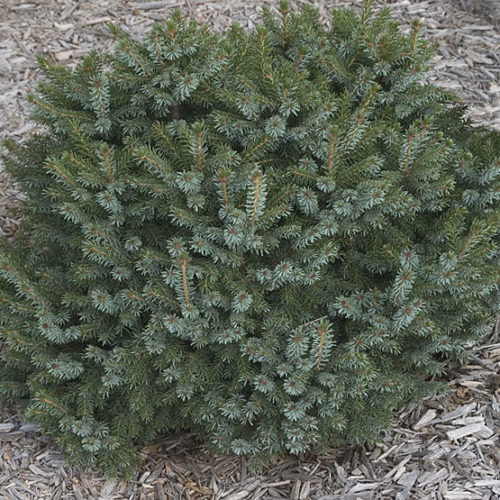
Picea omorika ‘Nana’ (Dwarf Serbian spruce)

Picea omorika ‘Nana’ Photo/Illustration: Courtesy of Bailey Nurseries


Be the first to rate this plant

Plant Showcase - from our advertisers


Hardiness Zones: 1 2 3 4 5 6 7 8 9 10 11
Botanical Name: Picea omorika ‘Nana’ Common Name: Dwarf Serbian spruce Genus: Picea
A compact plant with a mature height of 8 feet, this conifer is densely globe-shaped when young, becoming pyramidal as it ages. Needles are soft green on top, bluish green at the bottom.
Noteworthy characteristics: A great bicolor conifer for a focal point among lower-growing plantings or in a mixed evergreen/conifer planting. Slow-growing, about 3-6 inches per year.
Care: Prefers deep, moist but well-drained, neutral to acidic soil.
Propagation: Graft in winter.
Problems: Gall insects, aphids, caterpillars, sawfly, spider mites, lesion nematode, and scale instects. Various wood rots, witches' broom, mistletoe, rust, and needle cast.
Height 3 ft. to 6 ft.
Spread 3 ft. to 6 ft.
Growth Pace Slow Grower
Light Full Sun to Part Shade
Moisture Medium Moisture
Characteristics Showy Foliage
Foliage Color Evergreen
Uses Specimen Plant/ Focal Point
Style Formal Garden
Type Trees

Plants you might also like

Tsuga canadensis 'Pendula' Tsuga canadensis 'Pendula'
(Sargent's weeping hemlock, Eastern hemlock)
Be the first to rate this plant
Hardiness Zones: 1 2 3 4 5 6 7 8 9 10 11

This hemlock cultivar makes a very beautiful specimen, slowly forming a 10- to 15-foot-tall and 30-foot-wide, multi-layered mound of greenery. Its horizontally speading branches are covered with smaller weeping branches clothed in short, dark green needles. It looks great growing over a rock wall, in a rock garden, or by water. Its size may be controlled by regular clipping.

no image available Picea pungens ‘Procumbens’
(Colorado blue spruce)
(1 user review)
Hardiness Zones: 1 2 3 4 5 6 7 8 9 10 11

'Procumbens' is similar to 'Pendula' in color but prostrate in habit, with cascading branches sometimes staying stiffly horizontal. Makes a spreading, undulating, mounding ground cover of silvery white needles.

Prunus virginiana 'Schubert' Prunus virginiana 'Schubert'
('Schubert' choke cherry)
Be the first to rate this plant
Hardiness Zones: 1 2 3 4 5 6 7 8 9 10 11

'Schubert' choke cherry, with its vivid foliage and pyramidal form, makes a fine focal point. Ephemeral, light pink flowers are followed by abundant, dark red-purple fruit that birds love. (Don't plant it near patios or walks, as they'll quickly be covered by bird droppings.) If the tree you buy isn't grafted onto nonsuckering rootstock; otherwise, suckers could become problematic as the years go by. -Ron Smith, Regional Picks: Upper Plains, Fine Gardening issue #120

no image available Chamaecyparis thyoides ‘Heatherbun’
(White cedar, White false cypress, Heatherbun false cypress)
Be the first to rate this plant
Hardiness Zones: 1 2 3 4 5 6 7 8 9 10 11

This evergreen, coniferous tree has flattened sprays of scale-like adult leaves. 'Heatherbun' has soft, blue-green juvenile foliage that turns plum to bronze in winter and a compact, rounded form.

Tilia americana Tilia americana
(American linden, Basswood)
Be the first to rate this plant
Hardiness Zones: 1 2 3 4 5 6 7 8 9 10 11

This deciduous tree with dense foliage and a stately habit produces hanging clusters of fragrant yellow flowers in mid-summer. It grows in a broadly columnar shape and has dark green leaves that are glossy underneath. Basswood makes a good specimen or street tree, although it doesn't tolerate pollution. It can grow as tall as 80 feet with a width of 50 feet. It attracts bees; basswood honey is a sought-after gourmet food.