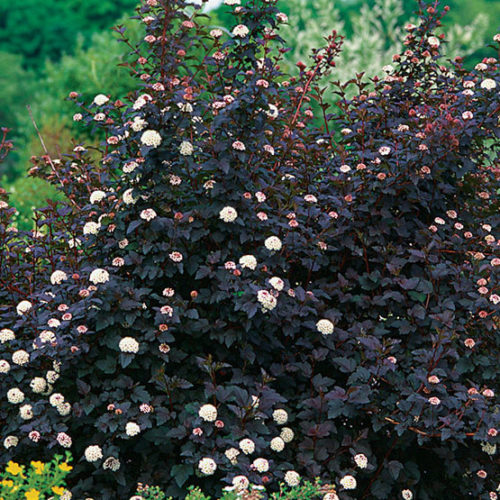
Physocarpus opulifolius 'Monlo' (Diabolo® ninebark)

Physocarpus opulifolius 'Monlo' Photo/Illustration: Bill Johnson


Be the first to rate this plant

Plant Showcase - from our advertisers


Hardiness Zones: 1 2 3 4 5 6 7 8 9 10 11
Botanical Name: Physocarpus opulifolius 'Monlo' fy-so-KAR-pus op-yew-lih-FOE-lee-us Common Name: Diabolo® ninebark Genus: Physocarpus
With its upright, arching branches and dark chocolate to purple foliage, Diabolo® ninebark offers a color contrast with silver-leaved plants and makes a fine backdrop hedge. Clusters of button-like, pinkish white flowers appear in summer. Even when they fade to a tawny tone, they stand out nicely against the dark leaves.
Noteworthy characteristics: Dark foliage; interesting bark.
Care: Provide full sun to part shade and rich, moist, well-drained, acidic soil.
Propagation: Start new plants from greenwood cuttings in summer, or remove rooted suckers in spring or fall. Alternatively, sow seed in containers outdoors in spring or fall.
Problems: Nothing serious. When grown in partial shade or with excessive heat, the foliage may turn dark green.
Height 6 ft. to 10 ft.
Spread 6 ft. to 10 ft.
Growth Habit Clumps
Light Full Sun to Part Shade
Moisture Medium Moisture
Maintenance Low
Characteristics Interesting Bark; Showy Flowers; Showy Foliage
Bloom Time Early Summer; Late Summer; Summer
Foliage Color Colorful/Burgundy Foliage
Flower Color White Flower
Uses , Beds and Borders, Hedge, Specimen Plant/ Focal Point
Seasonal Interest , Spring Interest, Summer Interest, Fall Interest
Type ,Shrubs

Plants you might also like

Rosa 'Blanc Double de Coubert' Rosa 'Blanc Double de Coubert'
(Hedgehog rose, Ramanas rose, Japanese rose, Sea tomato)
(1 user review)
Hardiness Zones: 1 2 3 4 5 6 7 8 9 10 11

The white of this rose has a purity of color that is without equal. It produces semi-double, very fragrant flowers from spring to fall, which are sometimes followed by orange hips. It grows to 6 feet high and wide.   

no image available Cornus alba
(Red-twig dogwood)
Be the first to rate this plant
Hardiness Zones: 1 2 3 4 5 6 7 8 9 10 11

These showy shrubs have two distinct phases of garden interest. In winter, they display boldly colorful bark—red, yellow, or orange—on twiggy stems to make a striking scene. In spring, the stems lose their vivid color and produce bright green, gold, or variegated foliage that accents the garden through the fall. Twig and leaf color vary acording to the cultivar.

Rosa rugosa var. alba Rosa rugosa var. alba
(Hedgehog rose, Ramanas rose, Japanese rose, Sea tomato)
Be the first to rate this plant
Hardiness Zones: 1 2 3 4 5 6 7 8 9 10 11

This variety has single, papery white blossoms that open from light pink buds and have contrasting yellow stamens. The heavily-scented flowers are followed by reddish-orange hips. It grows up to 6 feet high.

Sambucus racemosa ‘Sutherland Gold’ Sambucus racemosa ‘Sutherland Gold’
(European red elder, Golden elderberry)
(1 user review)
Hardiness Zones: 1 2 3 4 5 6 7 8 9 10 11

This choice specimen has a graceful habit with finely divided golden foliage that emerges as bronze. It is less susceptible to sun scorch than the other gold varieties. It bears creamy white flowers that mature into red fruits. 

Hydrangea paniculata ‘Unique’ Hydrangea paniculata ‘Unique’
(Panicle hydrangea)
(1 user review)
Hardiness Zones: 1 2 3 4 5 6 7 8 9 10 11

'Unique' bears 8-inch-long white flower heads that fade to pinkish white. It is similar to, but more vigorous than, Hydrangea paniculata 'Grandiflora'. The cultivar name refers to the shape of the flowerheads; they are broad at the base and rounded at the tip.