previous
  • Plants that Spark!
    Plants that Spark!
  • Slideshow: Beautiful Clematis
    Slideshow: Beautiful Clematis
  • Containers as Focal Points
    Containers as Focal Points
  • Pretty in Pink
    Pretty in Pink
  • Make a Succulent Topiary
    Make a Succulent Topiary
  • Fast-Growing Trees for Impatient Gardeners
    Fast-Growing Trees for Impatient Gardeners
  • Fragrant Plants for Pathways
    Fragrant Plants for Pathways
  • Indeterminate or Determinate Tomatoes?
    Indeterminate or Determinate Tomatoes?
  • Save Money by Growing Your Own
    Save Money by Growing Your Own
  • 6 Tips for Weed Control
    6 Tips for Weed Control
  • Garden Confidential: A Plant Walks into a Bar
    Garden Confidential: A Plant Walks into a Bar
  • Comfortable Alfresco Dining
    Comfortable Alfresco Dining
  • Elephant's Ears
    Elephant's Ears
  • Stylish Shady Containers
    Stylish Shady Containers
  • NEW Video Series: There's a Better Way
    NEW Video Series: There's a Better Way
  • Homegrown / Homemade
    Homegrown / Homemade
  • Dwarf Citrus Trees
    Dwarf Citrus Trees
  • Building a Compost Bin
    Building a Compost Bin
  • Plant an Easy-to-Water Strawberry Jar
    Plant an Easy-to-Water Strawberry Jar
  • Mulch for a Healthy Garden
    Mulch for a Healthy Garden
  • Designing with Curved Terraces
    Designing with Curved Terraces
  • Colorful Selections for Shade
    Colorful Selections for Shade
  • In Pursuit of the Perfect Potting Shed
    In Pursuit of the Perfect Potting Shed
  • Lawn Alternatives
    Lawn Alternatives
  • Thoughts From a Foreign Field
    Thoughts From a Foreign Field
next

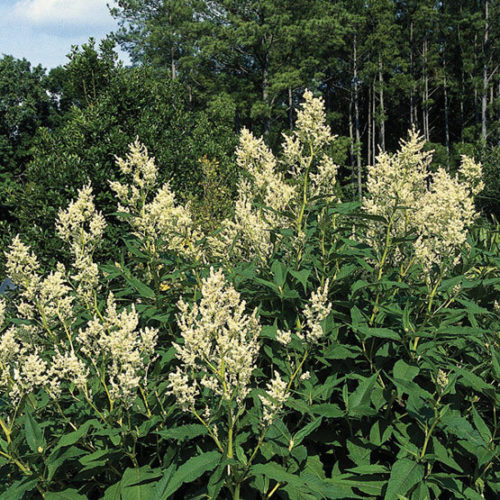
Persicaria polymorpha (Giant fleeceflower)

Persicaria polymorpha Photo/Illustration: Courtesy of Plant Delights

(Based on 1 user review)

Rate this plant

Plant Showcase - from our advertisers


Hardiness Zones: 1 2 3 4 5 6 7 8 9 10 11
Botanical Name: Persicaria polymorpha per-sih-KAR-ee-ah pol-ee-MOR-fah Common Name: Giant fleeceflower Synonyms: Bistorta polymorpha, Polygonum polymorpha Genus: Persicaria
This massive herbaceous shrub needs a lot of room to show off its vase-shaped form, but it does not spread or self-sow like some of its relatives. It blooms close to the ground from June and continues throughout the summer atop 6-foot-tall stems. The large, white, astilbe-like blossoms fade to pink and then reddish-brown as the season comes to a close. 
Noteworthy characteristics: Persicaria are rhizomatous or stoloniferous plants that are spreading and sometimes invasive. They have fleshy stems and conspicuously veined leaves, some of which exhibit autumn color. Many are suitable in a mixed container or border, others naturalized in a woodland or meadow. All plant parts may cause skin irritation on contact and stomach upset if ingested. 
Care: It prefers moist soil but can tolerate some shade and dry conditions.
Propagation: Divide in spring or fall. Sow seed in spring in a cold frame.
Problems: Aphids, Japanese beetles, slugs, snails.
Height 3 ft. to 6 ft.
Spread 6 ft. to 10 ft.
Growth Habit Clumps
Growth Pace Fast Grower
Light Full Sun to Part Shade
Moisture Adaptable
Maintenance Low
Tolerance Frost Tolerant
Characteristics Attracts Birds; Attracts Butterflies; Showy Flowers; Showy Seed Heads
Bloom Time Summer
Flower Color White Flower
Uses Beds and Borders, Specimen Plant/ Focal Point, Waterside
Style Cottage Garden
Seasonal Interest Spring Interest, Summer Interest, Fall Interest
Type Perennials

Plants you might also like

Echinacea purpurea Echinacea purpurea
(Purple coneflower)
(2 user reviews)
Hardiness Zones: 1 2 3 4 5 6 7 8 9 10 11

Because of its carefree performance, this native meadow perennial with daisy-like flowers appropriately inhabits the gardens of many. It blooms from midsummer into early autumn, with prominent, copper-orange central cones surrounded by rose-purple, ray petals (to 5 inches across).

Echinacea purpurea 'Magnus' Echinacea purpurea 'Magnus'
(Purple coneflower)
(12 user reviews)
Hardiness Zones: 1 2 3 4 5 6 7 8 9 10 11

This native meadow derivative has vibrant, daisy-like flowers that bloom from midsummer into early autumn. Its prominent, dark orange central cones are surrounded by larger (to 7 inches across) and more horizontal, reddish-pink, ray petals than the species.

Echinacea purpurea ‘Bright Star’ Echinacea purpurea ‘Bright Star’
(Purple coneflower)
Be the first to rate this plant
Hardiness Zones: 1 2 3 4 5 6 7 8 9 10 11

This native meadow derivative with daisy-like flowers blooms from early summer into early autumn. 'Bright Star' has prominent, copper-orange central cones surrounded by red-purple ray petals (to 5 inches across), and grows to less than 3 feet tall.

Rudbeckia fulgida var. sullivantii 'Goldsturm' Rudbeckia fulgida var. sullivantii 'Goldsturm'
(Orange Coneflower, Black-eyed Susan)
(12 user reviews)
Hardiness Zones: 1 2 3 4 5 6 7 8 9 10 11

Large flowers consisting of brassy orange-yellow rays surrounding brown cones are what make this plant so popular. It blooms for 7 or 8 weeks beginning in midsummer. The flowers top 18- to 30-inch-tall plants that will readily self sow in cultivated soils. 

no image available Echinacea angustifolia
(Coneflower)
Be the first to rate this plant
Hardiness Zones: 1 2 3 4 5 6 7 8 9 10 11

This native meadow perennial has daisy-like blossoms in early summer. It bears copper-orange central cones surrounded by short, arching, ray petals in pink or purple-pink, and occasionally white.