previous
  • Slideshow: Beautiful Clematis
    Slideshow: Beautiful Clematis
  • Lawn Alternatives
    Lawn Alternatives
  • Make a Succulent Topiary
    Make a Succulent Topiary
  • Indeterminate or Determinate Tomatoes?
    Indeterminate or Determinate Tomatoes?
  • Thoughts From a Foreign Field
    Thoughts From a Foreign Field
  • In Pursuit of the Perfect Potting Shed
    In Pursuit of the Perfect Potting Shed
  • Building a Compost Bin
    Building a Compost Bin
  • Plants that Spark!
    Plants that Spark!
  • Fast-Growing Trees for Impatient Gardeners
    Fast-Growing Trees for Impatient Gardeners
  • Colorful Selections for Shade
    Colorful Selections for Shade
  • Homegrown / Homemade
    Homegrown / Homemade
  • Dwarf Citrus Trees
    Dwarf Citrus Trees
  • Pretty in Pink
    Pretty in Pink
  • Stylish Shady Containers
    Stylish Shady Containers
  • NEW Video Series: There's a Better Way
    NEW Video Series: There's a Better Way
  • Mulch for a Healthy Garden
    Mulch for a Healthy Garden
  • Elephant's Ears
    Elephant's Ears
  • Containers as Focal Points
    Containers as Focal Points
  • Save Money by Growing Your Own
    Save Money by Growing Your Own
  • Fragrant Plants for Pathways
    Fragrant Plants for Pathways
  • Comfortable Alfresco Dining
    Comfortable Alfresco Dining
  • 6 Tips for Weed Control
    6 Tips for Weed Control
  • Designing with Curved Terraces
    Designing with Curved Terraces
  • Plant an Easy-to-Water Strawberry Jar
    Plant an Easy-to-Water Strawberry Jar
  • Garden Confidential: A Plant Walks into a Bar
    Garden Confidential: A Plant Walks into a Bar
next

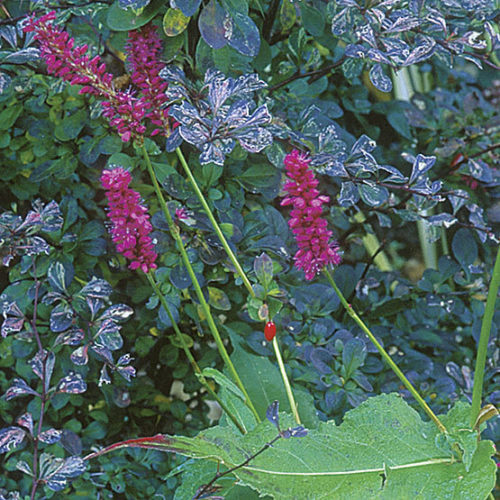
Persicaria amplexicaulis (Bistort, Mountain fleece)

Persicaria amplexicaulis Photo/Illustration: Steve Silk


Be the first to rate this plant

Plant Showcase - from our advertisers


Hardiness Zones: 1 2 3 4 5 6 7 8 9 10 11
Botanical Name: Persicaria amplexicaulis per-sih-KAR-ee-ah am-pleks-ih-KAWL-is Common Name: Bistort, Mountain fleece Synonyms: Bistorta amplexicaulis, Polygonum amplexicaule Genus: Persicaria
This vigorous, but noninvasive perennial flowers from early summer into autumn with bright red, purple, or white blossoms. The narrow blossoms are up to 4 inches long, and are held on long stalks above pointed, slightly puckered leaves. It grows to 4 feet high and wide.
Noteworthy characteristics: Persicaria are rhizomatous or stoloniferous plants that are spreading and sometimes invasive. They have fleshy stems and conspicuously veined leaves, some of which exhibit autumn color. Many are suitable in a mixed container or border, others naturalized in a woodland or meadow. All plant parts may cause skin irritation on contact and stomach upset if ingested.  
Care: Grow in moist soil in full sun to partial shade.
Propagation: Divide plants in spring or fall. Sow seed in spring in a cold frame.
Problems: Aphids, Japanese beetles, slugs, snails
Height 3 ft. to 6 ft.
Spread 3 ft. to 6 ft.
Growth Habit Spreads
Growth Pace Moderate Grower
Light Full Sun to Part Shade
Moisture Medium to Wet
Maintenance Low
Tolerance Frost Tolerant
Characteristics Attracts Birds; Attracts Butterflies; Showy Flowers
Bloom Time Fall; Summer
Flower Color Purple/ Lavender Flower; Red Flower; White Flower
Uses Beds and Borders, Ground Covers, Cut Flower, Dried Flower, Naturalizing, Waterside
Style Cottage Garden, Meadow Garden
Seasonal Interest Summer Interest, Fall Interest
Type Perennials

Plants you might also like

Persicaria amplexicaulis 'Firetail' Persicaria amplexicaulis 'Firetail'
(Bistort, Mountain fleece)
(1 user review)
Hardiness Zones: 1 2 3 4 5 6 7 8 9 10 11

This vigorous but noninvasive perennial flowers from early summer into autumn with crimson blossoms to 6 inches long. Its leaves are dark green, arrow-shaped, and slightly puckered. It grows to 4 feet high and wide.

Echinacea purpurea 'Magnus' Echinacea purpurea 'Magnus'
(Purple coneflower)
(12 user reviews)
Hardiness Zones: 1 2 3 4 5 6 7 8 9 10 11

This native meadow derivative has vibrant, daisy-like flowers that bloom from midsummer into early autumn. Its prominent, dark orange central cones are surrounded by larger (to 7 inches across) and more horizontal, reddish-pink, ray petals than the species.

Echinacea purpurea ‘Bright Star’ Echinacea purpurea ‘Bright Star’
(Purple coneflower)
Be the first to rate this plant
Hardiness Zones: 1 2 3 4 5 6 7 8 9 10 11

This native meadow derivative with daisy-like flowers blooms from early summer into early autumn. 'Bright Star' has prominent, copper-orange central cones surrounded by red-purple ray petals (to 5 inches across), and grows to less than 3 feet tall.

Echinacea purpurea Echinacea purpurea
(Purple coneflower)
(2 user reviews)
Hardiness Zones: 1 2 3 4 5 6 7 8 9 10 11

Because of its carefree performance, this native meadow perennial with daisy-like flowers appropriately inhabits the gardens of many. It blooms from midsummer into early autumn, with prominent, copper-orange central cones surrounded by rose-purple, ray petals (to 5 inches across).

Salvia pratensis Salvia pratensis
(Meadow clary)
Be the first to rate this plant
Hardiness Zones: 1 2 3 4 5 6 7 8 9 10 11

This woody-stemmed perennial produces sticky spikes of deep violet or, rarely, white to pink flowers. It blooms from early summer to autumn; reblooming is most reliable if spent flowers are deadheaded promptly. It has wrinkled leaves and forms an upright clump 3 feet tall by 1 foot wide. This salvia is most noted for its many hybirds with S. nemerosa.