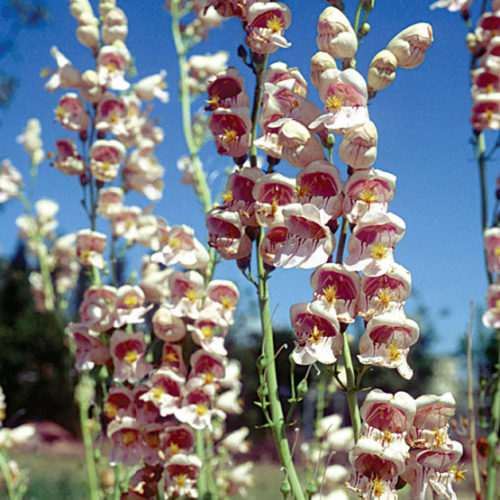
Penstemon palmeri (Palmer's penstemon)

Penstemon palmeri Photo/Illustration: Courtesy of www.highcountrygardens.com


Be the first to rate this plant

Hardiness Zones: 1 2 3 4 5 6 7 8 9 10 11
Botanical Name: Penstemon palmeri PEN-steh-mon PALM-er-eye Common Name: Palmer's penstemon Genus: Penstemon

Palmer's penstemon is much more than the typical sharp, prickly, gray-leaved plants that come to mind when we think of desert plants. This southwestern native thrives in the harshest conditions and is a true showstopper when in bloom in late spring or early summer. The snapdragon-like pale pink flowers have a sweet-honey scent and are a favorite among bumblebees. Its attractive toothed, sage green leaves skirt each plant's upright stems the remainder of the gardening season.

This perennial wildflower is one of the largest and most dramatic penstemons. Because of its height, Palmer's penstemon can be used in the back of the border or as a focal point near a patio or walkway where its fragrance can be enjoyed. In an informal planting, it looks great planted alongside other native penstemons and grasses. The best rule of thumb for this or any other waterwise plant is to group it with others that have similar maintenance and water requirements.


Noteworthy characteristics: This native of the southwestern U.S. is drought tolerant, tall, and has fragrant flowers.
Care: Provide full sun and lean, sandy, well-drained soil. Plant with the crown an inch or two above the soil surface. It will not tolerate extra water, fertilizer, or mulch. Deadhead to maintain a tidy appearance. This plant can be short-lived; allowing a few flowers to go to seed and self-sow can help prolong its stay.
Propagation: From seed or by division.
Height 3 ft. to 6 ft.
Spread 1 ft. to 3 ft.
Light Full Sun Only
Moisture Dry to Medium
Maintenance Low
Tolerance Drought Tolerant
Characteristics Attracts Hummingbirds; Native; Self Seeds; Showy Flowers
Bloom Time Early Summer; Late Spring
Flower Color Pink Flower
Uses Beds and Borders
Style Desert Garden, Meadow Garden
Seasonal Interest Spring Interest, Summer Interest
Type Perennials

Plants you might also like

Dianthus deltoides Dianthus deltoides
(Maiden pink)
(1 user review)
Hardiness Zones: 1 2 3 4 5 6 7 8 9 10 11

This mat-forming species with dark green leaves is one of the easiest to grow.  Blossoms range from white to red and are usually single and without fragrance. Use as bedding or in rock gardens.

Agastache foeniculum Agastache foeniculum
(Anise hyssop)
(1 user review)
Hardiness Zones: 1 2 3 4 5 6 7 8 9 10 11

A classic plant for both herb gardens and borders, anise hyssop is composed of erect branches of mint-and-licorice-scented, medium green leaves ending in fuzzy spikes of small lavender flowers. The plant grows to 3 to 5 feet tall and 1 foot wide and reseeds freely. The flowers are edible and are charming crumbled into salads. The flowers are highly attractive to bees, butterflies, and hummingbirds.

Hemerocallis 'Blackeyed Stella' Hemerocallis 'Blackeyed Stella'
(Daylily)
Be the first to rate this plant
Hardiness Zones: 1 2 3 4 5 6 7 8 9 10 11

Daylilies are classic, extremely popular garden plants. They feature long, arching, strappy leaves and long stems of generally 6-petaled flowers, though double flowers are popular as well. Each flower lasts only one day, hence the plant’s common name. Daylilies come in a wide range of colors, from cream and cheery yellow to peach, orange, fiery red, deep burgundy, pink, and purple. Some have contrasting throats and "eye-zones." Daylilies are ideal for a mixed herbaceous perennial border.

Ratibida columnifera Ratibida columnifera
(Mexican hat, Prairie coneflower, Long-head coneflower)
(1 user review)
Hardiness Zones: 1 2 3 4 5 6 7 8 9 10 11

This perennial coneflower, sometimes grown as an annual, has a long season of flowers on thin, branching stems. The flowers resemble small hats, with yellow reflexed ray florets and large greenish-brown columnar centers.

Hemerocallis 'Cool Jazz' Hemerocallis 'Cool Jazz'
(Daylily)
Be the first to rate this plant
Hardiness Zones: 1 2 3 4 5 6 7 8 9 10 11

Daylilies are classic, extremely popular garden plants. They feature long, arching, strappy leaves and long stems of generally 6-petaled flowers, though double flowers are popular as well. Each flower lasts only one day, hence the plant’s common name. Daylilies come in a wide range of colors, from cream and cheery yellow to peach, orange, fiery red, deep burgundy, pink, and purple. Some have contrasting throats and "eye-zones." Daylilies are ideal for a mixed herbaceous perennial border.