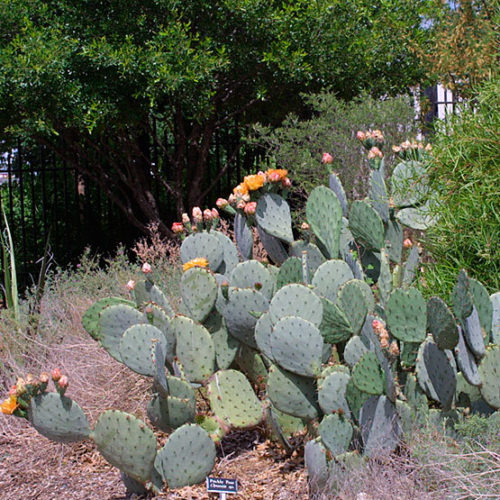
Opuntia compressa (Eastern prickly pear cactus)

Opuntia compressa Photo/Illustration: Steve Aitken


Be the first to rate this plant

Hardiness Zones: 1 2 3 4 5 6 7 8 9 10 11
Botanical Name: Opuntia compressa Common Name: Eastern prickly pear cactus Synonyms: Opuntia humifusa Genus: Opuntia
Prickly pear cactus is a clump-forming and semi-prostrate plant. Flattened round-to-oval green pads 2-10 inches across have scattered needle-like spines and tufts of glochids (bristles). Showy bright yellow flowers appear in late spring and summer, maturing to edible, pulpy, red or purple fruit.
Noteworthy characteristics: Bristles cause intense skin irritation and are difficult to remove. This plant becomes scraggly as the pads lose water before winter, greening up again in spring.
Care: Easy to grow in dry, sandy, or gravelly soil. Tolerates clay soil with good drainage. Naturalizes by pads breaking off and rooting.
Propagation: From separated root stem segments.
Problems: Cladode rots, zonate leaf spot, black spot, mealybugs, and scale insects. Also bacterial soft rot and viruses.
Height 6 in. to 12 in.
Spread 1 ft. to 3 ft.
Growth Habit Clumps
Light Full Sun to Part Shade
Moisture Dry
Characteristics Native; Showy Flowers
Bloom Time Spring; Summer
Flower Color Yellow Flower
Uses Beds and Borders, Naturalizing
Style Desert Garden, Rock Garden, Xeric Bed
Seasonal Interest Summer Interest
Type Cacti and Succulents

Plants you might also like

Othonna capensis Othonna capensis
Be the first to rate this plant
Hardiness Zones: 1 2 3 4 5 6 7 8 9 10 11

This evergreen, perennial succulent has pudgy, swollen, deep green stems which resemble a pickle, similar to those of the iceplant. Flowers begin as pearl-sized, pale mauve capsules sitting atop succulent 1-inch-high foliage, then open to reveal half-inch-long, yellow daisylike flowers. Blooms appear from mid-spring into fall.

Hesperaloe parviflora Hesperaloe parviflora
(Red yucca)
Be the first to rate this plant
Hardiness Zones: 1 2 3 4 5 6 7 8 9 10 11

A clump-forming succulent, red yucca has arching, leathery, linear foliage rising to between 2 and 3 feet tall. Dark olive-green leaves with no thorns or spines are sparsely covered with fibrous strands along the margins. Deep coral pink flowers with golden yellow throats crowd the length of the stalks that reach three feet or more. Foliage has a reddish bronze hue during winter's chill for year-round interest.

Agave parryi Agave parryi
(Mescal)
(2 user reviews)
Hardiness Zones: 1 2 3 4 5 6 7 8 9 10 11

This plant has a dense rosette of fleshy blue-gray leaves and produces tall, cream-colored flowers tinged with red or pink in summer.

Sedum ‘Autumn Joy’ Sedum ‘Autumn Joy’
(Stonecrop)
(12 user reviews)
Hardiness Zones: 1 2 3 4 5 6 7 8 9 10 11

This plant is as dependable and adaptable as they come. Its flowers bloom from August into November; they open pink and mature to a copper befitting of autumn. It is 2 feet tall and wide, with succulent stems and leaves. 'Autumn Joy' looks great with ornamental grasses.  

Aeonium arboreum 'Zwartkop' Aeonium arboreum 'Zwartkop'
(Black rose)
(2 user reviews)
Hardiness Zones: 1 2 3 4 5 6 7 8 9 10 11

Even those accustomed to the diversity and color of succulents are amazed by the "flowers" of black rose. They are actually burgundy-black leaves arranged in rosettes at the ends of stalklike stems. The bright yellow flowers in winter are a stunning contrast against the dark foliage. 'Zwartkop' is a wonderful backdrop plant, providing a black velvet canvas against which many companion plants shine.