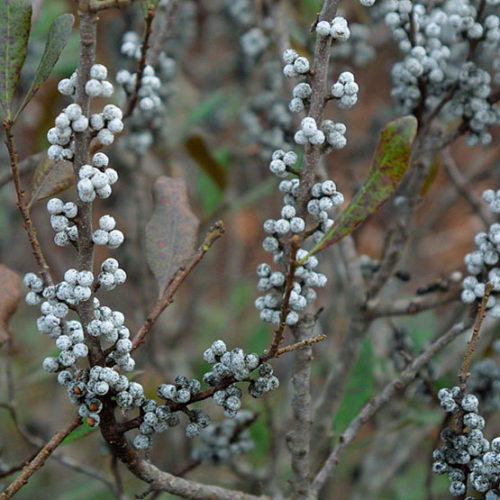
Myrica pensylvanica (Northern bayberry, Bayberry)

Myrica pensylvanica Photo/Illustration: Jennifer Benner


Be the first to rate this plant

Hardiness Zones: 1 2 3 4 5 6 7 8 9 10 11
Botanical Name: Myrica pensylvanica mih-REE-kah pen-sil-VAN-ih-kah Common Name: Northern bayberry, Bayberry Genus: Myrica
This North American coastal native exhibits quiet beauty and an easy-going habit. It grows to 10 feet tall, and spreads slowly to form colonies with glossy, semi-evergreen aromatic leaves.  It looks equally at home as a hedge, in an herb garden, or in a natural meadow.
Noteworthy characteristics: Myricas are most effective en masse, for use in woodlands, meadows, borders, and formal areas. They have aromatic, dark green leaves and small flowers. The clustered fruits are small, bluish-black spheres encrusted with a whitish, waxy coating; plant at least one male to pollinate the female species. Many species were used for making bayberry candles, sealing wax, and soap. Some species are native to North America. 
Care: Grow in moist, humus-rich, preferably acidic soil in full sun to partial shade. They are tolerant of poor soils, drought, wet soils, and coastal conditions.
Propagation: Layer in spring, root greenwood cuttings in summer, or sow seed in a cold frame when ripe.
Problems: Leaf spots, dieback, stem rots, root rots, rust.
Height 6 ft. to 10 ft.
Spread 10 ft. to 15 ft.
Growth Habit Spreads
Growth Pace Moderate Grower
Light Full Sun to Part Shade
Moisture Adaptable
Maintenance Low
Tolerance Drought Tolerant;Frost Tolerant
Characteristics Attracts Birds; Fragrant Foliage; Native; Showy Foliage; Showy Fruit
Bloom Time Spring
Flower Color Green Flower; Yellow Flower
Uses Beds and Borders, Hedge, Naturalizing, Roadside, Screening, Waterside
Style Herb Garden, Meadow Garden, Woodland Garden
Seasonal Interest Winter Interest, Spring Interest, Summer Interest, Fall Interest
Type Shrubs

Plants you might also like

Rhus aromatica ‘Gro-low’ Rhus aromatica ‘Gro-low’
(Fragrant sumac)
(1 user review)
Hardiness Zones: 1 2 3 4 5 6 7 8 9 10 11

This vigorous shrub hugs the ground (to 2 feet tall) and spreads out to 8 feet, making it an excellent choice for stablizing a bank or smothering weeds. It has small yellow flowers, hairy red fruits, and glossy leaves that change to gorgeous orange-red in autumn. 

Rosa 'Blanc Double de Coubert' Rosa 'Blanc Double de Coubert'
(Hedgehog rose, Ramanas rose, Japanese rose, Sea tomato)
(1 user review)
Hardiness Zones: 1 2 3 4 5 6 7 8 9 10 11

The white of this rose has a purity of color that is without equal. It produces semi-double, very fragrant flowers from spring to fall, which are sometimes followed by orange hips. It grows to 6 feet high and wide.   

Rosa 'Charles Albanel' Rosa 'Charles Albanel'
(Hedgehog rose, Ramanas rose, Japanese rose, Sea tomato)
Be the first to rate this plant
Hardiness Zones: 1 2 3 4 5 6 7 8 9 10 11

This spreading rose grows to only 2 feet tall, making it an ideal groundcover for a steep bank or roadside. It produces fragrant, double, deep-pink blossoms from spring to fall.  

Rosa rugosa var. alba Rosa rugosa var. alba
(Hedgehog rose, Ramanas rose, Japanese rose, Sea tomato)
Be the first to rate this plant
Hardiness Zones: 1 2 3 4 5 6 7 8 9 10 11

This variety has single, papery white blossoms that open from light pink buds and have contrasting yellow stamens. The heavily-scented flowers are followed by reddish-orange hips. It grows up to 6 feet high.

Rosa 'Frau Dagmar Hastrup' Rosa 'Frau Dagmar Hastrup'
(Hedgehog rose, Ramanas rose, Japanese rose, Sea tomato)
(1 user review)
Hardiness Zones: 1 2 3 4 5 6 7 8 9 10 11

This choice rose has single, gently cupped light-pink flowers that exude an intense, clove-scented perfume. It blooms in spring and sporadically throughout the season, and produces red hips. In autumn, the foliage turns deep maroon, which changes to yellow tinged with coppery highlights. It grows to 3 to 4 feet high and wide.