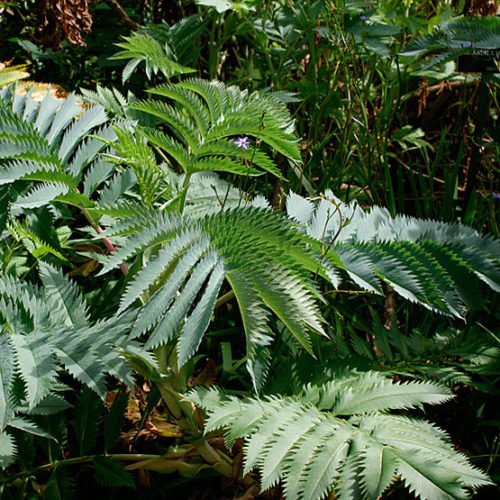
Melianthus major (Honey bush)

Melianthus major Photo/Illustration: Michelle Gervais

(Based on 2 user reviews)

Rate this plant

Hardiness Zones: 1 2 3 4 5 6 7 8 9 10 11
Botanical Name: Melianthus major mel-ee-AN-thus MAY-jor Common Name: Honey bush Genus: Melianthus
Honey bush has attractive, 12- to 20-inch-long pinnate leaves with sharply toothed silver-green leaflets. It bears spike-like racemes of oddly scented brownish crimson to brick-red flowers from late spring to midsummer.
Care: Grow in fertile, moist but well-drained soil. Shelter from cold and wind, and protect from excessive winter moisture. Where not hardy, grow in a cold greenhouse and plant or stand outside in summer. Or treat as a perennial; it will resprout annually from the base where temperatures do not fall below 23°F.
Propagation: Root basal or softwood cuttings in late spring or early summer.
Problems: Spider mites and whiteflies under glass.
Height 6 ft. to 10 ft.
Spread 3 ft. to 6 ft.
Growth Habit Spreads
Light Full Sun Only
Moisture Medium Moisture
Characteristics Fragrant Flowers; Showy Foliage
Bloom Time Spring; Summer
Flower Color Red Flower
Uses Beds and Borders, Container, Specimen Plant/ Focal Point
Seasonal Interest Spring Interest, Summer Interest
Type Shrubs

Plants you might also like

Yucca filamentosa ‘Golden Sword’ Yucca filamentosa ‘Golden Sword’
(Adam's needle, Bear grass, Weak-leaf yucca, Golden Sword soapwort)
Be the first to rate this plant
Hardiness Zones: 1 2 3 4 5 6 7 8 9 10 11

This easy to grow evergreen yucca bears dramatic, sword-shaped yellow leaves with a dark green edge. Not as staunchly upright as some yuccas, its leaf tips sometimes droop with age. Its foliage color is best from fall to spring. Plants grow to nearly 2 feet in height and 3 feet in width. In summer, it produces a 6-foot-tall spike covered with nodding, fragrant, white bell-shaped flowers.

Robinia hispida Robinia hispida
(Rose acacia, Bristly locust)
Be the first to rate this plant
Hardiness Zones: 1 2 3 4 5 6 7 8 9 10 11

This showy flowering shrub grows to 8 feet tall and wide and features dark green, compound pinnate leaves on bristly stems and pendant clusters of fragrant, pea-like, rose-pink flowers that are attractive to bees and butterflies in late spring and early summer. The flowers are occasionally followed by bristly, reddish-brown seed pods. Native to the southeastern United States, this aggressive shrub spreads by suckers and is considered invasive in Michigan, New Jersey, Ohio, Pennsylvania, and Washington. All parts of this plant are at least mildly poisonous.

Melampodium leucanthum Melampodium leucanthum
(Blackfoot daisy)
Be the first to rate this plant
Hardiness Zones: 1 2 3 4 5 6 7 8 9 10 11

A native perennial shrub that grows to about 2 feet tall and wide and covers itself the whole season with honey-scented, white and yellow daisy flowers. The foliage is typical of the aster family. Plant en masse in a well-drained border or use in a rock garden. Blackfoot daisy can be short-lived.

no image available Nandina domestica
(Heavenly bamboo)
(1 user review)
Hardiness Zones: 1 2 3 4 5 6 7 8 9 10 11

Yellow-white flowers appear in late spring, followed by prolific berries that ripen from green to bright-red or purple in fall. The elegant foliage turns fiery red in fall. There are low, ground-hugging Nandina varieties; medium-sized shrubs for mid-border; and tall, bushy types for the back of the border.

Clematis texensis 'Duchess of Albany' Clematis texensis 'Duchess of Albany'
(Scarlet clematis, Leather flower, Texas clematis)
Be the first to rate this plant
Hardiness Zones: 1 2 3 4 5 6 7 8 9 10 11

This vigorous climber can easily cover a support of 8 to 10 feet tall once established. Finely textured, dense light-green foliage makes an excellent foil for dainty, pink and carmine teardrop-shaped flowers 2 inches across. Blooms appear in early August and continue well into autumn.