previous
  • Save Money by Growing Your Own
    Save Money by Growing Your Own
  • Stylish Shady Containers
    Stylish Shady Containers
  • Garden Confidential: A Plant Walks into a Bar
    Garden Confidential: A Plant Walks into a Bar
  • Make a Succulent Topiary
    Make a Succulent Topiary
  • 6 Tips for Weed Control
    6 Tips for Weed Control
  • Fragrant Plants for Pathways
    Fragrant Plants for Pathways
  • Colorful Selections for Shade
    Colorful Selections for Shade
  • Pretty in Pink
    Pretty in Pink
  • Lawn Alternatives
    Lawn Alternatives
  • Fast-Growing Trees for Impatient Gardeners
    Fast-Growing Trees for Impatient Gardeners
  • Building a Compost Bin
    Building a Compost Bin
  • Slideshow: Beautiful Clematis
    Slideshow: Beautiful Clematis
  • Homegrown / Homemade
    Homegrown / Homemade
  • In Pursuit of the Perfect Potting Shed
    In Pursuit of the Perfect Potting Shed
  • Dwarf Citrus Trees
    Dwarf Citrus Trees
  • Elephant's Ears
    Elephant's Ears
  • Containers as Focal Points
    Containers as Focal Points
  • Comfortable Alfresco Dining
    Comfortable Alfresco Dining
  • NEW Video Series: There's a Better Way
    NEW Video Series: There's a Better Way
  • Indeterminate or Determinate Tomatoes?
    Indeterminate or Determinate Tomatoes?
  • Mulch for a Healthy Garden
    Mulch for a Healthy Garden
  • Designing with Curved Terraces
    Designing with Curved Terraces
  • Plants that Spark!
    Plants that Spark!
  • Plant an Easy-to-Water Strawberry Jar
    Plant an Easy-to-Water Strawberry Jar
  • Thoughts From a Foreign Field
    Thoughts From a Foreign Field
next

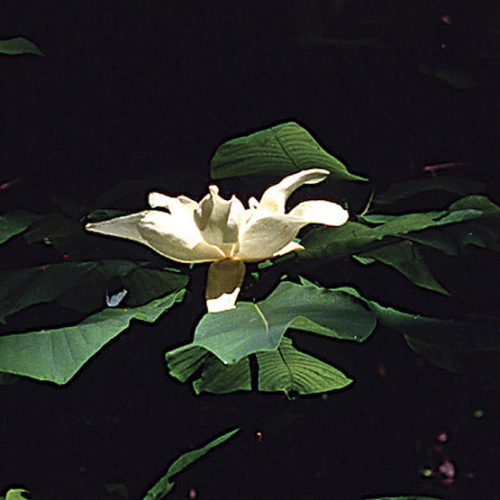
Magnolia macrophylla (Bigleaf magnolia, Large-leaved cucumber tree, Umbrella tree)

Magnolia macrophylla Photo/Illustration: Virginia Small


Be the first to rate this plant

Plant Showcase - from our advertisers


Hardiness Zones: 1 2 3 4 5 6 7 8 9 10 11
Botanical Name: Magnolia macrophylla mag-NO-lee-ah mak-roe-FIL-lah Common Name: Bigleaf magnolia, Large-leaved cucumber tree, Umbrella tree Genus: Magnolia
This deciduous species has remarkable leaves that are over 3 feet long and 1 foot wide. They are light green above and silvery beneath. It flowers in early summer with creamy-white, fragrant blossoms that reach a foot across. Magnolia macrophylla grows up to 40 feet tall and wide. It is native to North America.
Care: Grow in moist, well-drained, preferably acidic to neutral soil in sun or partial shade; magnolias do not tolerate wet feet. Magnolia flowerbuds are susceptible to late-season frosts; shelter large-leaved species from windy locations. Prune trees and deciduous shrubs in late winter or late summer to prevent bleeding of sap; prune minimally to maintain a healthy framework. 
Propagation: Sow seeds in autumn or stratify to hasten germination. Root softwood cuttings in early summer. Magnolias can be layered in early spring, grafted in winter, and propagated by bud in summer.
Problems: Bacterial leaf spot, spot anthracnose, canker, dieback, butt rot, powdery mildew, anthracnose, fungal spots, weevils, snails, scale insects, thrips, planthoppers.
Height Over 30 ft.
Spread Over 30 ft.
Growth Habit Clumps
Growth Pace Moderate Grower
Light Full Sun to Part Shade
Moisture Medium Moisture
Maintenance Low
Characteristics Fragrant Flowers; Native; Showy Flowers; Showy Foliage; Showy Fruit
Bloom Time Summer
Flower Color White Flower
Uses Flowering Tree, Naturalizing, Specimen Plant/ Focal Point, Waterside
Style Formal Garden, Woodland Garden
Seasonal Interest Spring Interest, Summer Interest, Fall Interest
Type Trees

Plants you might also like

Magnolia ashei Magnolia ashei
(Ashe magnolia)
Be the first to rate this plant
Hardiness Zones: 1 2 3 4 5 6 7 8 9 10 11

This spreading deciduous shrub or small tree has large, light-green glossy leaves to 2 feet long. It flowers in early summer with jasmine- and citrus-scented blossoms in white with maroon markings at the base. Each flower is up to 10 inches across. It grows up to 30 feet tall and wide and is a native of North America.

no image available Magnolia denudata 'Forrest's Pink'
(Lily tree, Magnolia, Yulan)
Be the first to rate this plant
Hardiness Zones: 1 2 3 4 5 6 7 8 9 10 11

This cultivar creates a fragrant cloud of rich bubblegum-pink blossoms on bare branches in spring. It grows to 40 feet tall and wide.

Oxydendrum arboreum Oxydendrum arboreum
(Sourwood)
Be the first to rate this plant
Hardiness Zones: 1 2 3 4 5 6 7 8 9 10 11

Sourwood, the lone species of the genus, is found in woodlands and along streams of eastern North America. This plant (named for the sour taste of its leaves) forms a pyramidal tree to 30 feet tall, with canoe-shaped, glossy leaves that turn vivid maroon, yellow, or purple in autumn. In late summer, its delicate panicles of fragrant, urn-shaped flowers spray forward, decorating the tree in white. The blossoms, which resemble lily-of-the-valley, are followed by yellowish seed capsules that turn brown and persist into winter. It makes an outstanding specimen both for a prominent position and also for a naturalized setting.

Magnolia kobus Magnolia kobus
(Magnolia)
Be the first to rate this plant
Hardiness Zones: 1 2 3 4 5 6 7 8 9 10 11

This deciduous tree grows to 40 feet tall and blooms in early spring with a profusion of white-tinged pink goblet to saucer-shaped blossoms that are 3 to 4 inches wide.

Magnolia stellata Magnolia stellata
(Star magnolia)
Be the first to rate this plant
Hardiness Zones: 1 2 3 4 5 6 7 8 9 10 11

This species is a small, spreading tree with lovely, upward-facing, star-shaped blossoms. Each pure white flower—they are occasionally flushed pink— is 5 inches across and comprised of up to 15 individual petals. They light up the tree's bare branches in early to mid-spring.