previous
  • Stylish Shady Containers
    Stylish Shady Containers
  • Plant an Easy-to-Water Strawberry Jar
    Plant an Easy-to-Water Strawberry Jar
  • Comfortable Alfresco Dining
    Comfortable Alfresco Dining
  • Fine Gardening's Tip Off!
    Fine Gardening's Tip Off!
  • Containers as Focal Points
    Containers as Focal Points
  • Indeterminate or Determinate Tomatoes?
    Indeterminate or Determinate Tomatoes?
  • Dwarf Citrus Trees
    Dwarf Citrus Trees
  • Garden Confidential: A Plant Walks into a Bar
    Garden Confidential: A Plant Walks into a Bar
  • Homegrown / Homemade
    Homegrown / Homemade
  • Meet Our Mini-Magazines
    Meet Our Mini-Magazines
  • Thoughts From a Foreign Field
    Thoughts From a Foreign Field
  • 6 Tips for Weed Control
    6 Tips for Weed Control
  • In Pursuit of the Perfect Potting Shed
    In Pursuit of the Perfect Potting Shed
  • NEW Video Series: There's a Better Way
    NEW Video Series: There's a Better Way
  • Make a Succulent Topiary
    Make a Succulent Topiary
  • Slideshow: Beautiful Clematis
    Slideshow: Beautiful Clematis
  • Fragrant Plants for Pathways
    Fragrant Plants for Pathways
  • Save Money by Growing Your Own
    Save Money by Growing Your Own
  • Elephant's Ears
    Elephant's Ears
  • Designing with Curved Terraces
    Designing with Curved Terraces
  • Mulch for a Healthy Garden
    Mulch for a Healthy Garden
  • Building a Compost Bin
    Building a Compost Bin
  • Pretty in Pink
    Pretty in Pink
  • Colorful Selections for Shade
    Colorful Selections for Shade
  • Fast-Growing Trees for Impatient Gardeners
    Fast-Growing Trees for Impatient Gardeners
next

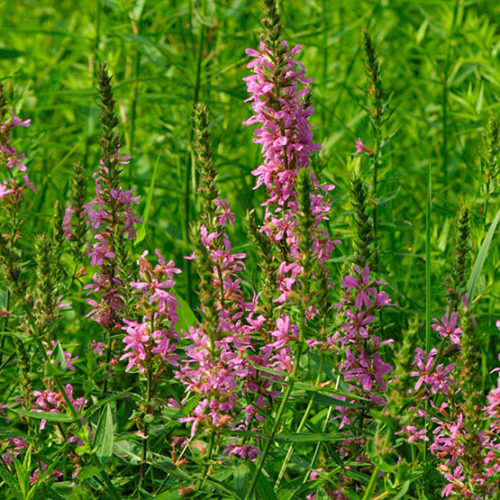
Lythrum salicaria (Purple loosestrife)

Lythrum salicaria Photo/Illustration: Jennifer Benner

(Based on 2 user reviews)

Rate this plant

Plant Showcase - from our advertisers


Hardiness Zones: 1 2 3 4 5 6 7 8 9 10 11
Botanical Name: Lythrum salicaria LITH-rum sal-ih-KARE-ee-ah Common Name: Purple loosestrife Genus: Lythrum
The showy purple spikes of purple loosestrife are attractive in the garden and along roadsides, but the plant's rampant spread has greatly reduced the ecological value of marshes by displacing native wetland vegetation such as cattails (Typha spp.) that wildlife uses as food or shelter. One mature plant can produce over 2 million seeds a year that are easily transported by the wind or water into wetlands. The seeds easily germinate, and no natural predator holds this plant in check. Even cultivars reported to be sterile can produce highly fertile seed if grown with other cultivars or wild loosestrife.
Noteworthy characteristics: Showy purple flower spikes. Highly invasive in all regions.
Care: Grows in any moist soil in full sun.
Propagation: Self-sows with abandon.
Problems: Slugs, snails, Japanese beetles.
Height 3 ft. to 6 ft.
Spread 1 ft. to 3 ft.
Growth Habit Clumps
Growth Pace Invasive/Aggressive Grower
Light Full Sun Only
Moisture Medium to Wet
Maintenance Moderate
Characteristics Showy Flowers
Bloom Time Fall; Summer
Flower Color Pink Flower; Purple/ Lavender Flower
Uses Beds and Borders
Seasonal Interest Summer Interest
Type Perennials

Plants you might also like

Liatris aspera Liatris aspera
(Rough gayfeather, Rough blazing star)
Be the first to rate this plant
Hardiness Zones: 1 2 3 4 5 6 7 8 9 10 11

This tuberous perennial has dense clusters of linear, rough leaves borne in basal tufts to 16 inches long. Dense spikes, up to 18 inches long, of button-like lavender-purple flowerheads are borne in late summer and early autumn. Blooms open from the top of the inflorescences downward.

Agastache foeniculum Agastache foeniculum
(Anise hyssop)
(2 user reviews)
Hardiness Zones: 1 2 3 4 5 6 7 8 9 10 11

A classic plant for both herb gardens and borders, anise hyssop is composed of erect branches of mint-and-licorice-scented, medium green leaves ending in fuzzy spikes of small lavender flowers. The plant grows to 3 to 5 feet tall and 1 foot wide and reseeds freely. The flowers are edible and are charming crumbled into salads. The flowers are highly attractive to bees, butterflies, and hummingbirds.

Hemerocallis 'Autumn Minaret' Hemerocallis 'Autumn Minaret'
(Daylily)
Be the first to rate this plant
Hardiness Zones: 1 2 3 4 5 6 7 8 9 10 11

Daylilies are classic, extremely popular garden plants. They feature long, arching, strappy leaves and long stems of generally 6-petaled flowers, though double flowers are popular as well. Each flower lasts only one day, hence the plant’s common name. Daylilies come in a wide range of colors, from cream and cheery yellow to peach, orange, fiery red, deep burgundy, pink, and purple. Some have contrasting throats and "eye-zones." Daylilies are ideal for a mixed herbaceous perennial border.

Hemerocallis 'Cool Jazz' Hemerocallis 'Cool Jazz'
(Daylily)
Be the first to rate this plant
Hardiness Zones: 1 2 3 4 5 6 7 8 9 10 11

Daylilies are classic, extremely popular garden plants. They feature long, arching, strappy leaves and long stems of generally 6-petaled flowers, though double flowers are popular as well. Each flower lasts only one day, hence the plant’s common name. Daylilies come in a wide range of colors, from cream and cheery yellow to peach, orange, fiery red, deep burgundy, pink, and purple. Some have contrasting throats and "eye-zones." Daylilies are ideal for a mixed herbaceous perennial border.

Hemerocallis 'Elizabeth's Magic' Hemerocallis 'Elizabeth's Magic'
(Daylily)
(1 user review)
Hardiness Zones: 1 2 3 4 5 6 7 8 9 10 11

Daylilies are classic, extremely popular garden plants. They feature long, arching, strappy leaves and long stems of generally 6-petaled flowers, though double flowers are popular as well. Each flower lasts only one day, hence the plant’s common name. Daylilies come in a wide range of colors, from cream and cheery yellow to peach, orange, fiery red, deep burgundy, pink, and purple. Some have contrasting throats and "eye-zones." Daylilies are ideal for a mixed herbaceous perennial border.