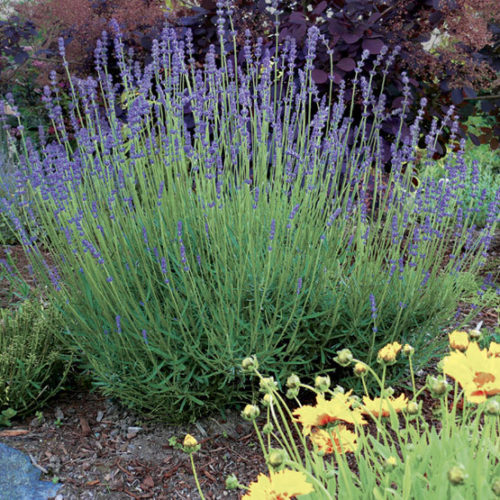
Lavandula angustifolia 'Violet Intrigue'

Lavandula angustifolia 'Violet Intrigue' Photo/Illustration: Courtesy of Skagit Gardens


Be the first to rate this plant

Hardiness Zones: 1 2 3 4 5 6 7 8 9 10 11
Botanical Name: Lavandula angustifolia 'Violet Intrigue' lah-VAN-dew-lah an-gus-tih-FOE-lee-ah Genus: Lavandula
'Violet Intrigue' exhibits the typical handsome gray foliage of good lavenders, but its form and flowers are particularly noteworthy. Each stem is strongly upright, and requires no staking, and the blooms are a deep violet that remains vibrant even when temperatures rise. Other than occasional deadheading, no additional maintenance chores are required.
Noteworthy characteristics: Strong, upright form. Deep violet flowers. Tolerant of heat and humidity.
Care: Provide full sun and humusy, very well-drained soil. Plants may be overwintered indoors in a warm, bright area or in a cold frame or unheated garage.
Height 1 ft. to 3 ft.
Spread 1 ft. to 3 ft.
Light Full Sun Only
Moisture Dry to Medium
Maintenance Moderate
Characteristics Attracts Butterflies; Fragrant Flowers; Fragrant Foliage; Showy Flowers
Bloom Time Early Summer; Late Summer; Summer
Foliage Color Silver/Grey
Flower Color Purple/ Lavender Flower
Uses Beds and Borders, Dried Flower, Suitable as Annual
Style Herb Garden, Cottage Garden, Rock Garden
Seasonal Interest Summer Interest
Type Herbs,Perennials

Plants you might also like

Lavandula × intermedia 'Grosso' Lavandula × intermedia 'Grosso'
('Grosso' lavender)
Be the first to rate this plant
Hardiness Zones: 1 2 3 4 5 6 7 8 9 10 11

This hardy lavender stands out for its unusually large, dark blue-purple flowers, silvery green foliage, and heavy fragrance. It is often used in perfumes. Growing to 30 inches tall and nearly as wide, 'Grosso'  has very long flower spikes and blooms from midsummer into autumn. It is especially attractive as an edging.

Nepeta Little Trudy™ Nepeta Little Trudy™
(Catmint)
Be the first to rate this plant
Hardiness Zones: 1 2 3 4 5 6 7 8 9 10 11

This new compact catmint, with the cultivar name 'Psfike', only reaches 8 to 10 inches tall and 12 to 16 inches wide, the perfect size for containers, bed edges, or other small nooks and crannies. It features the same silvery foliage and summer lavender blooms that we know and love, and thrives in full sun to partial shade and well-drained soil in Zones 4 to 9.

Ocimum × citriodorum 'Pesto Perpetuo' Ocimum × citriodorum 'Pesto Perpetuo'
('Pesto Perpetuo' basil)
Be the first to rate this plant
Hardiness Zones: 1 2 3 4 5 6 7 8 9 10 11

'Pesto Perpetuo' basil not only produces copious amounts of leaves for cooking but also is easy on the eye. It has creamy white variegated leaves and a columnar habit. It does not flower, so nothing will detract from the foliage.

Salvia officinalis 'Berggarten' Salvia officinalis 'Berggarten'
(Common sage, Culinary sage, Purple sage)
Be the first to rate this plant
Hardiness Zones: 1 2 3 4 5 6 7 8 9 10 11

Cooks and gardeners alike are indebted to this evergreen perennial for the unique, pungent flavor and aroma that its gray-green leaves produce. S. 'Berggarten' is more compact than the species, forming a 2-foot tall by 3-foot wide bush with woody stems that may be trimmed back to newly emerging growth or strong stems in spring. In early to mid-summer, it sends up purple flower spikes. It boasts attractively rounded leaves and, like the species, has both ornamental and culinary qualities in an herb garden. It tolerates alkaline soils, but not wet winter conditions.

Salvia nemorosa 'Caradonna' Salvia nemorosa 'Caradonna'
(Sage)
(4 user reviews)
Hardiness Zones: 1 2 3 4 5 6 7 8 9 10 11

This drought-tolerant perennial is noted for its vivid indigo flowers along deep purple-black stems, which gives it a bicolor appearance. It blooms in early summer and then sporadically if spent flowers are deadheaded. It forms an upright clump, with the flower spikes rising to 2 feet in height; its wrinkled, softly hairy leaves form a mound 1 foot high. Plants spread 1 or 2 feet wide. These are some of the showiest plants for containers and mixed borders. Butterflies love them.