previous
  • Dwarf Citrus Trees
    Dwarf Citrus Trees
  • Fast-Growing Trees for Impatient Gardeners
    Fast-Growing Trees for Impatient Gardeners
  • Designing with Curved Terraces
    Designing with Curved Terraces
  • In Pursuit of the Perfect Potting Shed
    In Pursuit of the Perfect Potting Shed
  • Garden Confidential: A Plant Walks into a Bar
    Garden Confidential: A Plant Walks into a Bar
  • Plants that Spark!
    Plants that Spark!
  • Elephant's Ears
    Elephant's Ears
  • Save Money by Growing Your Own
    Save Money by Growing Your Own
  • NEW Video Series: There's a Better Way
    NEW Video Series: There's a Better Way
  • Colorful Selections for Shade
    Colorful Selections for Shade
  • Indeterminate or Determinate Tomatoes?
    Indeterminate or Determinate Tomatoes?
  • Comfortable Alfresco Dining
    Comfortable Alfresco Dining
  • Pretty in Pink
    Pretty in Pink
  • Lawn Alternatives
    Lawn Alternatives
  • Building a Compost Bin
    Building a Compost Bin
  • Slideshow: Beautiful Clematis
    Slideshow: Beautiful Clematis
  • Make a Succulent Topiary
    Make a Succulent Topiary
  • Fragrant Plants for Pathways
    Fragrant Plants for Pathways
  • 6 Tips for Weed Control
    6 Tips for Weed Control
  • Containers as Focal Points
    Containers as Focal Points
  • Thoughts From a Foreign Field
    Thoughts From a Foreign Field
  • Stylish Shady Containers
    Stylish Shady Containers
  • Homegrown / Homemade
    Homegrown / Homemade
  • Plant an Easy-to-Water Strawberry Jar
    Plant an Easy-to-Water Strawberry Jar
  • Mulch for a Healthy Garden
    Mulch for a Healthy Garden
next

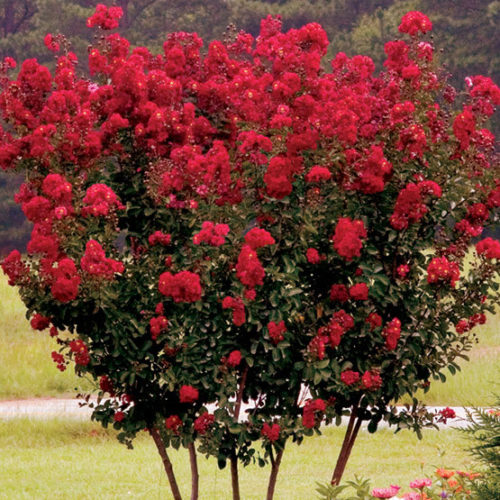
Lagerstroemia indica (Crape myrtle)

Lagerstroemia indica Lagerstroemia 'Red Rocket' Photo/Illustration: Courtesy of Park Seed


Be the first to rate this plant

Plant Showcase - from our advertisers


Hardiness Zones: 1 2 3 4 5 6 7 8 9 10 11
Botanical Name: Lagerstroemia indica lag-er-STRO-mee-ah IN-dih-kah Common Name: Crape myrtle Genus: Lagerstroemia
Crape myrtle is an upright deciduous tree or large shrub. Dark green leaves emerge bronze. White, pink, red, or purple flowers appear from summer to autumn. Peeling gray-and-brown bark is attractive. 
Noteworthy characteristics: Hybrids of L. indica and L. fauriei vary greatly in size, habit, hardiness, and resistance to powdery mildew.
Care: Thrives in moderately fertile, well-drained soil. Grow against a warm, sunny wall where marginally hardy or overwinter in a greenhouse. Can be hard pruned if renovation is required.
Propagation: Root softwood cuttings in late spring, or semi-ripe cuttings in summer.
Problems: Dieback, powdery mildew, aphids, scale insects, mealybugs, and whiteflies.
Height 15 ft. to 30 ft.
Spread 15 ft. to 30 ft.
Light Full Sun Only
Moisture Dry to Medium
Maintenance Low
Characteristics Interesting Bark; Showy Flowers; Showy Seed Heads
Bloom Time Fall; Summer
Flower Color Pink Flower; Purple/ Lavender Flower; Red Flower; White Flower
Uses Flowering Tree, Hedge, Screening, Specimen Plant/ Focal Point
Seasonal Interest Winter Interest, Summer Interest, Fall Interest
Type Trees

Plants you might also like

Lagerstroemia fauriei Lagerstroemia fauriei
Be the first to rate this plant
Hardiness Zones: 1 2 3 4 5 6 7 8 9 10 11

This is a fast-growing, upright deciduous tree with delicate white flowers in early summer. As it matures, it develops a spectacular patchwork of bark in shades of gray, maroon, and brown. Oblong dark green leaves turn red-orange in autumn. Cultivar 'Fantasy' is vigorous and hardier than the species, with exceptional bark.

Heptacodium miconioides Heptacodium miconioides
(Seven-son flower)
Be the first to rate this plant
Hardiness Zones: 1 2 3 4 5 6 7 8 9 10 11

The tiered branches of this fast-growing species are covered with white blossoms for over a month, starting in late summer. The flowers fade to reveal fuchsia calyxes that persist well into autumn. The pale, peeling bark can be exposed by pruning the lower branches of the interior. Although the form of the species is variable (single or multi-stemmed), it can usually be pruned into an elegant vase-shaped specimen, or maintained as a shrub.

Oxydendrum arboreum Oxydendrum arboreum
(Sourwood)
Be the first to rate this plant
Hardiness Zones: 1 2 3 4 5 6 7 8 9 10 11

Sourwood, the lone species of the genus, is found in woodlands and along streams of eastern North America. This plant (named for the sour taste of its leaves) forms a pyramidal tree to 30 feet tall, with canoe-shaped, glossy leaves that turn vivid maroon, yellow, or purple in autumn. In late summer, its delicate panicles of fragrant, urn-shaped flowers spray forward, decorating the tree in white. The blossoms, which resemble lily-of-the-valley, are followed by yellowish seed capsules that turn brown and persist into winter. It makes an outstanding specimen both for a prominent position and also for a naturalized setting.

Sciadopitys verticillata Sciadopitys verticillata
(Japanese umbrella pine)
Be the first to rate this plant
Hardiness Zones: 1 2 3 4 5 6 7 8 9 10 11

This glorious conifer constitutes the sole member of both its genus and plant family. It is without a peer in its beauty; on a mature specimen, its rich needles compose a sculpture of form, texture, and color that is unrivaled. The foliage develops a bronzy tint in winter. While it often grows to 30 feet in cultivation and 90 feet in the wild, its slow-growing nature inspires patience.

Vitex agnus-castus var. latifolia Vitex agnus-castus var. latifolia
(Chaste tree)
(2 user reviews)
Hardiness Zones: 1 2 3 4 5 6 7 8 9 10 11

Chaste tree is a southern favorite beginning to gain favor across the country. Whether left to grow as a large, multistemmed shrub or cut back annually for a more compact look, this selection is a winner. Fine, lacy leaves are glossy and green. Bright blue flower panicles begin to form in early summer and continue through the heat of the season and into fall. This is a reasonably cold-hardy, deer-resistant woody plant, and while V. agnus-castus is typically considered a Zone 7 plant, the variety latifolia can be grown in Zone 6 and even in southern areas of Zone 5.