Ipomoea alba (Belle-de-nuit, Moonflower)

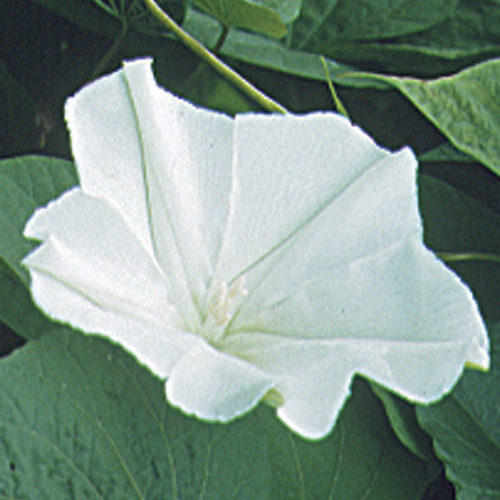
Ipomoea alba Photo/Illustration: Robert E. Lyons

(Based on 1 user review)

Rate this plant

Hardiness Zones: 1 2 3 4 5 6 7 8 9 10 11
Botanical Name:Ipomoea alba eye-poe-MEE-ah AL-bah Common Name: Belle-de-nuit, Moonflower Synonyms: Calonyction aculeatum, Ipomoea bona-nox Genus: Ipomoea
This twining perennial has evergreen, oval or rounded, mid- to dark green leaves. Fragrant, 6-inch white blooms appear in early summer to fall, opening in early evening.
Noteworthy characteristics: Seeds are highly toxic if ingested.
Care: Grow in moderately fertile, well-drained soil. Provide support. Shelter from cold, drying winds.
Propagation: Chip seeds or soak for 24 hours before sowing. Sow seed in spring. Root softwood cuttings in spring or summer, or semi-ripe cuttings in summer.
Problems: White blister, rust, fungal leaf spots, stem rot, thread blight, charcoal rot, and wilt.
Height 10 ft. to 15 ft.
Light Full Sun Only
Moisture Dry to Medium
Characteristics Fragrant Flowers; Showy Flowers
Bloom Time Fall; Summer
Flower Color White Flower
Uses Ground Covers, Poisonous, Suitable as Annual, Trellis
Seasonal Interest Summer Interest, Fall Interest
Type Perennials

Plants you might also like

no image available Pelargonium sidoides
(Kalwerbossie geranium , Silverleaf geranium)
Be the first to rate this plant
Hardiness Zones: 1 2 3 4 5 6 7 8 9 10 11

This exemplary species has felted, gray, crinkled leaves. Over a long period, it exhibits sprays of butterfly-shaped, rich wine-red flowers, which contrast dramatically with the foliage. Its small stature makes it a perfect candidate for a container or a walkway edge. It has been used medicinally for the treatment of various infections, including bronchitis. It is a native of Africa.

Cosmos atrosanguineus Cosmos atrosanguineus
(Chocolate cosmos, Black cosmos)
(1 user review)
Hardiness Zones: 1 2 3 4 5 6 7 8 9 10 11

A chocolate scented flower! Dark red-brown, sometimes almost black, velvety flowers on long, slender, reddish brown stems bloom from early summer to autumn. Chocolate cosmos is a tuberous-rooted, tender perennial native to Mexico that can be overwintered indoors where not hardy. Grow in a border or in containers where the flowers can be appreciated up close. They also make good cut flowers.

Salvia microphylla var. neurepia Salvia microphylla var. neurepia
Be the first to rate this plant
Hardiness Zones: 1 2 3 4 5 6 7 8 9 10 11

This native of the American Southwest and Mexico forms an evergreen shrub or shrubby perennial with dark, glossy leaves that are small (but slightly larger than most microphyllas) and softly toothed. It blooms off and on all summer, and again, more vigorously, in late summer and autumn, in blossoms of cherry-red. Its attractive foliage cloaks the plant to the ground, so it is well suited to the front of the border. It can grow to 4 feet tall and twice as wide.

Carpobrotus edulis Carpobrotus edulis
(Iceplant, Hottentot fig, Kaffir fig)
Be the first to rate this plant
Hardiness Zones: 1 2 3 4 5 6 7 8 9 10 11

This ground-hugging succulent perennial roots at the nodes, has a creeping habit, and often forms deep mats covering large areas. It produces abundant yellow daisy-like flowers that open at noon and turn pink later in the day.

Agastache foeniculum Agastache foeniculum
(Anise hyssop)
(1 user review)
Hardiness Zones: 1 2 3 4 5 6 7 8 9 10 11

A classic plant for both herb gardens and borders, anise hyssop is composed of erect branches of mint-and-licorice-scented, medium green leaves ending in fuzzy spikes of small lavender flowers. The plant grows to 3 to 5 feet tall and 1 foot wide and reseeds freely. The flowers are edible and are charming crumbled into salads. The flowers are highly attractive to bees, butterflies, and hummingbirds.