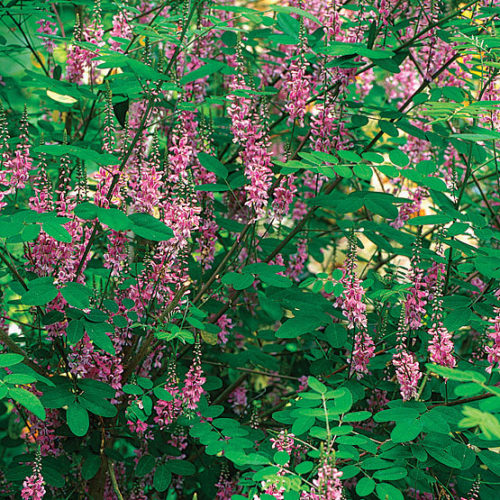
Indigofera amblyantha (Indigofera, Pinkflower, Chinese indigo)

Indigofera amblyantha Photo/Illustration: Jerry Pavia


Be the first to rate this plant

Hardiness Zones: 1 2 3 4 5 6 7 8 9 10 11
Botanical Name:Indigofera amblyantha in-dih-GO-fer-ah am-blee-AN-thah Common Name: Indigofera, Pinkflower, Chinese indigo Genus: Indigofera
This deciduous shrub growing to 6 feet tall and 8 feet wide bears erect racemes of pea-like, pink flowers from summer to early fall above leaves composed of several leaflets. The flowers are followed by long, dark purple seed pods.
Care: In colder climates this shrub may die back to the ground, resprouting from the base in spring. Provide full sun and moist, well-drained soil in USDA Hardiness Zones 6 to 9. Prune out wayward and crossing branches in spring.
Propagation:

 Sow seeds outdoors in fall or take cuttings in spring.


Problems:

 Rust and various rots may occur.


Height 6 ft. to 10 ft.
Spread 6 ft. to 10 ft.
Growth Habit Spreads
Growth Pace Moderate Grower
Light Full Sun Only;Full Sun to Part Shade
Moisture Adaptable;Medium Moisture
Maintenance Moderate
Characteristics Showy Flowers; Showy Seed Heads
Bloom Time Early Fall; Fall; Late Summer; Summer
Flower Color Pink Flower
Style Sun, Texture, Summer Interest, Fall Interest
Type Shrubs

Plants you might also like

Robinia hispida Robinia hispida
(Rose acacia, Bristly locust)
Be the first to rate this plant
Hardiness Zones: 1 2 3 4 5 6 7 8 9 10 11

This showy flowering shrub grows to 8 feet tall and wide and features dark green, compound pinnate leaves on bristly stems and pendant clusters of fragrant, pea-like, rose-pink flowers that are attractive to bees and butterflies in late spring and early summer. The flowers are occasionally followed by bristly, reddish-brown seed pods. Native to the southeastern United States, this aggressive shrub spreads by suckers and is considered invasive in Michigan, New Jersey, Ohio, Pennsylvania, and Washington. All parts of this plant are at least mildly poisonous.

Hydrangea quercifolia ‘Snow Queen’ Hydrangea quercifolia ‘Snow Queen’
(Oakleaf hydrangea)
Be the first to rate this plant
Hardiness Zones: 1 2 3 4 5 6 7 8 9 10 11

This cultivar produces 8-inch-long, conical flower heads from early summer on. It is as notable for its distinct, deeply lobed leaves as for its reliably showy, creamy blooms. The foliage produces outstanding fall color and the flowers take on purplish-pink hues when dried.

Hydrangea quercifolia ‘Snowflake’ Hydrangea quercifolia ‘Snowflake’
(Oakleaf hydrangea)
Be the first to rate this plant
Hardiness Zones: 1 2 3 4 5 6 7 8 9 10 11

This cultivar has large flowerheads of intricate double blossoms layered on top of one another. It is as notable for its distinct, deeply lobed leaves as for its reliably showy, creamy blooms. The foliage produces outstanding fall color, and the flowers take on purplish-pink hues as they dry. 

Hibiscus syriacus 'Diana' Hibiscus syriacus 'Diana'
('Diana' Rose of Sharon)
Be the first to rate this plant
Hardiness Zones: 1 2 3 4 5 6 7 8 9 10 11

'Diana' has a strong presence in the garden. The foliage is deep green and the large, pure white flowers bloom from mid- to late-summer. Unlike some other roses of Sharon, 'Diana' has flowers that remain open at night.

Caryopteris × clandonensis 'Longwood Blue' Caryopteris × clandonensis 'Longwood Blue'
(Blue beard, blue-mist shrub)
(1 user review)
Hardiness Zones: 1 2 3 4 5 6 7 8 9 10 11

'Longwood Blue' is ideal for a mixed or shrub border. It's an attractive woody shrub up to 3 feet tall and 5 feet wide with silvery leaves and violet-blue flowers.. The flowers appear along the stems in late summer and early autumn.This plant is relatively drought tolerant and very heat tolerant. The shrub expands as branches that touch the ground form their own roots and may self-seed.