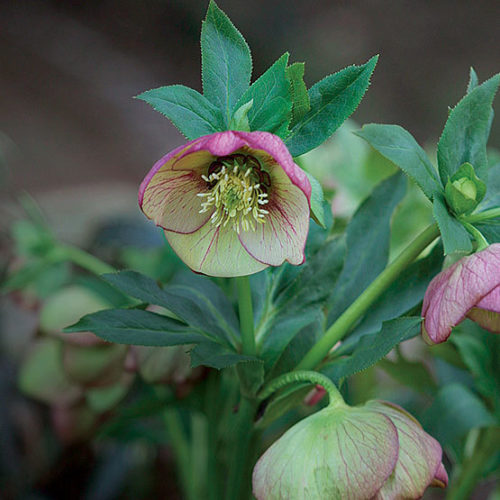
Helleborus 'Ivory Prince' (Hellebore)

Helleborus 'Ivory Prince' Helleborus x hybridus Photo/Illustration: Steve Aitken

(Based on 1 user review)

Rate this plant

Hardiness Zones: 1 2 3 4 5 6 7 8 9 10 11
Botanical Name: Helleborus 'Ivory Prince' heh-LEB-or-us Common Name: Hellebore Synonyms: 'Walhelivor' Genus: Helleborus
Year-round gray-green foliage persists through shade and snow and is fairly deer and rabbit resistant. Flowers appear in early spring with daffodils and tulips. This cultivar produces flowers that sit well above the foliage and point upward, which adds to its showiness.
Noteworthy characteristics: 'Ivory Prince' is a sterile form, so it won't produce colonies.
Care: Provide rich, humusy, moist but well-drained soil in part to full shade.
Propagation: Divide after flowering in spring.
Problems: Slugs, snails, aphids, black spot and leaf spot.
Height 6 in. to 12 in.
Spread 6 in. to 12 in.
Growth Habit Clumps
Light Part Shade Only
Moisture Medium Moisture
Maintenance Low
Tolerance Deer Tolerant;Frost Tolerant
Characteristics Showy Flowers; Showy Foliage
Bloom Time Early Spring; Spring
Foliage Color Evergreen
Flower Color Blue Flower; White Flower
Uses Beds and Borders
Style Shade, Cottage Garden, Woodland Garden
Seasonal Interest Winter Interest, Spring Interest, Summer Interest, Fall Interest
Type Perennials

Plants you might also like

Geranium pratense 'Dark Reiter' Geranium pratense 'Dark Reiter'
('Dark Reiter' geranium)
Be the first to rate this plant
Hardiness Zones: 1 2 3 4 5 6 7 8 9 10 11

This fairly new cultivar has a short mounded habit and dissected dark leaves highlighted by bright lilac-blue blossoms in spring. Trimming it back after flowering encourages more blooms in fall and helps maintain its neat habit. 'Dark Reiter' is slow growing, making it perfect for a rock garden, and like many other geraniums, deer tend to avoid browsing. Silver-toned foliage tends to pop when paired with this beauty.

Viola ‘Etain’ Viola ‘Etain’
Be the first to rate this plant
Hardiness Zones: 1 2 3 4 5 6 7 8 9 10 11

A hardworking, compact perennial, ‘Etain’ violet blooms intermittently throughout spring, summer, and fall. It forms wellbehaved clumps, unlike other violets that are usually spreading ground covers. Like all violets, ‘Etain’ enjoys regular fertilizing, steady watering, and frequent deadheading. The attractive, fleshy, bright green foliage needs protection from slugs and can be cut back if it gets too leggy.

Geranium pratense 'Midnight Reiter' Geranium pratense 'Midnight Reiter'
(Meadow cranesbill)
Be the first to rate this plant
Hardiness Zones: 1 2 3 4 5 6 7 8 9 10 11

Deeply cut plum-purple leaves emerge in spring and stay true to color throughout the season. Lavender-blue flowers bloom beginning in late spring. 'Midnight Reiter' grows to only about 6 or 8 inches tall and twice as wide. More shade causes the foliage to be greener.

Corydalis flexuosa 'Blue Panda' Corydalis flexuosa 'Blue Panda'
Be the first to rate this plant
Hardiness Zones: 1 2 3 4 5 6 7 8 9 10 11

The first of the coveted blue corydalises to be introduced, it produces fragrant clusters of long-spurred, azure flowers on a compact plant. 

Helleborus odorus 'Double Queen' Helleborus odorus 'Double Queen'
(Lenten rose, hellebore)
Be the first to rate this plant
Hardiness Zones: 1 2 3 4 5 6 7 8 9 10 11

Hellebores begin blooming in mid-winter in a range of colors, adding much needed color very early in the season. They bloom when the temperature is below freezing, even amidst the snow. Protect from cold winter winds, especially when not insulated by snow, to avoid damaged foliage. Avoid ingestion of all plant parts and contact with the sap.