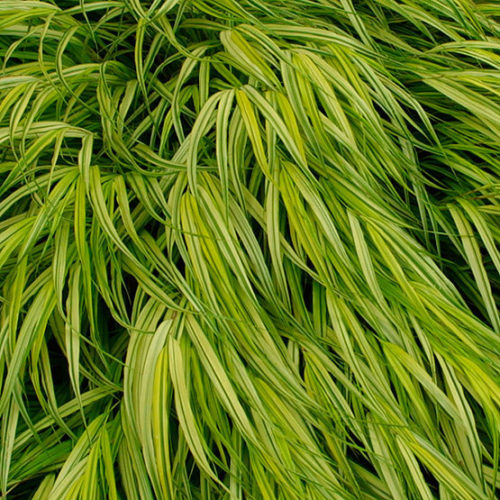
Hakonechloa macra 'Aureola’ (Golden Japanese forest grass)

Hakonechloa macra  'Aureola’ Photo/Illustration: Michelle Gervais


Be the first to rate this plant

Hardiness Zones: 1 2 3 4 5 6 7 8 9 10 11
Botanical Name: Hakonechloa macra 'Aureola’ hak-on-eh-KLO-ah MAK-rah Common Name: Golden Japanese forest grass Genus: Hakonechloa

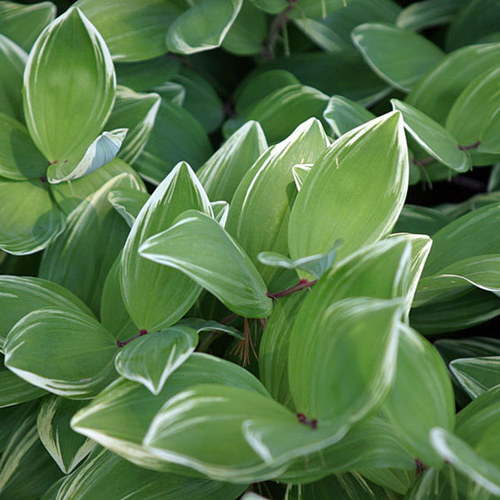
This Japanese forest grass boasts brightly variegated golden foliage, with green stripes near the leaf margins. Be aware that too much shade causes the golden portion to fade to lime green. While this grass grows slowly—often not reaching a mature size for three years—its durability and showstopping texture will reward the patient gardener for years to come.


Noteworthy characteristics: Foliage tends to be mostly golden when grown in sun, with a sharp contrast between green and yellow if grown in shade. Use it to line pathways or waterways, or plant under trees and shrubs.
Care: Prefers uniformly moist, humus-rich soils and partial shade.
Propagation: Divide in spring.
Problems: Infrequent.
Height 1 ft. to 3 ft.
Spread 1 ft. to 3 ft.
Light Full Sun to Part Shade
Moisture Medium Moisture
Characteristics Showy Foliage
Foliage Color Variegated Foliage
Flower Color Green Flower
Uses Beds and Borders, Waterside
Style Rock Garden
Seasonal Interest Summer Interest, Fall Interest
Type Grasses

Plants you might also like

Pennisetum orientale Pennisetum orientale
(Oriental fountain grass, Tall tails)
(2 user reviews)
Hardiness Zones: 1 2 3 4 5 6 7 8 9 10 11

Pink, bottle-brush flowers rise well above arching clumps of graceful foliage in summer. This grass is beautiful in a mixed border, rock garden, or massed at waterside. It blooms in June with pink plumes.

Chasmanthium latifolium Chasmanthium latifolium
(Northern sea oats, Spangle grass, Wild oats)
(1 user review)
Hardiness Zones: 1 2 3 4 5 6 7 8 9 10 11

Northern sea oats is a loosely tufted, clump-forming grass with lance-shaped, arching mid-green foliage that turns yellow in winter. Summer brings highly decorative oat-like panicles of flat, green flowerheads that shimmer and rustle in the wind, aging to bronze by late summer.

Calamagrostis × acutiflora 'Karl Foerster' Calamagrostis × acutiflora 'Karl Foerster'
(Feather reed grass)
(1 user review)
Hardiness Zones: 1 2 3 4 5 6 7 8 9 10 11

Gardeners love this plant for its handsome, thin, vertical green foliage from spring through fall and for its wonderful flowers, which start out pink and then change to a fine tawny color with the cool days of autumn. 'Karl Foerster' reaches 6 feet high and 6 feet wide. Use in a border.  

Festuca mairei Festuca mairei
(Atlas fescue)
Be the first to rate this plant
Hardiness Zones: 1 2 3 4 5 6 7 8 9 10 11

This sturdy groundcover is fast becoming one of the most dependable grasses for creating drought-tolerant meadows. Clumping evergreen foliage is a rich khaki green and grows in an arching clump. The flowers, while noticeable, are not showy. Atlas fescue is at its best in groups and grows in all but hot, humid, and low desert climates.

Carex divulsa Carex divulsa
(Berkeley sedge)
Be the first to rate this plant
Hardiness Zones: 1 2 3 4 5 6 7 8 9 10 11

This sedge is one of the most adaptable of the ground-cover grasses. Its ability to look the same in sun or shade makes it a valuable asset in plantings that go in and out of full sun. Berkeley sedge is a good solution for areas under stress where lawn grasses often fail. The flowers are not particularly noteworthy.