
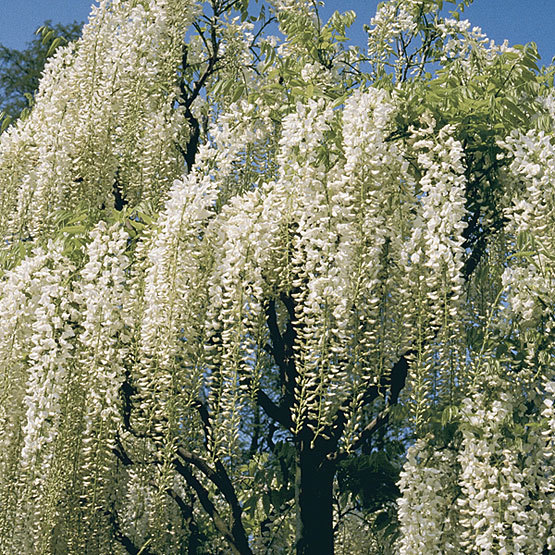
Genus Wisteria

Wisteria Wisteria floribunda Photo/Illustration: Peter Lindtner
wis-TEER-ee-ah
The genus Wisteria is comprised of ten species of deciduous climbers found in moist woods and along streambanks in China, Korea, Japan, and the U.S. Chinese wisteria (W. chinensis or W. sinensis) is a familiar garden vine, but it can be invasive in some areas. American wisteria, W. frutescens, is native to the central and southern U.S. and has unscented blue flowers that emerge after the leaves. Flowers of all wisteria are showy and pea-like; they are borne in racemes in spring or summer. Wisteria can be trained against a wall, into a large tree, over an arch or pergola, or as a standard. Be sure supports are very sturdy, as vines can grow to 30 feet.
Noteworthy characteristics: Showy, pendent, fragrant flowers and bean-like seed pods. All parts may cause severe discomfort if ingested.
Care: Wisteria need fertile, moist but well-drained soil in full sun or partial shade.
Propagation: In early to midsummer, take basal cuttings from side shoots and root with bottom heat. Wisteria can also be layered in autumn or grafted in winter.
Problems: Dieback, crown gall, leaf spots, viruses, Japanese beetles, aphids, leaf miners, scale insects, and mealybugs.

Species, varieties and cultivars for genus Wisteria

Wisteria floribunda Wisteria floribunda
(Japanese wisteria)
(1 user review)
Hardiness Zones: 1 2 3 4 5 6 7 8 9 10 11

Dramatic clusters of blue-violet to red-violet flowers with an intoxicating fragrance grace this vigorous twining climber. Its springtime cascading flower clusters can grow to 3 feet long or more in some cultivars. Blooms typically open first at the base and last at the tip of each cluster. Trunk diameter can reach 7 to 8 inches after 20 years, and the plant can climb to 35 or more feet in height, though its size is easily contolled by pruning.

Wisteria frutescens Wisteria frutescens
(American wisteria)
Be the first to rate this plant
Hardiness Zones: 1 2 3 4 5 6 7 8 9 10 11

This North American native vine boasts abundant clusters of pale lilac-purple flowers. Though it is not as fragrant as Asian wisterias, it is easier to control because it doesn't send out long root suckers. American wisteria blooms later, from June to August, so its blossoms are less prone to being killed by a late frost. It can grow to 30 feet or more when trained to climb over an arbor, pergola, or wall. It can also be trained into a small tree or standard. 'Nivea' is a white-flowered form.

Wister­ia sinensis Wister­ia sinensis
(Chinese wisteria)
(2 user reviews)
Hardiness Zones: 1 2 3 4 5 6 7 8 9 10 11

Dramatic flowers with an intoxicating fragrance cover this vigorous twining climber. Its cascading flower clusters grow to about 1 foot in length and are borne in abundance, with each one on the plant blooming more or less simultaneously, in late spring. Each small flower is usually light blue mixed with white, but plants are also available in colors such as violets, whites, and pinks. It blooms before foliage emerges.


