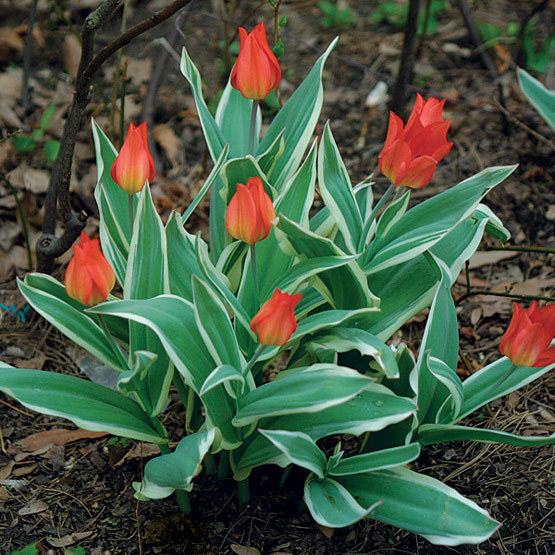
Genus Tulipa (Tulip)

Tulipa Photo/Illustration: Jennifer Benner
TEW-lih-pah Common Name: Tulip
Tulips originate in regions with cold winters and dry summers. (They require a cold treatment in order to bloom.) They are invaluable for early spring color in bedding schemes, parterres, cottage gardens, and mixed borders. Smaller species are suitable for rock gardens. Many only last and bloom reliably for one season (best treated as annuals, or lifted six weeks after blooming, dried, with only the largest bulbs replanted), but some of the species will naturalize. Many are suitable for forcing. Tulips are grouped into 15 divisions: Single Early, Double Early, Triumph, Darwin Hybrid, Single Late, Lily-flowered, Fringed, Viridiflora, Rembrandt, Parrot, Double Late, Daufmanniana, Fosteriana, Greigii, and Miscellaneous.
Noteworthy characteristics: These beloved bulbs offer a definite sign that winter is history, and spring is here to stay. Their vessel-like blooms take many forms—single, double, peony, fringed, and lily—and are offered in every color of the rainbow. Their diversity is enhanced by the varied patterning of colors; they can be margined, flamed from the base, striped, or chameleon.
Care: Grow in fertile, well-drained soil in full or afternoon sun. Plant to a depth of two and a half times the height of the bulb. In regions warmer than Zone 8, bulbs will need a cold treatment (40° to 45°F for 8 to 10 weeks).
Propagation: Sow seed of species in a cold frame or cold greenhouse in the fall. Divide offshoots in summer and replant.
Problems: Bulb and root rot, gray mold, slugs, snails, aphids, nematodes, voles.

Species, varieties and cultivars for genus Tulipa

Tulipa 'Carnaval de Nice' Tulipa 'Carnaval de Nice'
(Tulip)
Be the first to rate this plant
Hardiness Zones: 1 2 3 4 5 6 7 8 9 10 11

For later-blooming flowers with ornamental foliage, try Tulipa 'Carnaval de Nice'. It has grayish green foliage finely outlined in white and fragrant white-and-burgundy-feathered blooms. Its flower patterns and height are variable (ranging from 16 to 20 inches tall) but always eye-catching.

Tulipa 'Charmeur' Tulipa 'Charmeur'
(Tulip)
Be the first to rate this plant
Hardiness Zones: 1 2 3 4 5 6 7 8 9 10 11

Tulipa ‘Charmeur’ features leaves with curled yellow edges and 18-inch-tall white-rimmed dark rosy blooms. The color combination may be a bit garish for some, but it will certainly brighten up container plantings in a drab doorway.

no image available Tulipa 'Esperanto'
(Tulip)
Be the first to rate this plant
Hardiness Zones: 1 2 3 4 5 6 7 8 9 10 11

Tulipa 'Esperanto' has white-bordered leaves, but it is unique with its long-lasting deep rose red and dark green streaked flowers, which stand 10 to 12 inches tall.

Tulipa 'Garant' Tulipa 'Garant'
(Tulip)
Be the first to rate this plant
Hardiness Zones: 1 2 3 4 5 6 7 8 9 10 11

Tulipa 'Garant' has striking yellow-framed leaves that are even more prominent when its 16- to 18-inch-tall sunny yellow flowers appear in midspring. Uniformity of color makes this an elegant, charismatic tulip in beds and borders.

Tulipa 'New Design' Tulipa 'New Design'
(Tulip)
Be the first to rate this plant
Hardiness Zones: 1 2 3 4 5 6 7 8 9 10 11

Tulipa ‘New Design’ (1974) has pink-bordered leaves and silvery pink, 14- to 20-inch-tall blooms flushed yellow with pale fuchsia tips. This bulb is easygoing and long-lived.

Tulipa 'Silverstream' Tulipa 'Silverstream'
(Tulip)
Be the first to rate this plant
Hardiness Zones: 1 2 3 4 5 6 7 8 9 10 11

Reaching 20 to 24 inches tall, Tulipa 'Silverstream' has chartreuse and yellow flowers suffused with red-and-rose markings that create a watercolor effect. The foliage has distinct cream-colored edging. Grouping these in a garden with a pastel palette would have driven Monet viridian with envy.

no image available Tulipa batalinii 'Bright Gem'
(Tulip)
Be the first to rate this plant
Hardiness Zones: 1 2 3 4 5 6 7 8 9 10 11

This named variety of the species has soft sulfur-yellow flowers up to 3 inches across. The spring blossoms sit 4-6 inches high, surrounded by wavy-edged, gray-green foliage that reaches 8-10 inches tall. Species tulips prefer sharp drainage and plenty of room to grow. Most do well in rock gardens, small displays, and containers.

Tulipa greigii 'Calypso' Tulipa greigii 'Calypso'
(Tulip)
Be the first to rate this plant
Hardiness Zones: 1 2 3 4 5 6 7 8 9 10 11

The 12-inch-tall Tulipa 'Calypso' (1992) is known for being reliably perennial. It has decorative stippled leaves and large orange-red flowers rimmed with primrose and a black base.

Tulipa greigii 'Oratorio' Tulipa greigii 'Oratorio'
(Tulip)
Be the first to rate this plant
Hardiness Zones: 1 2 3 4 5 6 7 8 9 10 11

Known for being reliably perennial, Tulipa ‘Oratorio’ (introduced in 1952) blooms in midspring and has splayed, flashy maroon-mottled leaves. It is a standout in the garden from the moment the exquisite heavily striped leaves emerge. Its dazzling 14- to 16-inch-tall coral pink flowers are an added bonus.

Tulipa greigii 'Red Riding Hood' Tulipa greigii 'Red Riding Hood'
(Tulip)
Be the first to rate this plant
Hardiness Zones: 1 2 3 4 5 6 7 8 9 10 11

Tulipa 'Red Riding Hood' (introduced in 1953) is a true beauty, with flowers that are scarlet red inside, carmine outside, and black at the base. They float above richly striped foliage on 10- to 12-inch tall stems.

no image available Tulipa linifolia
(Tulip)
Be the first to rate this plant
Hardiness Zones: 1 2 3 4 5 6 7 8 9 10 11

This species tulip blooms in mid- to late spring with fire-engine-red flowers that look like open, pointed stars with purple centers. It reaches 4-6 inches tall and not quite as wide. Species tulips prefer sharp drainage and plenty of room to grow; they will often naturalize. Most do well in rock gardens, small displays, and containers.

Tulipa praestans 'Unicum' Tulipa praestans 'Unicum'
(Tulip)
Be the first to rate this plant
Hardiness Zones: 1 2 3 4 5 6 7 8 9 10 11

This bunch tulip has multiple orange-red flowers that bloom in spring above green leaves edged in creamy white. A species tulip, it is more likely to bloom in subsequent years. It reaches less than a foot tall and is stunning planted en masse.