previous
  • Big Flowers from Bigleaf Hydrangeas
    Big Flowers from Bigleaf Hydrangeas
  • Perfect Edges for Your Beds and Borders
    Perfect Edges for Your Beds and Borders
  • 15 Deer-Resistant Plants
    15 Deer-Resistant Plants
  • Friendly Ways to Battle Garden Pests
    Friendly Ways to Battle Garden Pests
  • Off With Their Heads: Deadheading Perennials
    Off With Their Heads: Deadheading Perennials
  • Variegated Plants Create Drama
    Variegated Plants Create Drama
  • 10 Perennials Easily Grown from Seed
    10 Perennials Easily Grown from Seed
  • Video: Make a Straw-Bale Garden
    Video: Make a Straw-Bale Garden
  • All About Starting Seeds
    All About Starting Seeds
  • Make Your Own Hypertufa Container
    Make Your Own Hypertufa Container
  • Lilacs: Time for a Fresh Look
    Lilacs: Time for a Fresh Look
  • Backyard Makeover Game
    Backyard Makeover Game
  • The Only Shrubs You Need to Grow
    The Only Shrubs You Need to Grow
  • Bold and Beautiful Zinnias
    Bold and Beautiful Zinnias
  • Soil Testing is Worth the Effort
    Soil Testing is Worth the Effort
  • Find the Perfect Tomato
    Find the Perfect Tomato
  • Building a Compost Bin
    Building a Compost Bin
  • How to Grow Raspberries
    How to Grow Raspberries
  • Enchanting Japanese Maples
    Enchanting Japanese Maples
  • Garden Catalog Collector
    Garden Catalog Collector
  • Viburnums are Versatile Shrubs
    Viburnums are Versatile Shrubs
  • Free Download: Rose Pruning and Bed Prep
    Free Download: Rose Pruning and Bed Prep
  • A gardener's checklist for early summer
    A gardener's checklist for early summer
  • 25 Robust Summer Bloomers
    25 Robust Summer Bloomers
  • How to Start a Vegetable Garden
    How to Start a Vegetable Garden
next

Genus Symphytum (Comfrey)

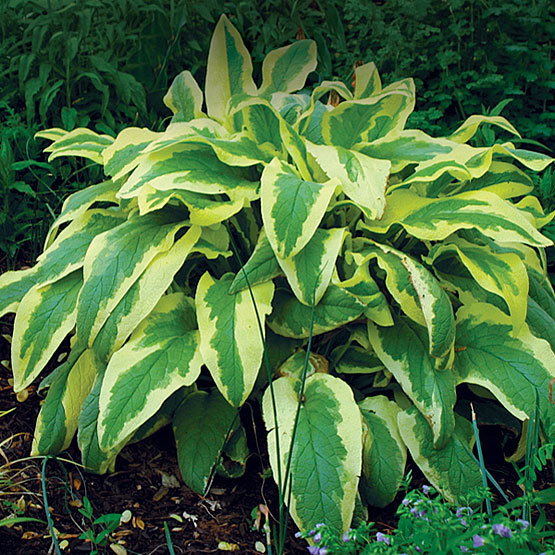
Symphytum Symphytum × uplandicum 'Axminster Gold' Photo/Illustration: Virginia Small
sim-FY-tum Common Name: Comfrey
This genus is made up of 25 to 35 species of coarse, bristly or hairy, rhizomatous perennials. Some are very invasive. Comfrey is native to damp, often shady, habitats in Europe, North Africa, and West Asia. From fleshy roots come long-stalked, wrinkled, prominently veined leaves. Blue, purple, pink, yellow, or white flowers are pendent and tubular. These plants are useful as a ground cover in a shady garden, but they can spread rampantly.
Noteworthy characteristics: Sometimes invasive. Contact with foliage may cause skin irritation, and ingestion of roots and leaves may cause severe discomfort. Some species are used medicinally or for fertilizer. S. officinale and S. × uplandicum can be grown for plant food.  
Care: Needs moist, moderately fertile soil in full sun or partial shade. All except the variegated cultviars can be very invasive, growing from even small pieces of root.
Propagation: Sow seed in a cold frame in spring or fall; divide in spring; take root cuttings in early winter.
Problems: Infrequent.

Species, varieties and cultivars for genus Symphytum

no image available Symphytum 'Hidcote Blue'
(Hidcote comfrey)
Be the first to rate this plant
Hardiness Zones: 1 2 3 4 5 6 7 8 9 10 11

This prolific cultivar has dark green foliage and bears nodding blue flowers from mauve buds. It grows to a compact height of 18 inches tall. It may become invasive and difficult to eradicate once established.

Symphytum × uplandicum 'Axminster Gold' Symphytum × uplandicum 'Axminster Gold'
(Russian comfrey)
(1 user review)
Hardiness Zones: 1 2 3 4 5 6 7 8 9 10 11

This notably beautiful plant produces huge, elongated banana-shaped leaves, which are arfully edged in luminescent yellow. The rosette sits at 18 inches tall, and in early summer the plant bears clusters of mauve-pink bells atop stems that are 4 to 5 feet tall.